
The 1950s in Japan were a period of profound transformation, characterized by unprecedented economic growth that ignited a national sense of optimism and paved the way for a fundamental reevaluation of the country’s identity. This era of rapid development, however, also paradoxically fostered a prevailing culture of conformity—a collective inclination to blend in and belong rather than to distinguish oneself. Filmmakers of the time grappled with these societal shifts, with Yuzo Kawashima standing out for his incisive explorations of the inherent conflicts arising from the pursuit of a new national identity, often intertwined with themes of self-deception, manipulation, and the sheer struggle for survival. His 1962 masterpiece, "Elegant Beast" (1962), is widely regarded as a pivotal work, representing both a thematic and aesthetic culmination of his directorial career and serving as a crucial bridge between the cinematic sensibilities of the 1950s and the more experimental and radical tendencies that would define Japanese cinema in the 1960s. The film remains a vital and eye-opening cinematic achievement, offering a biting and enduring satire on societal dynamics within Japan that continue to resonate today.
The Maeda Family: A Facade of Bourgeois Respectability
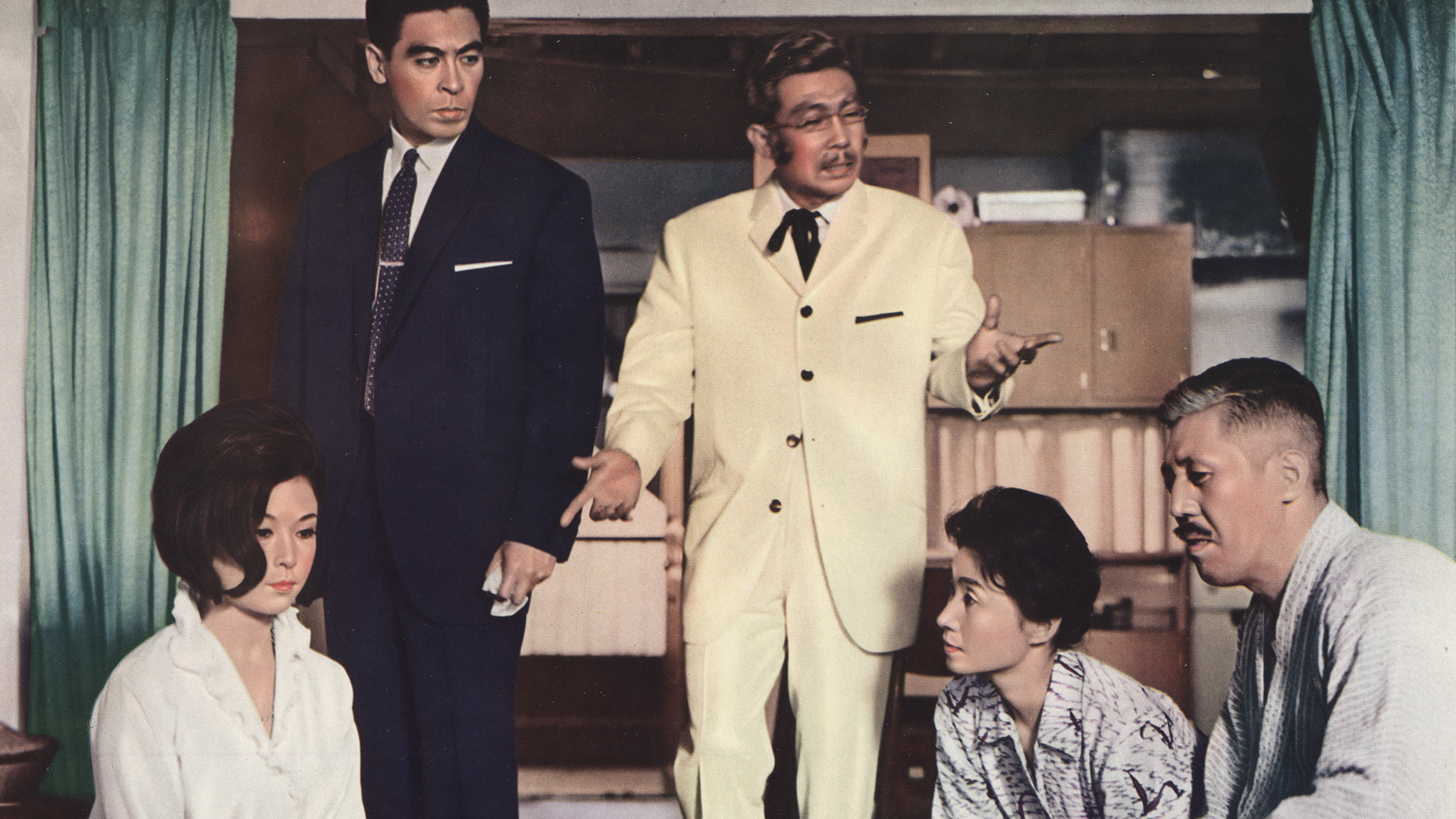
At its core, "Elegant Beast" presents the Maeda family, a seemingly typical middle-class household. However, this carefully constructed bourgeois facade crumbles upon closer inspection, revealing a foundation built upon exploitation, manipulation, and outright deception. The patriarch, Tokizo, and his wife, Yoshina, played with nuanced performances by Eiji Funakoshi and Haruko Sugimura respectively, subsist entirely on the ill-gotten gains of their adult children, Minoru and Tomoko. Their complicity extends to actively encouraging their offspring to engage in increasingly elaborate schemes to generate income. Minoru, portrayed by Hideo Takamatsu, exploits the trust of his employer, the owner of a talent and event agency, while Tomoko, memorably embodied by Ayako Wakao, employs her considerable charm and cunning to manipulate a mediocre yet successful writer who has fallen deeply in love with her. This intricate web of deceit has allowed the Maedas to establish a veneer of comfort and prosperity, with Tomoko’s lover inadvertently funding their luxurious apartment and Minoru’s pilfered funds providing the upscale furniture and gourmet food that adorn their home.
The Unraveling of the Deception
However, the precarious equilibrium the Maeda family has so painstakingly maintained begins to fracture as their carefully orchestrated lies start to unravel. The writer, previously blinded by affection, grows impatient and demands the return of his money, threatening to sever the relationship and expose Tomoko’s duplicity. Simultaneously, Minoru’s employer, facing his own legal troubles, finally uncovers the extent of his employee’s embezzlement, setting the stage for immediate and potentially devastating consequences. These converging crises threaten to shatter the illusion of respectability the Maedas have so desperately clung to, forcing them to confront the inevitable reckoning.
A Social Commentary Rooted in Performance
Based on a compelling stage play by Kaneto Shindo, who also penned the film’s astute screenplay, "Elegant Beast" wastes no time in dissecting the perfidious lies underpinning the Maeda’s bourgeois existence. The film opens with a scene of frenetic activity: Yoshina and Tokizo are seen hastily concealing their most opulent furnishings, replacing them with cheaper, shabbier alternatives. This desperate act is motivated by the impending arrival of Minoru’s furious employer, who must not be allowed to suspect the family’s illicit enrichment. However, the transformation extends far beyond material possessions. The characters’ very posture and speech are recalibrated, meticulously performing the roles of impoverished, naive parents who are nevertheless supportive of their son and profess their earnest desire to make restitution. This initial sequence immediately establishes the film’s central theme: the performance of identity and respectability in a society that increasingly values appearance over authenticity.
The Bitter Truth of Survival
"Elegant Beast" delivers a particularly sharp and unsparing form of social satire. Through its darkly humorous lens, the film exposes a stark and uncomfortable truth: in post-war Japan, deceit and manipulation have become not just viable, but essential, means of maintaining a stable and comfortable way of life. The true luxury, the film suggests, is not material wealth but inherent dignity and genuine respectability. Yet, these are precisely the commodities the Maeda family, and by extension, many in their society, cannot afford. In a world that rewards cunning and mendacity, a commitment to integrity would only render survival more arduous.
Maintaining Dramatic Tension Through Intertwined Deceits
One of the most remarkable aspects of "Elegant Beast" is its ability to sustain a palpable sense of dramatic tension even after revealing its core premise within the opening minutes. Once the other family members are introduced and their individual deceptions become apparent, a complex and fascinating dynamic emerges. The family members are engaged in a perpetual, multi-layered game of deception, not only against outsiders but against each other. Hideo Takamatsu’s portrayal of Minoru positions him as arguably the most cunning and self-serving member of the household, constantly maneuvering to secure personal advantages and engaging in a subtle, yet fierce, competition with both his sister and his father. Eiji Funakoshi and Haruko Sugimura, as Tokizo and Yoshina, form an equally calculating duo, their primary objective being the preservation of their carefully constructed illusion of respectability. Tokizo, in particular, is depicted as clinging to an idealized, almost anachronistic, vision of Japanese identity, a relic of a pre-war era lost after the nation’s defeat in World War II. The narrative is masterfully constructed as a battlefield of liars, with each character either on the precipice of exposing another’s transgressions or equally adept at perpetuating their own falsehoods. Kawashima crafts a compelling narrative landscape where the only constant is deception.
Aesthetic Influences: Ozu’s Dramas and Kabuki’s Theatricality
Aesthetically, "Elegant Beast" draws upon two significant traditions within Japanese cinema and theatre. On one hand, Kawashima and cinematographer Nobuo Munekawa employ visual techniques and narrative sensibilities that echo the intimate family dramas of filmmakers such as Yasujiro Ozu. Despite the characters’ morally compromised actions, they are undeniably a family navigating universal challenges—similar to those depicted in Ozu’s seminal works like "Late Spring" (1949) or "Tokyo Story" (1953). This juxtaposition of moral ambiguity within a seemingly conventional familial structure is a testament to Kawashima’s nuanced approach. On the other hand, the film incorporates clear references to Japanese theatre, most notably Kabuki, which serve to underscore the profound moral dimensions of the narrative. While the audience may find themselves condemning the Maedas’ actions, these theatrical elements also serve as a critical lens on the society that enables and, at times, actively encourages such behavior. In this context, judging the Maeda family becomes a complex undertaking, as social decline would represent the ultimate failure—a fate they are resolutely determined to avoid.
The Societal Roots of Deception: A Broader Critique
The economic boom of the post-war era, while bringing prosperity, also introduced societal pressures that exacerbated the divide between outward appearances and inner realities. Japan’s rapid industrialization and modernization meant that traditional social structures were strained, and new forms of social mobility, often dependent on appearances and connections, emerged. This environment created fertile ground for individuals and families to prioritize the projection of success, even if it meant resorting to dubious means. The "economic miracle" was not uniformly experienced, and for many, the struggle to ascend the social ladder or simply maintain a respectable standing involved navigating a landscape where integrity could be a liability. The film can be seen as a microcosm of this broader societal phenomenon, reflecting anxieties about rapid change and the potential erosion of traditional values in the face of new economic imperatives.
The Enduring Relevance of "Elegant Beast"
"Elegant Beast" stands as a ruthless and incisive satire on a society where identity itself has become a performance. Yuzo Kawashima masterfully exposes a world where respectability is no longer anchored in intrinsic values but is meticulously staged through a constant performance of deception. This compels individuals to perpetually negotiate the precarious balance between appearance and survival. What begins as a seemingly conventional family drama gradually unfolds into a sweeping critique of a socio-economic system that rewards illusion over integrity. The film ultimately forces the audience to confront a disconcerting reality: the eventual collapse of any discernible distinction between authenticity and artifice, leaving individuals trapped in a perpetual cycle of performance. The themes of societal pressure, the commodification of identity, and the ethical compromises made in the pursuit of success remain remarkably pertinent in contemporary global society, making "Elegant Beast" a timeless and essential cinematic experience. Its critical examination of the performance of identity in the face of societal pressures continues to offer valuable insights into the complexities of human behavior and the structures that shape it.