

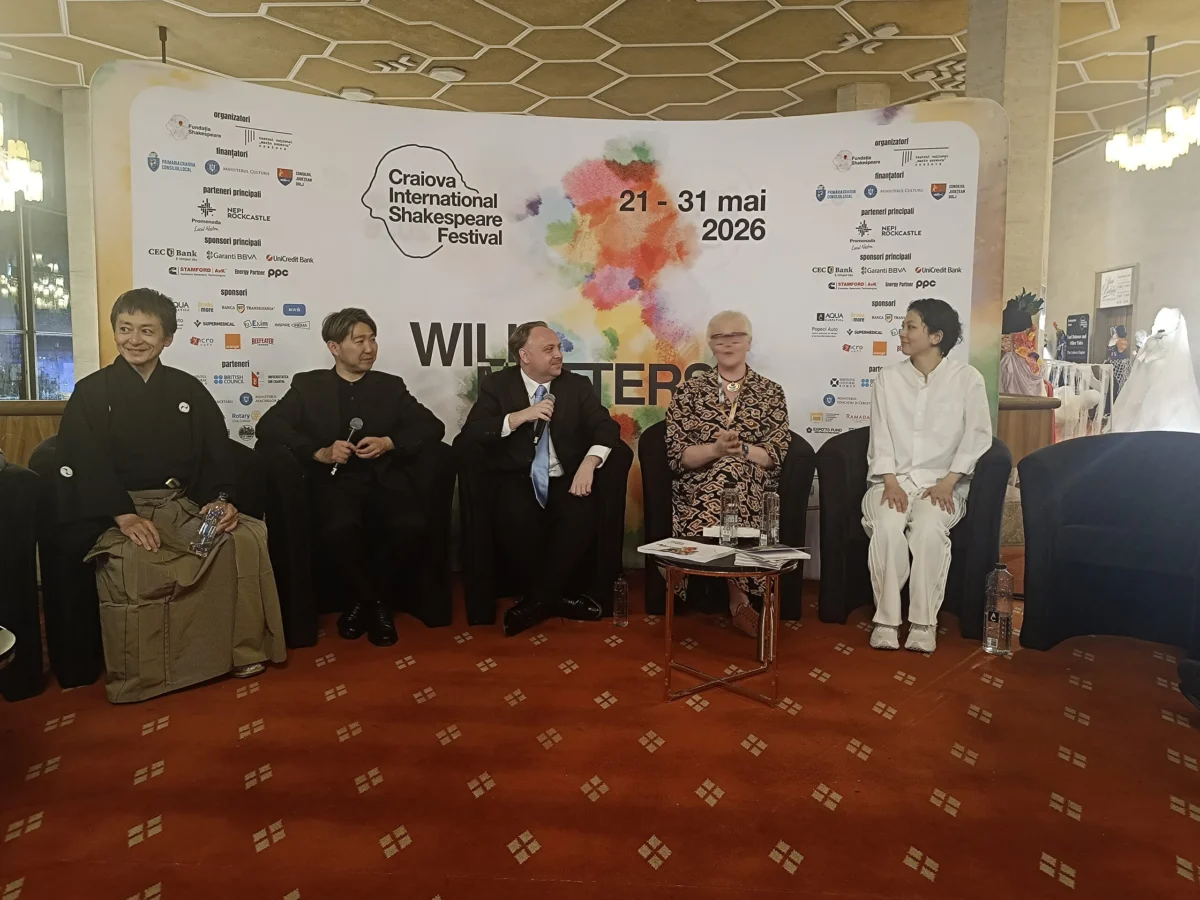
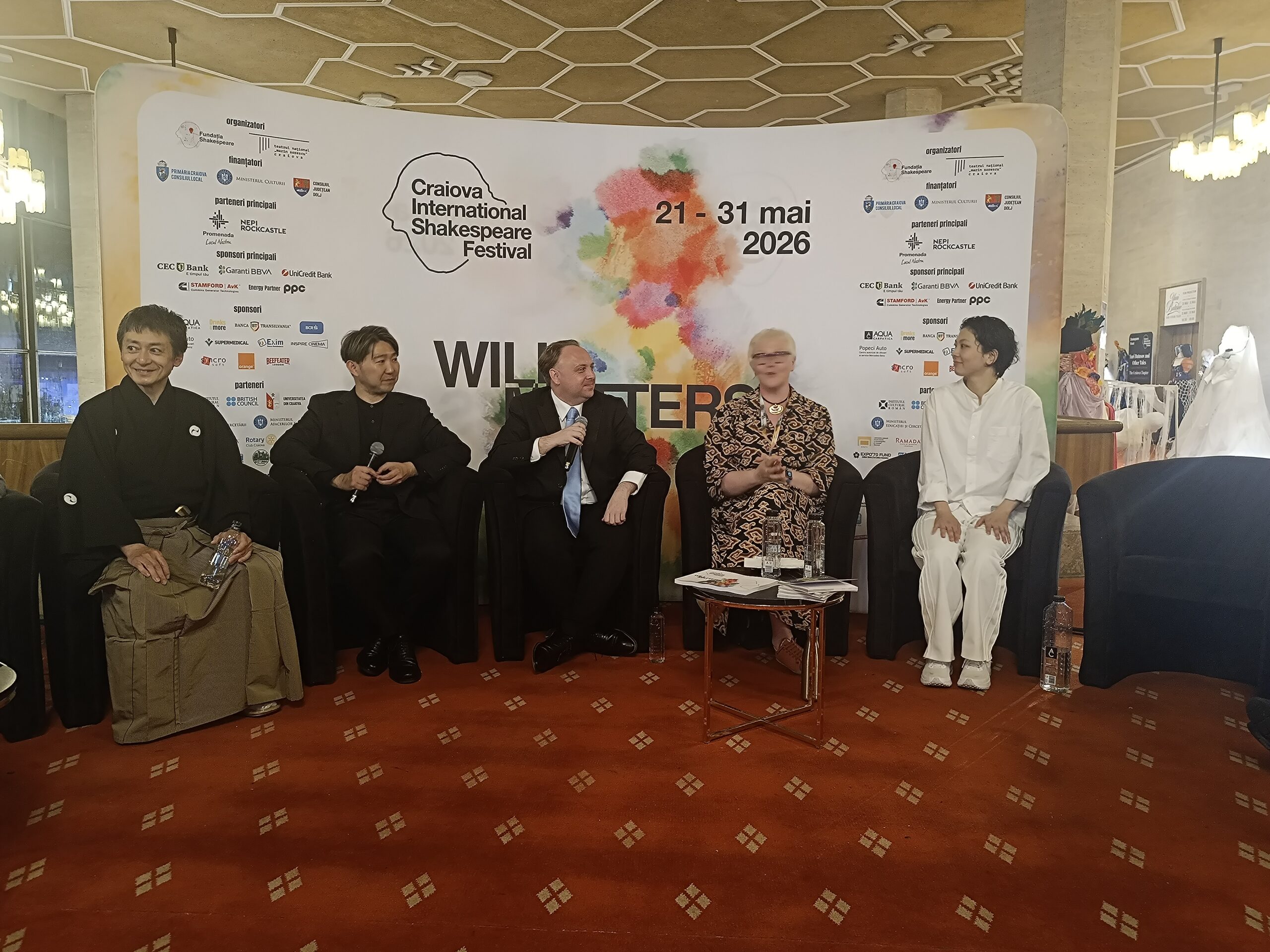
Following the critically acclaimed presentation of "Titus Andronicus: Reborn" at the prestigious Craiova Shakespeare International Festival, a profound public discussion unfolded, delving into the intricate tapestry of this unique production. The panel, featuring visionary director Ryunosuke Kimura, the esteemed Noh actor and Living National Heritage Yamai Tsunao, and the compelling actress Rion Yanagimoto, offered audiences invaluable insights into the genesis of the work, its intricate relationship with Shakespeare’s original text, and the potent resonance of Japanese performance traditions in addressing contemporary global concerns. This illuminating discussion, a cornerstone of the festival’s public programming, provided a deep dive into one of the most thought-provoking productions of this year’s edition, underscoring the festival’s commitment to fostering international artistic exchange and interpretation.
The Craiova International Shakespeare Festival, a biannual event that has firmly established itself as a vital platform for theatrical innovation and scholarship, typically draws renowned companies and directors from across the globe. Now in its [Insert year of festival if known, otherwise use a placeholder like ‘latest edition’], the festival continues its tradition of showcasing diverse interpretations of Shakespeare, encouraging dialogues that transcend geographical and cultural boundaries. This year’s focus on innovative stagings and cross-cultural collaborations proved particularly fruitful with the inclusion of "Titus Andronicus: Reborn," a production that has generated considerable buzz for its audacious fusion of classical Western tragedy with the profound aesthetics of Japanese Noh theatre.
Bridging Worlds: The Director’s Vision and the Transcendent Stage
The conversation commenced with an exploration of the inherent challenges in transplanting a performance conceived within Japan’s rich theatrical landscape to a distinctly different theatre and cultural milieu. Director Ryunosuke Kimura articulated his core philosophy, asserting that Shakespearean theatre possesses an inherent universality, capable of thriving in any space designated for performance. This perspective strongly echoes the influential concept of the "open stage" championed by theatre legend Peter Brook, which emphasizes the power of imagination over the architectural specifics of a venue. Kimura posited that the true essence of theatrical magic lies not in the grandeur of the physical space, but in the vibrant imagination of the creator, the actors’ profound embodiment of that vision, and, crucially, the empathetic connection forged with the audience. He underscored Shakespeare’s remarkable ability to weave an invisible thread between performers and spectators, a bond that empowers his works to adapt and resonate across diverse geographical locations and cultural contexts.
Kimura further reflected on the evolving role of the director in the contemporary theatrical landscape, a shift he believes has been particularly accelerated by the global pandemic. Prior to this period, he perceived the director’s mission as often narrowly focused on achieving a singular objective or charting a singular course. However, in the post-pandemic era, Kimura now views the director’s role as more "transcendental," requiring a fluid movement across temporal dimensions – past, present, and future – and across geographical and cultural divides – East and West. In this expanded conception, the director’s paramount task is to synthesize disparate elements into a cohesive and compelling theatrical universe, while remaining acutely attuned to the pressing issues confronting contemporary society and the specific sensibilities of the intended audience.
Genesis from Adversity: The Unforeseen Path of "Titus Andronicus: Reborn"
The journey of "Titus Andronicus: Reborn" to the stage was far from straightforward, a narrative of resilience and adaptation that imbues the production with an even deeper layer of meaning. Kimura revealed that the renowned KAKUSHINHAN theatre company initially attempted to stage the play twice during the height of the pandemic. Both endeavors were ultimately thwarted by unforeseen circumstances, specifically the contracting of the virus by individuals involved in the production. Consequently, the eventual realization of "Titus Andronicus: Reborn" emerged from a crucible of hardship, sorrow, and unexpected disruptions. This challenging genesis lends a profound and poignant resonance to the production’s central themes of violence, trauma, and the enduring human capacity for renewal.
Unpacking Shakespeare: Violence, Humor, and the "Bare Naked" Bard
When questioned about the incorporation of humor within the context of such a relentlessly brutal tragedy, Kimura emphasized that Shakespeare’s genius lies in his refusal to present simplistic narratives. He explained that even in his most blood-soaked plays, tragedy and comedy are inextricably intertwined, with moments of stark brutality often giving way to unexpected bursts of laughter. Kimura’s artistic objective was not to transform "Titus Andronicus" into a mere parody, but rather to illuminate Shakespeare’s works from a multiplicity of perspectives. He described this approach as presenting a "bare naked Shakespeare," inviting the audience to engage with the playwright not as an immutable, untouchable monument of literary history, but as a profoundly human artist grappling with universal themes. This interpretive stance challenges audiences to reconsider established perceptions and engage with the text on a more intimate and relatable level.
The Crow and the Bard: A Dialogue Across Time
One of the most compelling aspects of the panel discussion revolved around the innovative introduction of Shakespeare himself into the play, embodied by the enigmatic figure of the Crow. Kimura conceptualized Shakespeare as a living, breathing organism, a dynamic entity akin to a vital brain or cell that perpetually responds to the evolving circumstances of the world. The central question that animated his directorial inquiry was: what would Shakespeare, were he alive today, articulate in response to the profound horrors depicted in "Titus Andronicus"? This line of questioning directly connects to the "Reborn" element of the production’s title. Shakespeare, Kimura suggested, is perpetually reborn through each successive generation, and the intricate dialogue between the Crow and the Boy in the play serves as a vital conduit for transmitting the enduring questions of the tragedy into the future, ensuring their continued relevance for contemporary audiences.
Confronting Violence Through a Japanese Lens
Kimura elaborated on his deliberate choice of "Titus Andronicus," explaining that the play offered a powerful framework for confronting violence on multiple existential levels: the violence perpetrated at a national scale, the violence inherent in state structures, and the deeply personal violence experienced by individual human beings. He argued that these profound societal issues remain unresolved, and his artistic endeavor was to explore how Shakespeare, if reanimated in the present day, might endeavor to address them through the transformative medium of theatre. In this context, the production strategically employs Japanese theatrical heritage not as mere decorative ornamentation, but as a sophisticated analytical tool for dissecting and understanding violence in the contemporary global landscape. This deliberate fusion of artistic traditions allows for a fresh examination of timeless human struggles.
The Legacy of Noh: Yamai Tsunao’s Embodiment of Titus
The presence of Yamai Tsunao, a revered figure in the world of Noh theatre, was absolutely pivotal to this innovative approach. Kimura drew a direct lineage between Tsunao’s profound artistic practice and the legacy of Zeami Motokiyo, the foundational architect of Noh theatre. He proposed that the traditions embodied by Tsunao offered a uniquely potent method for processing the intense violence and complex spiritual quandaries embedded within Shakespeare’s tragic narrative.
Tsunao himself articulated the multifaceted nature of his portrayal of Titus through three principal conceptual frameworks:
The Warrior’s Code: Knighthood and Duty
The first concept revolved around knighthood, specifically the archetype of the warrior. Recognizing Japan’s own rich warrior tradition, exemplified by the samurai and bushi, Tsunao approached the character of Titus through this lens. He sought to forge connections between Shakespeare’s Roman general and the deeply ingrained Japanese codes of duty, honor, and martial identity. This perspective allowed for a nuanced exploration of Titus’s actions, framed by a cultural understanding of martial responsibility and the burdens of leadership.
The Mask of Humanity: Demons and Ambiguity
The second pivotal idea centered on the use of masks, particularly the striking demon mask employed in the production. Tsunao explained that within the intricate grammar of Noh theatre, a demon is not merely a simplistic embodiment of evil to be feared or reviled. Instead, it often represents a tormented entity returning from the realm of the dead, a figure driven by unfulfilled promises, profound pain, or an insatiable thirst for vengeance. This profound understanding of the demon archetype served to complicate the portrayal of Titus himself. While his actions might appear monstrous, he is simultaneously a figure steeped in grief, burdened by duty, and inherently ambiguous. Tsunao astutely observed that human beings are in a constant state of flux, wrestling with the inherent duality of good and evil. What one individual perceives as righteous may be viewed as malevolent by another. In this deeply human paradox, the demon, Tsunao suggested, resides within the heart of every individual.
The Pursuit of Peace: Harmony with Land and Spirit
The third concept Tsunao discussed was peace. He referenced a specific, evocative movement within Noh theatre that signifies peace, expanding its meaning to encompass not only human society but also the very land itself. This gesture, deeply rooted in Japan’s agrarian cultural heritage, offers a profound vision of collective existence, emphasizing sharing, mutual understanding, and the cultivation of harmony, not only among people but also in a symbiotic relationship with the earth. Within the context of "Titus Andronicus: Reborn," this concept gains particular salience. The production, rather than merely depicting acts of violence, actively endeavors to explore pathways beyond it, seeking solace and resolution in a world saturated with conflict.
Navigating Identity: Rion Yanagimoto’s Lucius
Rion Yanagimoto, who embodies the character of Lucius, addressed the multifaceted challenges inherent in navigating issues of gender, age, race, and performance style within the production. She powerfully emphasized that for Shakespeare, the spoken word forms the very bedrock of dramatic creation. Actors, in her view, are akin to a flock of sheep diligently working to internalize and process those profound words. For Yanagimoto, language became the indispensable foundation upon which she built her interpretation of Lucius, a male warrior and soldier. Through a deep immersion in Shakespeare’s linguistic richness, she discovered the means to inhabit and comprehend the character, while simultaneously forging a profound connection with Yamai Tsunao through their shared artistic journey of physically and emotionally embodying the text. This shared commitment to textual integrity and emotional resonance underscored the collaborative spirit of the production.
A Transformed Tragedy for a Modern Age
In summation, the panel discussion unequivocally demonstrated that "Titus Andronicus: Reborn" transcends a simple Japanese adaptation of Shakespeare’s seminal tragedy. It represents a meticulously conceived and artistically audacious endeavor to engage Shakespeare’s profound text in a dynamic dialogue with the timeless artistry of Noh, the pervasive traumas of the contemporary era, the pervasive uncertainty born from pandemic experiences, the enduring specter of violence, the unexpected solace of humor, and the very future of theatrical expression. Through Ryunosuke Kimura’s visionary direction, Yamai Tsunao’s Noh-infused embodiment of Titus, and Rion Yanagimoto’s insightful engagement with language and the complexities of gendered performance, the production poses a fundamental question: how can ancient tragedies be fearlessly reborn for contemporary audiences, and can theatre, even amidst a world irrevocably marked by bloodshed, continue its vital search for peace and understanding? The enduring power of this production lies in its ability to provoke such profound inquiries, offering a testament to the enduring capacity of art to illuminate the human condition across time and culture.