
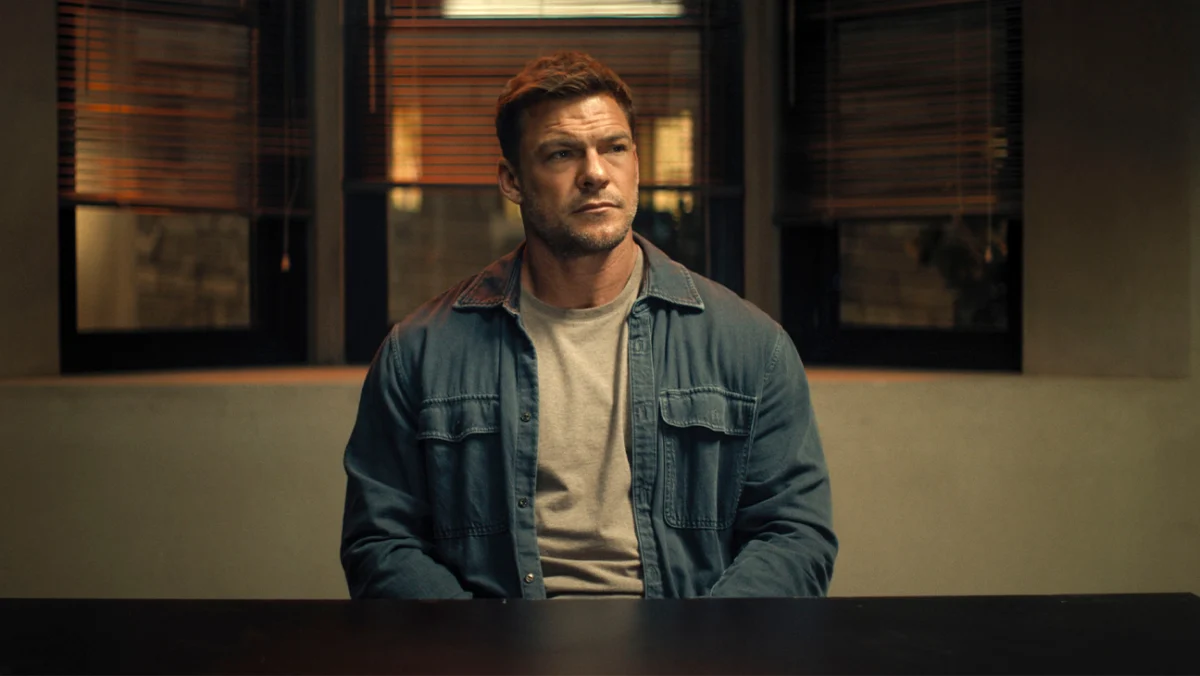
The critically acclaimed Prime Video series Reacher has captivated audiences globally by faithfully translating the rugged, nomadic justice of Lee Child’s iconic protagonist to the screen. However, behind the scenes of the hit show, the creative process has faced unexpected friction. Alan Ritchson, who embodies the titular character, recently disclosed that his personal favorite installment from the sprawling book series—the 1998 novel Die Trying—was once slated for adaptation, only for the project to be derailed by political controversy.
The disclosure emerged on Friday via the social media platform Threads, where Ritchson responded to a fan’s inquiry regarding the notable absence of Die Trying in the show’s production roadmap. The fan expressed a desire to see the plot of the second Jack Reacher novel brought to life, citing its intense narrative involving a militia-led kidnapping. Ritchson’s reply was stark: "My favorite book. Fun fact: I had it approved until someone got re-elected."
While Ritchson did not explicitly name the political figure in question, his well-documented public stance against Donald Trump, coupled with the timing of his remarks, leaves little ambiguity regarding the nature of the interference he alleges.
The Narrative Conflict of Die Trying
Die Trying is a seminal work in Lee Child’s bibliography. The plot follows Jack Reacher as he is abducted alongside a high-ranking politician’s daughter in Chicago. The kidnappers are revealed to be members of a radical, white-supremacist militia that has seized a remote mountain compound in Montana. The group’s objective is to use the hostage as leverage to force the United States government to cede territory and recognize their own sovereign, racially segregated state.
The thematic intensity of the novel, which deals with domestic terrorism, political instability, and the rise of extremist factions, mirrors the polarized political climate of the modern United States. Producers and studio executives often weigh the potential for "real-world" controversy against the creative merit of a story. In this instance, Ritchson suggests that the proximity of the novel’s themes to contemporary political tensions—specifically those exacerbated by the rhetoric of the Trump administration—rendered the project unpalatable for the studio at that specific juncture.
A Pattern of Political Candidacy
Alan Ritchson has become one of the most vocal figures in Hollywood regarding political accountability. His criticism of Donald Trump has been both frequent and vitriolic. Earlier this year, during a high-profile appearance on the Happy Sad Confused podcast, Ritchson addressed the release of documents related to the late financier and convicted sex offender Jeffrey Epstein.
Ritchson expressed deep frustration over the perceived lack of transparency regarding the Epstein files, arguing that the public deserves to know the extent of the connections between powerful figures and the abuse ring. His comments were pointed: "These fucking rapists. We’re just cool with it. That bitch has the keys to the nuclear codes. He’s like all up into 13-year-olds. Like dude, what? Go to jail."
These remarks highlight the actor’s willingness to align his professional brand with his personal moral convictions. However, in the high-stakes environment of streaming television, where multi-million dollar investments are subject to risk assessment, such outspokenness can create friction between talent and studio executives, particularly when a property touches upon themes as volatile as those found in Die Trying.
The Context of the Epstein Files and Public Scrutiny
The tension between the entertainment industry and political figures often centers on the perception of institutional corruption. The Jeffrey Epstein files, which have been a flashpoint for public debate, remain a source of significant controversy. To date, the U.S. government has released approximately 3.5 million pages of documentation related to the investigations into Epstein.
Despite this massive release, watchdog groups and investigative journalists, including those at the Associated Press and The Washington Post, have noted that significant gaps remain. These gaps, whether due to privacy laws or ongoing redactions, fuel the narrative that accountability has been obstructed. Donald Trump has been mentioned roughly 1,000 times in these records. While these mentions do not inherently constitute evidence of criminal activity, the optics of the association have proven to be a lightning rod for criticism. Ritchson’s decision to link his professional disappointment regarding the Reacher adaptation to the political climate suggests a belief that the "chilling effect" of certain political figures extends even to the boardroom decisions of major streaming platforms.
Production Roadmap and Strategic Shifts
The Reacher series, produced by Amazon MGM Studios, Skydance Television, and Paramount Television Studios, operates on a highly structured development cycle. With the show currently enjoying an early renewal for a fifth season—which is set to adapt the 12th book in the series, Make Me—the production team has demonstrated a preference for standalone stories that avoid overly localized political entanglements where possible.
The decision-making process for which book to adapt next is influenced by a variety of factors:
- Character Development: Producers prioritize novels that allow for the organic growth of Reacher as a character.
- Logistical Feasibility: Locations and scale of action sequences are budgeted years in advance.
- Market Sensitivity: As seen with the potential shelving of Die Trying, the cultural climate of the intended release year plays a massive role in whether a script is greenlit.
By skipping the early novels, Amazon has opted for a "greatest hits" approach that allows the series to maintain a broad appeal, avoiding the potential for polarized audience reactions that a story about a white-supremacist militia might invite in the current American landscape.
Implications for Creative Autonomy
Ritchson’s revelation raises broader questions about the nature of creative autonomy in the age of corporate-owned streaming services. When an actor or creator claims that a project was "approved until" a political shift occurred, it highlights the vulnerability of artistic expression to corporate risk management.
For the studio, the primary goal is the retention of the subscriber base. If a story is deemed "too political" or "too controversial" to the point of potentially alienating a segment of the audience or creating negative PR, the incentive to pivot to a safer, more conventional plot is high. Conversely, for an actor like Ritchson, who views his work as a vehicle for truth-telling, this level of interference is a barrier to his artistic vision.
Moving Forward: The Future of Reacher
As Prime Video moves toward its fifth season, the focus remains on maintaining the momentum that has made the show a staple of the platform’s library. While Die Trying remains a fan favorite and a personal goal for Ritchson, its future on screen remains uncertain.
Whether the studio will eventually reconsider the novel as the political landscape shifts or if they will continue to favor the later, more episodic books in the series remains to be seen. For now, the takeaway is clear: the intersection of high-octane action entertainment and the volatile reality of American politics is becoming increasingly difficult to navigate. For Alan Ritchson, the struggle to tell the stories he values is a testament to the fact that, in Hollywood, the line between art and politics is thinner than it has ever been.