
Australian pop royalty Kylie Minogue returned to the Melbourne Cricket Ground on Saturday, September 26, 2026, delivering a career-defining 20-minute headline performance during the pre-game entertainment of the Australian Football League (AFL) Grand Final. Playing to an impassioned crowd of more than 100,000 spectators inside the stadium—with millions more tuning in globally—Minogue commanded the stage with an elaborate, high-flying production that celebrated more than three decades of chart-topping music. Despite persistent rain that had soaked the Victorian capital throughout the day, the weather did little to dampen the enthusiasm of the homecoming crowd or the technical ambition of the live set.
The Main Facts of the Historic Homecoming
Minogue’s appearance at the 2026 AFL Grand Final marks a major milestone in her storied career: it was her first time performing at the prestigious sporting event in her hometown of Melbourne. Marking the occasion with characteristic flair, the performance functioned as a visual and auditory retrospective, weaving together iconic cuts from her extensive catalog alongside high-concept staging, pyro-technics, and an army of professional dancers.
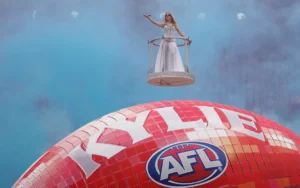
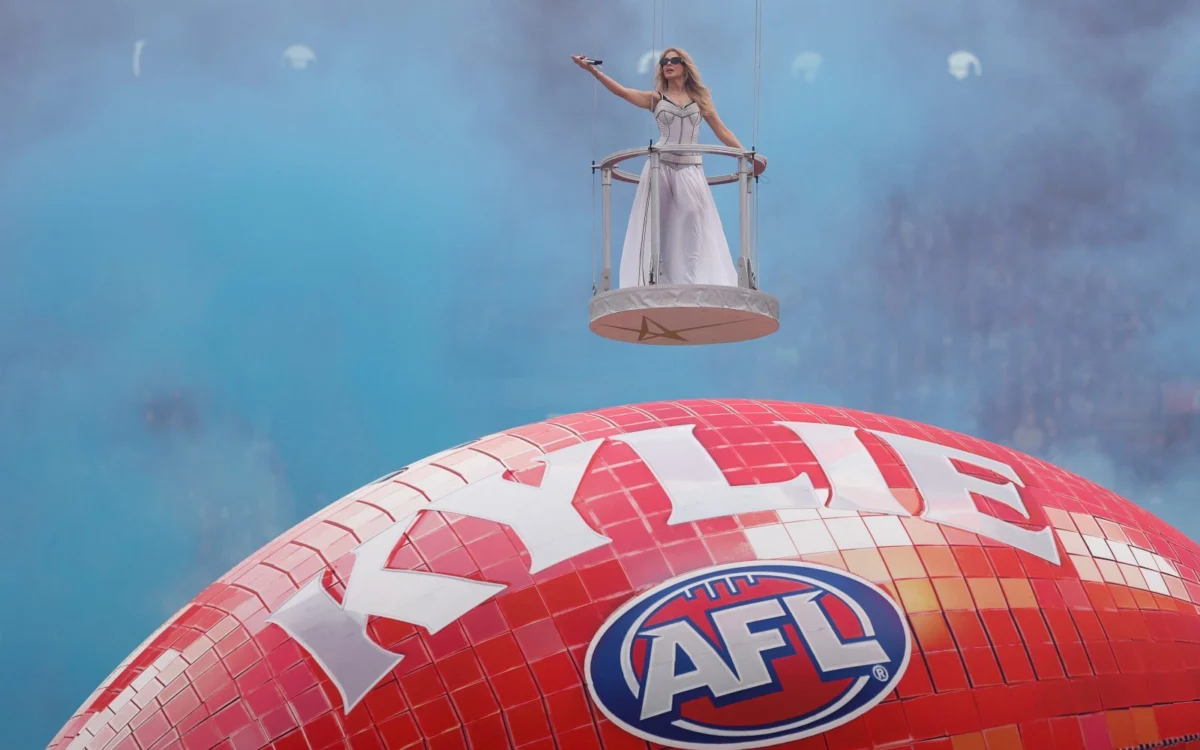
The production value of the set matched the cultural significance of the event. Minogue made full use of the Melbourne Cricket Ground’s expansive turf, utilizing multiple costume changes and interactive props, most notably a giant, bedazzled football emblazoned with her name. The singer broke formal performance boundaries by soaring above the arena mid-set, offering a stadium-wide spectacle that blended traditional pop choreography with large-scale theatricality.
Chronology and Set Breakdown
The meticulously timed 20-minute sequence began long before Minogue stepped onto the stage. A nostalgia-inducing video montage opened the broadcast, featuring archival home footage from Minogue’s Melbourne childhood, culminating in a visual of a young schoolgirl walking out onto the turf. This transition bridged past and present seamlessly as the pop icon materialized in real life to launch straight into her 2001 global smash “Love at First Sight.”
Maintaining a relentless pace, the setlist seamlessly traversed her extensive discography, moving through fan favorites such as “In Your Eyes,” “Get Outta My Way,” “On a Night Like This,” and “All the Lovers.”
The production also featured strategic guest collaborations that highlighted the breadth of contemporary Australian music. Kalkadunga songman William Barton joined Minogue on stage for a dramatic, orchestral-infused rendition of her 1994 single “Confide in Me,” injecting a powerful indigenous musical element into the pop-heavy afternoon. Later, rising Australian star G Flip—who had opened the pre-game festivities earlier with a dynamic three-instrument performance—returned to the stage to trade vocals on a high-energy, rock-leaning interpretation of Minogue’s recent viral phenomenon, “Padam Padam.”
Following a playful, false-ending sequence set to “The Loco-Motion” that prompted widespread audience participation, Minogue emerged from the bedazzled football prop. Suspended in the air, she soared above the stadium to deliver a grand finale of “Can’t Get You Out of My Head.” The closing track featured a custom remix by Melbourne house producer Dom Dolla, who humorously augmented the performance by appearing on the field dressed as an aircraft marshaller.
Supporting Data and Historical Context

Minogue’s booking represents a significant shift in the AFL’s entertainment strategy. She is the first solo Australian act to headline the Grand Final since veteran rocker Paul Kelly performed in 2019, and the first Australian overall since a localized pandemic-era medley held during the 2021 Grand Final in Perth. In the intervening years, the league relied heavily on international superstars to draw global attention, booking acts such as Robbie Williams, KISS, Katy Perry, and Snoop Dogg.
The decision to bring Minogue back to Melbourne underscores her enduring commercial viability and cultural stature. Globally, she has sold in excess of 80 million records, anchoring a career that spans nearly four decades. In her native Australia, she has amassed an unprecedented nine No. 1 albums.
While her mainstream American commercial peak was anchored by the enduring success of “Can’t Get You Out of My Head”—which climbed to No. 7 on the Billboard Hot 100—she remains a titan of electronic and dance music. That signature track also marked the first of her remarkable 14 No. 1 hits on the Billboard Dance Club Songs chart. An 18-time ARIA Award recipient and two-time Grammy Award winner, Minogue successfully re-entered the global pop consciousness through the viral traction of “Padam Padam” and her critically acclaimed, Grammy-winning studio album Tension, which preceded her extensive 2026 tour of Australia.
Official Responses and Industry Perspectives
While formal statements from league organizers focused on the logistical triumph of staging an event of such magnitude in adverse weather conditions, industry analysts have pointed to the cultural importance of centering homegrown talent for Australia’s most-watched sporting broadcast. Cultural commentators noted that enlisting an artist of Minogue’s caliber serves to bridge generational divides among sports fans and music enthusiasts alike.
The guest collaborators also expressed reverence for the opportunity. Sharing the stage with a formative icon like Minogue was framed by both Barton and G Flip as a testament to the interconnectedness and diversity of the contemporary Australian music ecosystem. Meanwhile, the inclusion of Dom Dolla and G Flip demonstrated a deliberate effort by the production team to bridge classic pop history with the vanguard of current Australian electronic and rock sounds.
Broader Impact and Implications
The success of Minogue’s Grand Final appearance carries notable implications for the broader entertainment and sports sectors in Australia. By proving that a domestic artist can generate the same—if not superior—spectacle, ticket demand, and viewership engagement as international headliners, the performance may reset expectations for future marquee sporting events.
Furthermore, the performance served as a massive commercial showcase for Minogue’s ongoing era, driving renewed streaming interest across her catalog and reinforcing her status as an active, contemporary force rather than a legacy act. By integrating traditional Australian instrumentation via William Barton, queer-coded modern pop via G Flip, and localized electronic prestige via Dom Dolla, the set functioned as a cohesive snapshot of modern Australian auditory culture on a world-stage platform.
As Minogue continues her touring commitments and capitalizes on the global momentum of her recent musical output, the 2026 AFL Grand Final performance will be remembered not merely as a brief pre-game diversion, but as a defining celebratory moment in the career of one of pop music’s most enduring figures.