Nearly a quarter-century after its initial theatrical run was derailed by geopolitical tragedy, Richard Kelly’s seminal psychological sci-fi thriller Donnie Darko is preparing for a landmark return to the big screen. To commemorate its upcoming milestone, Fathom Entertainment has scheduled a limited theatrical re-release of the film in a pristine 4K restoration, set to launch on October 2. The event will feature a newly recorded exclusive introduction by Kelly, offering contemporary audiences a chance to experience the surreal suburban nightmare that formally introduced the world to the enigmatic mind of its creator.
Yet, the 25th-anniversary screenings represent only one facet of Kelly’s ongoing creative resurgence. On December 15, the 51-year-old writer-director will expand the universe of his debut feature with the release of an 800-page companion novel titled The Philosophy of Time Travel. Published to lay the narrative groundwork for a prospective cinematic sequel, the mammoth volume signifies a deliberate reclamation of Kelly’s artistic trajectory on his own terms. Sitting down at Santa Monica’s historic Aero Theatre—a repertory landmark featured prominently in the 2001 film—Kelly reflected on a career inextricably tied to a project that has continually evolved from a box-office casualty into a towering cinematic touchstone.
Main Facts and the 25th-Anniversary Re-Release
The return of Donnie Darko to select theaters nationwide via Fathom Entertainment underscores the enduring commercial and cultural viability of a property that initially struggled to find an audience. Released on October 26, 2001, the film’s theatrical distribution suffered an insurmountable blow in the wake of the September 11 terrorist attacks. Because the plot’s central narrative hinges on a bizarre aviation accident—a jet engine crashing into a suburban teenager’s bedroom—exhibitors and marketers were hesitant to promote the film, resulting in a negligible box-office footprint.
However, the picture found a second life in the burgeoning home video market, eventually achieving legendary status through midnight screenings, particularly at venues like New York City’s Pioneer Theater. The upcoming 4K presentation aims to reintroduce the intricate supernatural mystery to both nostalgic cinephiles and a younger generation of moviegoers discovering the title through streaming and physical media. Screenings appropriately commence on October 2, the exact calendar date that plunges mentally unstable protagonist Donnie Darko—portrayed by Jake Gyllenhaal—into a 28-day countdown toward the end of the world.
Chronology of a Cult Classic: From Hollywood Purgatory to Midnight Phenomenon
The journey of Donnie Darko from an unproduced spec script to a defining entry in 21st-century independent cinema is a study in industry perseverance and serendipitous timing. Written by Kelly in the late 1990s, the screenplay languished in Hollywood development hell for roughly a year. Major studios and financiers balked at the project’s ambition, balking further at Kelly’s insistence on making his directorial debut with such a conceptually dense narrative while retaining total creative control.
The tide turned when actor Jason Schwartzman formally attached himself to the lead role of Donnie Darko, lending immediate credibility to the package and circulating the script among high-profile industry circles. Although scheduling conflicts ultimately forced Schwartzman to exit the project, his early involvement proved pivotal. The script eventually reached Nancy Juvonen and actress Drew Barrymore at Flower Films. Barrymore championed the material, agreeing to take on a supporting role as English teacher Mrs. Pomeroy in exchange for producing the film under her banner.
Production moved with breathless urgency during the summer of 2000, capitalizing on a commercial actors’ strike that left a wealth of talent available in Los Angeles. This specific window allowed Kelly to assemble a remarkably stacked ensemble cast, including a young Jake Gyllenhaal and his real-life sister, Maggie Gyllenhaal, who provided foundational dramatic weight as Donnie’s older sister. The cast also featured burgeoning talents such as Seth Rogen in his inaugural feature film role as a high-school bully, alongside seasoned character actors like Mary McDonnell, Katharine Ross, and Beth Grant—whose deadpan delivery of the line, "Sometimes I doubt your commitment to Sparkle Motion," has since achieved immortal status in pop culture lexicon.
Supporting Production Data and Creative Hurdles
Beneath its supernatural facade, Donnie Darko was executed under stringent budgetary and logistical constraints typical of independent cinema at the turn of the millennium. Set in 1988, the production required a meticulous aesthetic recreation of the late 1980s suburban landscape, balancing period-accurate automobiles, television sets, and costume design by the late, Oscar-nominated April Ferry without leaning into kitsch or over-stylized caricature.
Musical licensing presented another formidable hurdle for the production team. Kelly’s distinct vision relied heavily on post-punk and new wave anthems, notably incorporating Tears for Fears’ "Head Over Heels" into an elaborate, unbroken Steadicam sequence tracking students entering Fairfax High School. Music supervisors Manish Raval and Tom Wolfe successfully curated a cohesive sonic landscape featuring Joy Division and Echo and the Bunnymen—tracks that were relatively straightforward to license in the year 2000 compared to contemporary copyright standards. However, budget limitations forced last-minute alterations, such as swapping out an originally choreographed Pet Shop Boys routine for Duran Duran during the infamous Sparkle Motion talent show sequence.
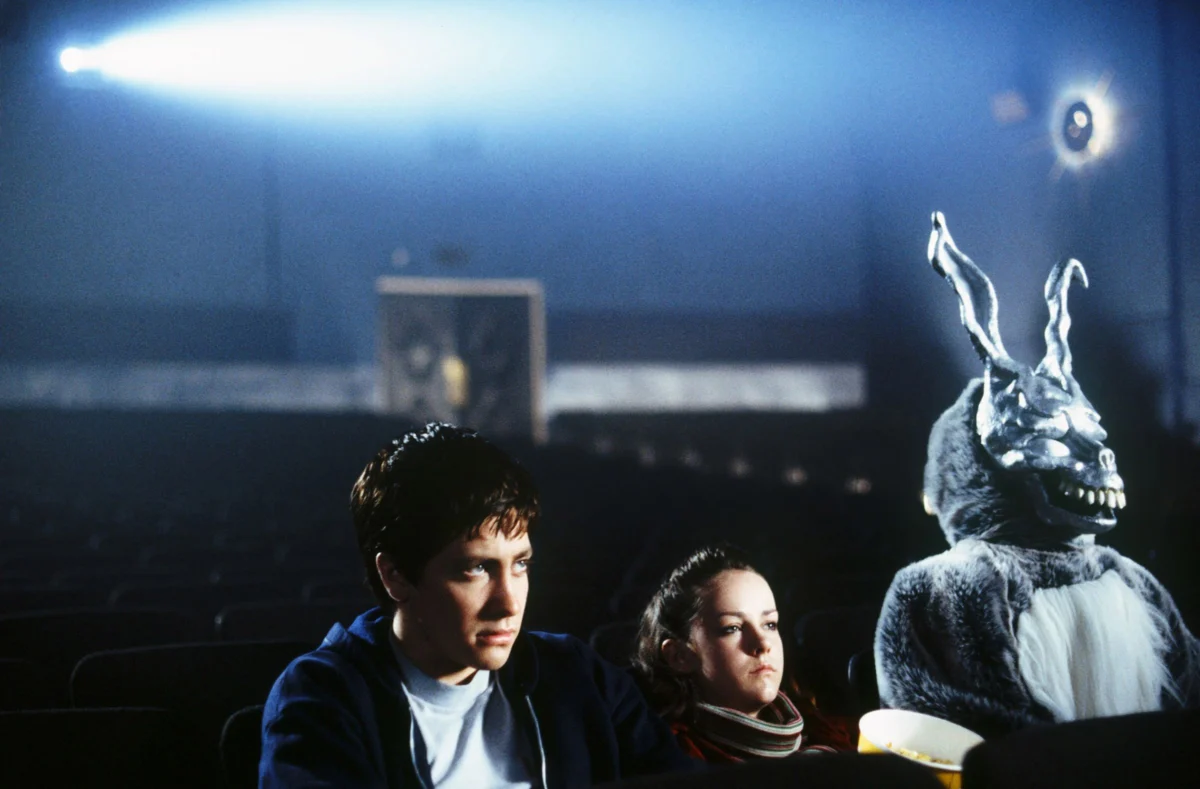
Furthermore, cinematic references embedded in the narrative underwent frantic eleventh-hour revisions. The script originally called for Donnie and his girlfriend Gretchen to attend a screening of the 1984 horror film C.H.U.D. When studio licensing representatives proved uncooperative days before shooting at the Aero Theatre, Flower Films executive Linda McDonough brokered an arrangement with Sam Raimi and the producers of The Evil Dead. This fortuitous intervention allowed the production to feature The Evil Dead prominently on the theater marquee and within lobby displays, inadvertently cementing a legendary horror crossover into the fabric of the film.
Official Responses and Cultural Legacy
Reflecting on the unexpected trajectory of his directorial debut, Kelly has frequently emphasized gratitude toward the fanbase that sustained the film’s reputation over the decades. The critical turning point occurred in March 2002, when Kelly discovered a sold-out midnight screening of his film running at the Pioneer Theater in New York City’s East Village—a moment documented by cultural journalists and captured on local news broadcasts.
Industry analysts often cite Donnie Darko as a textbook example of home-entertainment distribution rescuing a quality picture from premature theatrical burial. Its complex mythology, touching upon tangential universes, time travel, and adolescent alienation, birthed early internet film-theory forums, cementing its status as an academic subject for modern cinephiles. Despite the chaotic landscape of modern social media discourse—which Kelly acknowledges as potentially toxic to contemporary artistic curation—the film’s legacy remains untarnished by commercial compromise.
Broader Impact and Future Implications
The simultaneous release of the 4K theatrical restoration and the 800-page literary companion, The Philosophy of Time Travel, signals a strategic expansion of Kelly’s intellectual property. By utilizing a traditional publishing format to establish the complex parameters of a long-awaited film sequel, Kelly is circumventing the traditional studio funding hurdles that have historically complicated his follow-up projects.
Beyond the Donnie Darko universe, Kelly continues to develop ambitious independent projects, including a planned biographical drama chronicling the life of legendary television writer Rod Serling. Utilizing speculative and science-fiction narrative techniques inspired by Serling’s own body of work—and drawing thematic parallels from Albert Brooks’ Defending Your Life and Bob Fosse’s All That Jazz—the prospective biopic highlights Kelly’s ongoing commitment to visionary, auteur-driven storytelling.
As the October 2 re-release approaches, the cultural reappraisal of Donnie Darko serves as a reminder of the volatile nature of film distribution and the enduring power of idiosyncratic cinema. For Richard Kelly, the milestone offers both a nostalgic reckoning with his beginnings and a springboard for the uncompromising creative endeavors yet to come.