
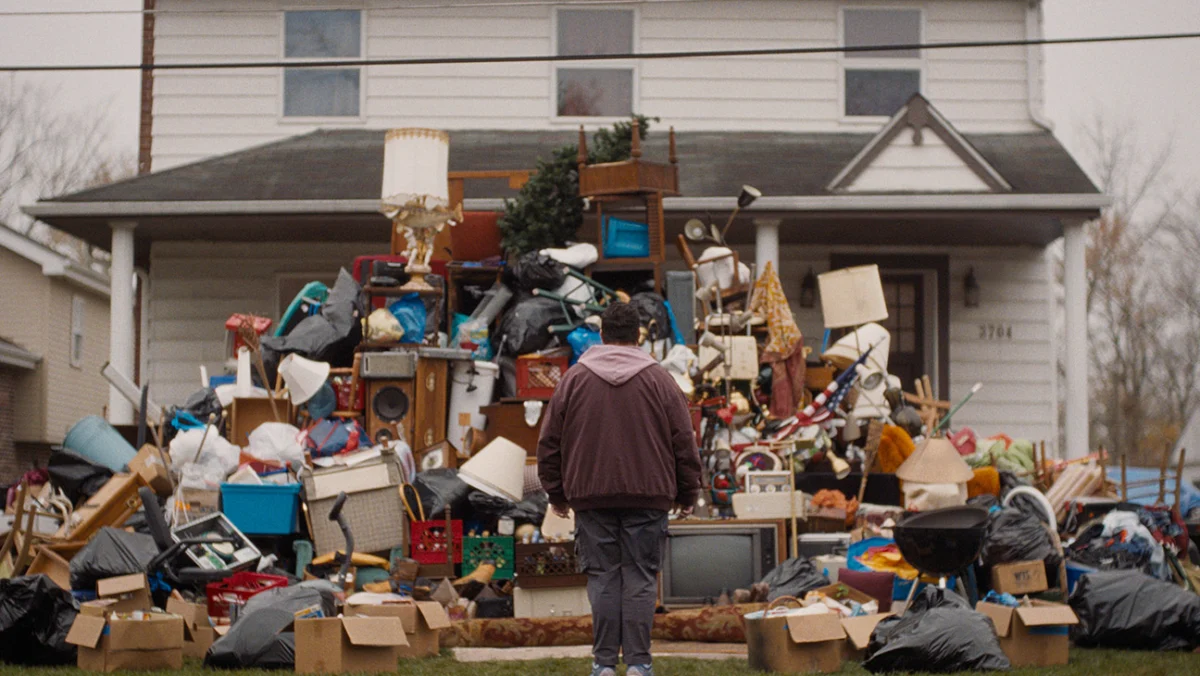
The Toronto International Film Festival, one of the most prestigious platforms for global cinema, served as the backdrop this past Friday for the world premiere of Trash Mountain, a dramedy that explores the intersections of mourning, family estrangement, and the physical manifestations of grief. Starring comedian Caleb Hearon and Zooey Deschanel, the film marks a significant pivot for Hearon, who is widely recognized for his razor-sharp stand-up and his upcoming role in the highly anticipated sequel to The Devil Wears Prada. The screening, held at the Scotiabank Theatre, highlighted a project that serves as both a creative vehicle for its star and a deeply personal meditation on the death of a parent.
The Genesis of a Comedic Weepie
Trash Mountain follows the story of Gavin, a gay man living in Chicago who is thrust back into his rural Missouri roots following the unexpected death of his father. The narrative centers on the complex, often messy reunion between Gavin and his half-sister, Abbi, portrayed by Deschanel. As the siblings navigate the wreckage of their father’s life—specifically the literal mountain of refuse accumulated through his hoarding—they are forced to confront the emotional baggage left behind.
For Hearon, the project is not merely an acting exercise; it is an exorcism of personal experience. Having lost his own father suddenly, Hearon co-wrote the screenplay with Ruby Caster with the intention of capturing the uncomfortable, often surreal humor that frequently accompanies tragedy. During a post-premiere Q&A session, Hearon addressed the tonal tightrope walk required to balance the film’s comedic elements with its heavy emotional core. When questioned about his reliance on humor as a defense mechanism, Hearon was resolute. "No. If anything, I’m eager to prove that I’m not just a clown," he stated, distancing himself from the perception that his background as a comic limits his dramatic range.
Collaborative Tension and Creative Boundaries
The writing process was characterized by a delicate negotiation of boundaries. Ruby Caster, Hearon’s co-writer, noted during the TIFF panel that she often found herself acting as a regulator, concerned that Hearon’s natural inclination toward sharp, comedic wit might undermine the film’s more vulnerable moments.
"I was wary," Caster admitted to the audience, explaining the necessity of ensuring the film did not cross the line from cathartic laughter into cynicism. Hearon, maintaining his quick-witted persona, used the moment to break the tension, telling the audience, "You stepped across a lot of lines. And I want to talk about that, here, tonight." This rapport between the co-writers is reflected in the film’s structure—a narrative that oscillates between the absurdity of dealing with a hoarder’s belongings and the profound silence of familial loss.
Material Culture and the Legacy of Grief
At the heart of the film’s plot is the "trash mountain" itself—a physical accumulation of objects that serves as a metaphor for the father’s mental state and his fractured relationship with his children. The film invites the audience to consider the role of objects as vessels for memory. This theme resonated deeply with the cast members, particularly Zooey Deschanel.
In a move that blurred the line between art and reality, Deschanel opted to incorporate a personal item into the film’s production. After an early wardrobe fitting, she requested permission to use a scarf that had belonged to her late grandfather. "I have them in my closet, and every time I see them I think of my grandfather," Deschanel explained. "These objects can be conduits for people that have passed."
This perspective provides the film with its emotional anchor. While Gavin and Abbi treat their father’s collection as "junk" to be hauled away, the narrative challenges the audience to recognize the significance of the detritus. By treating the hoarder’s hoard as both a burden and a collection of keepsakes, the film examines the universal human struggle to hold onto the past while attempting to move forward.
Industry Context: The TIFF Platform and Independent Cinema
The Toronto International Film Festival has long been a bellwether for the industry, often serving as the launching pad for critical darlings that bridge the gap between niche independent cinema and mainstream appeal. The inclusion of Trash Mountain—produced with the backing of executive producer Lilly Wachowski and featuring a robust ensemble cast including Jackie Weaver, Jaboukie Young-White, Kyle Martin, and Holmes—underscores the project’s industry legitimacy.
For Hearon, the transition from his HBO Max comedy special and his burgeoning film career to a lead role in a dramatic narrative represents a calculated shift in his professional trajectory. The film industry has historically struggled to categorize performers who possess strong comedic chops, often relegating them to supporting roles. Hearon’s performance in Trash Mountain is a direct challenge to this industry tendency. By anchoring a dramedy that deals with the complexities of queer identity in rural America and the generational trauma of hoarding, Hearon is positioning himself as a versatile lead actor capable of carrying emotional weight.
Analytical Perspectives on the "Comedic Weepie"
The "comedic weepie" is a notoriously difficult genre to master. Statistically, films that blend genres often face a higher risk of failing to find a core audience, as they can be perceived as lacking a clear identity. However, when executed correctly, they often achieve high critical acclaim and significant long-term cultural resonance.
The success of Trash Mountain will likely depend on the audience’s ability to engage with the film’s specific brand of humor, which is rooted in the "uncomfortable truth." In the context of American cinema, the depiction of rural poverty and mental health struggles—such as hoarding—has often been treated with clinical distance or melodramatic exploitation. By grounding the narrative in the specific, lived-in reality of a father-son relationship, the film avoids the pitfalls of trope-heavy storytelling.
Moreover, the film’s focus on the "hoarder’s father" archetype provides a unique lens through which to view familial debt. Hearon’s assertion that his character’s father was a "complicated guy" who did not produce a "perfect son" suggests that the film avoids the binary of good versus evil, instead opting for a more nuanced examination of human fallibility.
Looking Ahead
As the Toronto International Film Festival continues its run through September 20, the reception of Trash Mountain serves as a focal point for discussions regarding the future of independent dramedy. With the involvement of established producers and a cast that spans multiple generations of talent, the film is positioned to generate significant buzz during the upcoming awards season.
The broader implications of the film are twofold. First, it highlights the increasing viability of projects that explore specific subcultures—in this case, the experience of a gay man returning to his rural roots—without requiring those themes to be the sole defining feature of the protagonist. Second, it reaffirms the importance of the TIFF platform in elevating mid-budget, character-driven narratives in an era dominated by large-scale franchise cinema.
For Caleb Hearon, Trash Mountain is likely to be remembered as the project that solidified his reputation as a serious actor. While the title refers to a pile of literal garbage, the film’s content suggests a much more precious, if painful, excavation of the human heart. Whether the film finds its success in its ability to make audiences laugh through their tears or in its stark, honest portrayal of grief, it has already achieved its primary goal: proving that the man who tells the jokes is also the one who understands the weight behind them.