MGM+’s The Westies embarks on an eight-hour journey into the turbulent underworld of 1980s New York, a narrative steeped in the defiance of rules by low-level enforcers and mid-tier drug dealers operating under the noses of their prohibitionist bosses. The series, which chronicles the volatile dynamics between Irish and Italian criminal syndicates, initially presents a textual world where impulsive acts and disregard for established truces consistently derail even the most meticulously crafted schemes. Yet, beneath this veneer of lawlessness and chaotic ambition, the critical reception suggests a metatextual experience that remains firmly "within the lines," offering competence over genuine innovation or depth. Despite noteworthy performances from veteran actors J.K. Simmons and Titus Welliver, the gang drama, co-created by Chris Brancato and Michael Panes, producers known for Godfather of Harlem, struggles to transcend its foundational premise, delivering a product too polished to dismiss outright but too conventional to truly captivate. The prevailing sentiment is that The Westies is ultimately too slick to hate, yet too dull to truly love.
The Genesis of Conflict: A Truce Under Strain
The inaugural episode, helmed by acclaimed director Alan Taylor, immediately plunges viewers into a fragile period of détente between the Irish American Westies, a notorious outfit operating out of Hell’s Kitchen, and the formidable Italian American Gambino crime family. Following years of internecine warfare and bloody skirmishes, the respective bosses, Eamon Sweeney (portrayed by J.K. Simmons) of the Westies and Paul Castellano (played by Ron Lea) of the Gambinos, have brokered an uneasy truce. This cessation of hostilities is not born of newfound goodwill, but rather a pragmatic, business-minded realization: immense profits await both factions from the construction of the Jacob K. Javits Convention Center in Hell’s Kitchen, provided they can cease their destructive rivalry and cooperate.
However, the fragile peace proves tenuous. The rank and file of both organizations, accustomed to an ethos of violence and territorial dominance, harbor deep resentment towards the détente. The narrative quickly establishes the immense pressure exerted by the bosses to enforce the new rules, a brutal endeavor that inadvertently sows seeds of discontent throughout their ranks. This internal friction is particularly pronounced among the younger, more ambitious protégés, including the Westies’ Jimmy Roarke (Tom Brittney) and the Gambino’s rising star, John Gotti (Hamish Allan-Headley). Concurrently, federal law enforcement agencies begin to circle, with FBI Agent Birdie Polk (Jessica Frances Dukes) leading the charge, aided by the reluctant, morally compromised NYPD officer Glenn Keenan (Titus Welliver). The stage is thus set for a multi-front conflict, pitting internal dissent against external pressure from the authorities, all against the backdrop of a lucrative construction project ripe for exploitation.
New York’s Underworld: A Historical Canvas of the 1980s
To fully appreciate the world depicted in The Westies, it is crucial to contextualize it within the historical realities of 1980s New York City and the actual criminal organizations it draws upon. The Westies, while less globally renowned than their Italian counterparts, were a fearsome Irish-American street gang that dominated Hell’s Kitchen from the 1960s through the 1980s. Known for their extreme brutality, particularly their penchant for dismemberment, and their involvement in loan-sharking, gambling, extortion, and contract killings, they carved out a terrifying reputation. Led by figures like James Coonan and Mickey Featherstone, the Westies operated with a ruthless efficiency that often saw them ally with, or contend against, the city’s more organized Italian Mafia families. Their decline in the late 1980s was largely due to intensified law enforcement efforts and internal conflicts. The series’ decision to place Eamon Sweeney as a Westies boss, while fictional, grounds the narrative in this historical tradition of Irish-American gangland figures.
The Gambino crime family, on the other hand, was one of New York’s infamous "Five Families," and during the early 1980s, it was under the leadership of Paul Castellano. Castellano, known as "The Boss of Bosses," favored a more corporate, business-like approach to organized crime, moving away from street-level violence towards white-collar rackets and legitimate businesses. His focus on construction, waste management, and labor unions made the Javits Center project a prime target for the Gambino’s influence. The real-life Castellano’s reign ended dramatically in December 1985 with his assassination, orchestrated by John Gotti, who subsequently seized control of the family. The series’ portrayal of Gotti as a younger, ambitious figure during Castellano’s leadership hints at the historical tension that would eventually culminate in this pivotal event, a power struggle that reshaped the landscape of the New York Mafia.
The Javits Center itself, a monumental glass-and-steel structure on Manhattan’s west side, was a massive public works project of the era. Its construction, initiated in 1980 and completed in 1986, represented a significant economic opportunity and, consequently, a major target for organized crime. Mob families sought to control labor unions involved in the construction, extort contractors, and siphon off funds through various rackets. This backdrop provides a credible and compelling setting for the show’s central conflict, demonstrating how massive urban development projects frequently become battlegrounds for criminal enterprises. The series’ authentic recreation of 1980s New York, from its grimy streets and cramped apartments to its rundown bars, meticulously overseen by production designer Rocco Mateo, further grounds the fictional narrative in this palpable historical reality, even if the narrative itself doesn’t always delve into the deeper socio-economic currents of the time.
A Question of Character: Archetypes Over Individuality
While The Westies excels in maintaining a smooth tone and an even, deliberate pace—ensuring that viewers are neither lost nor bored—its primary shortfall lies in its character development. The show is criticized for populating its narrative with figures that feel more like well-worn clichés than individuals with distinctive personalities or compelling inner lives. This reliance on archetypes, rather than complex psychological portrayals, prevents the audience from forging a deeper emotional connection with the unfolding drama.
Jimmy Roarke, the series’ protagonist, embodies the "good guy" hero within a morally ambiguous world. He consistently acts with a perceived intelligence and kindness that seems to exist without any clear, comprehensible internal motivation, fulfilling a predetermined role rather than evolving organically. His relationship with his girlfriend, Bridget (Sarah Bolger), while presented as loving, similarly lacks specific details or unique interactions that would distinguish it from a generic romantic subplot. Bridget herself has a curious subplot involving a secret history with the IRA, an element noted as one of the few deviations from the typical gangster drama playbook. However, this intriguing detail is largely disconnected from the main narrative, raising questions about its purpose and integration into the broader story.
Mickey (Stanley Morgan), Jimmy’s best friend, serves as the quintessential "hotheaded low-level gangster" stereotype. His unpredictability is a narrative device, waxing and waning to introduce tension or derail Jimmy’s plans as required by the plot, rather than stemming from a consistent character pathology. The supporting cast largely functions as interchangeable background figures, existing primarily to fill screen space or serve as expendable casualties in the escalating conflicts.
Even the portrayal of John Gotti, a historical figure whose real-life persona was anything but bland, suffers from this adherence to archetype. The Westies‘ version of Gotti is depicted as a sanded-down composite of countless Italian mobsters seen across cinematic history. His introduction, featuring the familiar trope of a powerful gangster feigning offense before erupting in laughter, highlights the show’s reliance on established genre conventions, failing to capture the unique charisma and ruthlessness that defined the actual "Dapper Don."
Performances That Hint at Depth
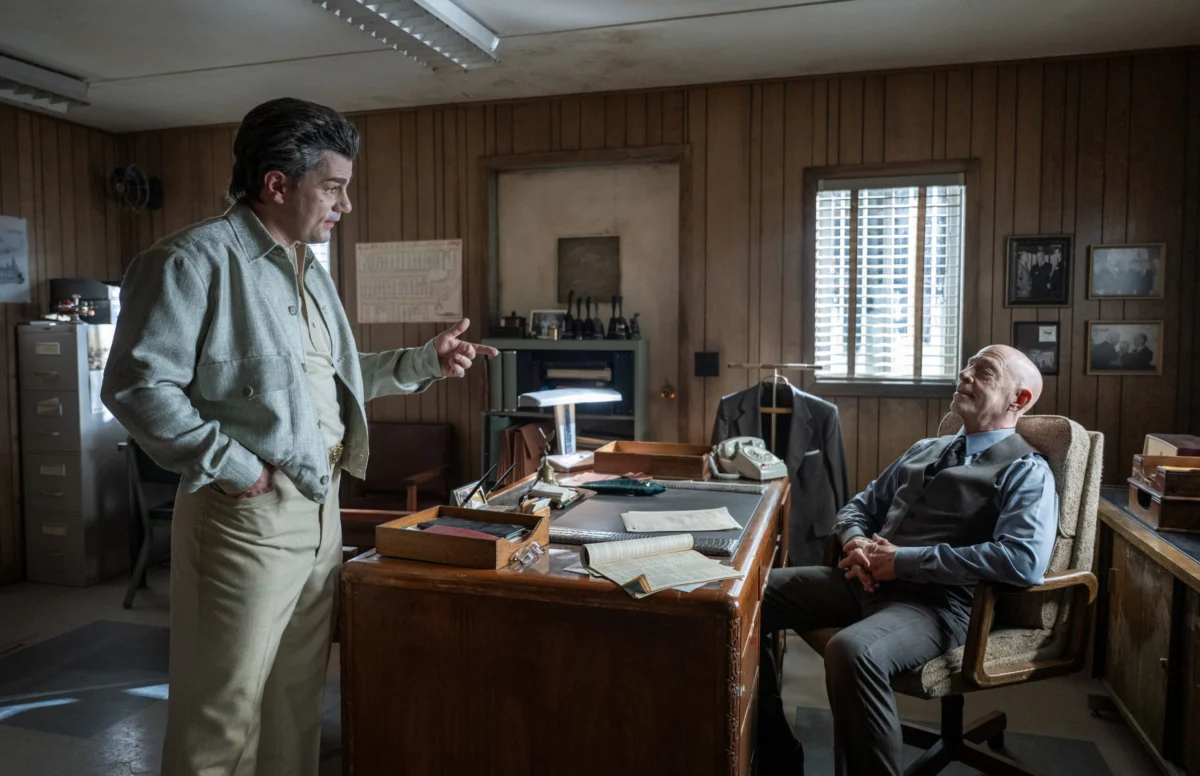
Despite the script’s limitations, a select few cast members manage to inject a semblance of interiority into their roles, suggesting a depth not fully explored by the writing. J.K. Simmons, as Westies boss Eamon Sweeney, delivers a performance marked by snark and weariness. While not among his most complex roles, Simmons’ nuanced line readings and subtle expressions imbue Sweeney with a believable sense of a man burdened by the demands of his position, navigating a world of constant threats and shifting loyalties. He brings a gravitas that hints at a rich backstory, even if the series itself doesn’t fully delve into it.
Similarly, Titus Welliver’s portrayal of the corrupt NYPD officer Glenn Keenan stands out. Welliver carries Keenan with a profound heaviness, hinting at deep-seated private pain and moral compromise. His performance suggests a character wrestling with significant personal demons, adding a layer of tragic complexity to his involvement with the criminal underworld. However, as the series gradually reveals the precise cause of Keenan’s sorrow, the narrative’s inability to fully integrate this emotional weight into the broader story diminishes its impact. The backstory, while not inherently uninteresting, becomes less compelling because the show has not provided sufficient reason for the audience to invest deeply in it, or in the character’s journey overall. These performances serve as tantalizing glimpses of what The Westies could have been, had its ambition matched the talent of its lead actors.
The Gangster Genre: Retracing Familiar Paths
The enduring appeal of the gangster drama genre lies in its capacity to offer more than just violence and revenge plots. Masterpieces from the likes of Francis Ford Coppola’s The Godfather saga, Martin Scorsese’s Goodfellas, and David Chase’s The Sopranos have redefined the genre by combining vivid stylistic flair with compelling, morally ambiguous characters and ambitious thematic explorations of the American Dream, family loyalty, and the corrosive nature of power. These works resonate because they delve into the psychological and societal implications of their criminal worlds, offering rich commentary alongside their dramatic narratives.
The Westies, in contrast, appears content with merely retracing the familiar tropes upon which these iconic works are built. It delivers the expected bag of body parts and revenge schemes but largely shies away from complex emotional processing, grander philosophical themes, or memorable quirks and sharp dialogue that define the genre’s best. In a saturated streaming landscape, where audiences have access to a vast library of sophisticated storytelling, a show that adheres strictly to formula risks becoming forgettable. While it demonstrates competence in its execution—its steady pace, clear narrative beats, and authentic production design—it lacks the distinctive voice or thematic depth required to carve out a unique space within the crowded pantheon of crime dramas.
For MGM+, a platform striving to establish its presence, The Westies represents a safe, albeit unadventurous, programming choice. It offers a solid, if unremarkable, option for viewers seeking a generic crime drama to accompany their evening routines, a show that can be appreciated for its visual fidelity and narrative clarity without demanding significant intellectual or emotional investment. Yet, the question remains whether competence without creativity is enough to sustain long-term audience engagement or critical acclaim in an era defined by bold, innovative storytelling.
Implications and Conclusion
The Westies stands as a testament to the fact that technical proficiency and adherence to genre conventions do not automatically equate to compelling television. While its production values are commendable, particularly Rocco Mateo’s success in creating a lived-in 1980s New York, and the direction by Alan Taylor for the premiere is smooth, the series ultimately suffers from a fundamental lack of ambition. It meticulously colors within the lines, but without the "snazzy shading" or unique flourishes that would provide an illusion of depth or a distinctive identity.
The implications for The Westies in the broader television landscape are significant. In an era where streaming services are fiercely competing for subscriber attention, shows that merely replicate established formulas, no matter how competently, struggle to stand out. While it may satisfy a niche audience looking for familiar comfort within the gangster genre, it is unlikely to generate the buzz or critical discussion that propels a series into the cultural zeitgeist. Its existence highlights a challenge faced by many contemporary productions: how to balance the need for reliable, genre-specific content with the imperative to innovate and surprise.
In conclusion, The Westies is a paradox: a well-crafted, efficient narrative that ultimately leaves little lasting impression due to its unwillingness to push boundaries. It functions as a proficiently executed, if unimaginative, foray into a well-trodden cinematic territory. While its lead performances offer glimpses of potential, the series’ overall commitment to archetypes and conventional storytelling prevents it from ascending beyond the realm of merely "tolerable." For viewers seeking a distraction rather than an immersive experience, The Westies might suffice. However, for those yearning for the vivid style, complex characters, and ambitious ideas that define the best of the gangster genre, the series regrettably settles for retracing familiar footsteps, offering a competent but ultimately uninspired echo of its illustrious predecessors.