

The landscape of contemporary genre filmmaking is undergoing a significant structural shift as creators traditionally rooted in sketch comedy and sitcoms pivot toward high-concept horror. This transition, exemplified by the critical and commercial success of filmmakers like Jordan Peele and Zach Cregger, has found its latest champion in Katie Dippold. Known for her foundational work on Parks and Recreation and MADtv, Dippold is the architect behind Apple TV+’s Widow’s Bay, a series that serves as both a culmination of her eighteen-year developmental journey and a case study in the intersection of comedic timing and supernatural dread. Starring Emmy winner Matthew Rhys as the optimistic mayor of a cursed New England island, the series represents a sophisticated blend of genres that challenges traditional television categorization while reinforcing the narrative kinship between the punchline and the jump scare.
The Comedy-to-Horror Pipeline: A Modern Contextual Shift
The emergence of Widow’s Bay occurs within a broader industry trend where auteurs have successfully migrated from the writers’ rooms of sketch comedy to the vanguard of prestige horror. The most prominent example remains Jordan Peele, who transitioned from the Comedy Central series Key & Peele to win the Academy Award for Best Original Screenplay for his 2017 directorial debut, Get Out. Peele’s subsequent works, Us (2019) and Nope (2022), solidified a blueprint for narratively ambitious films that utilize horror as a vehicle for social commentary while maintaining a sharp, satirical edge.
Similarly, Zach Cregger, a founding member of the comedy troupe The Whitest Kids U’ Know, pivoted to horror with the 2022 breakout hit Barbarian. The film’s success led to the high-profile production of Weapons, which recently garnered accolades for its cast, including Amy Madigan’s Best Supporting Actress win. Industry analysts suggest that this "comedy-to-horror pipeline" is not coincidental. Both genres rely heavily on the precise manipulation of audience expectations. The structural mechanics of a joke—setup, tension, and release—are fundamentally identical to the mechanics of a horror sequence. Dippold herself notes that the uncertainty of whether a build-up will lead to a laugh or a scream is where the creative potential of the hybrid genre lies.
The Genesis and Chronology of Widow’s Bay
The path to production for Widow’s Bay was uncommonly long, spanning nearly two decades. Dippold first conceived the project as a spec script during her tenure as a writer for Parks and Recreation. At its inception, the project was envisioned as a broad comedy, leveraging the mockumentary-style humor prevalent in mid-2000s television. However, as Dippold’s career progressed—penning the 2016 Ghostbusters reboot and the Justin Simien-directed Haunted Mansion—the script underwent a series of tonal evolutions.
The chronological development of the series reflects the shifting tastes of the streaming era. Between 2006 and 2024, the project moved from a traditional sitcom concept to a "prestige" genre hybrid. This evolution was facilitated by the involvement of executive producer Hiro Murai. Murai, an Emmy-winning director known for his surrealist work on FX’s Atlanta, the visceral realism of The Bear, and the post-apocalyptic atmosphere of Station Eleven, helped steer the project toward a darker, more cinematic visual tone. Murai directed five of the season’s ten episodes, ensuring a cohesive aesthetic that balances the "lawless" energy of 1980s haunted house attractions with modern television’s demand for high production value.
Narrative Structure: Optimism Amidst the Macabre
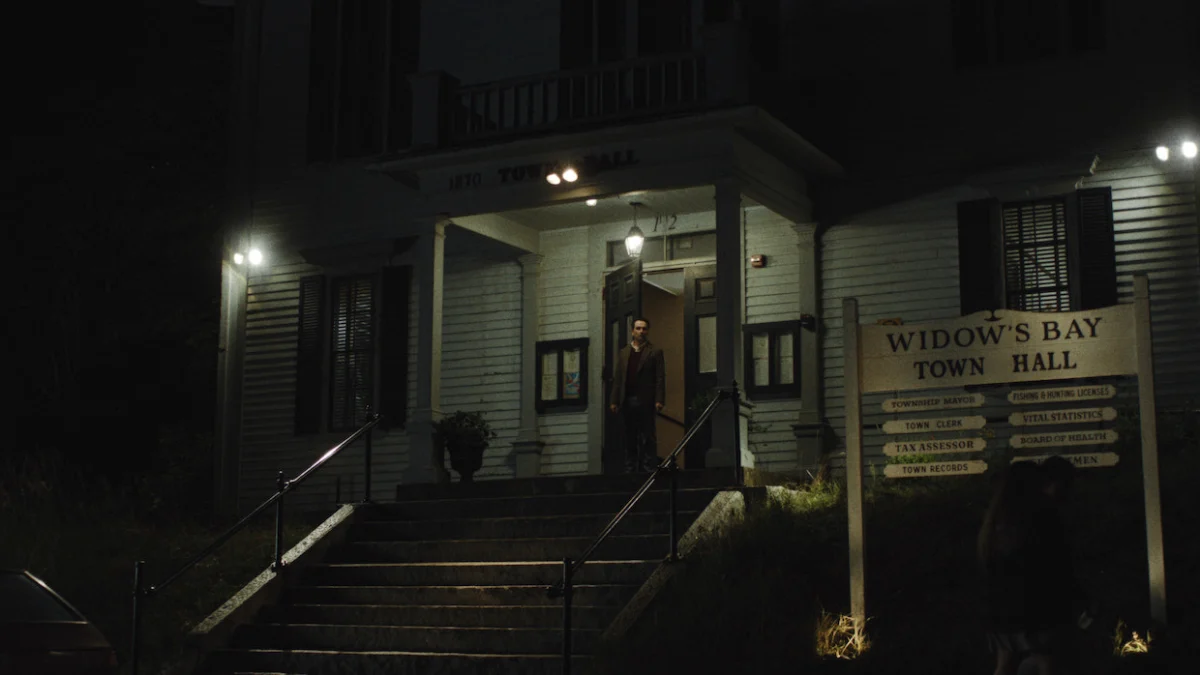
The plot of Widow’s Bay centers on Tom Loftis (Matthew Rhys), the mayor of an eponymous island located off the coast of New England. In a subversion of the "corrupt official" trope seen in classic horror films like Jaws, Loftis is portrayed as a genuine, if somewhat naive, optimist. His primary objective is to revitalize the island’s economy by transforming it into a premier vacation destination, despite the increasingly undeniable evidence that the location is a focal point for malevolent supernatural forces.
The series utilizes a "monster-of-the-week" framework layered over a serialized mystery. The island’s residents contend with a diverse array of horrors, including a killer clown, an amorous "sea hag," a haunted inn, and an ancient spellbook that threatens to turn a routine social gathering into a mass casualty event. The conflict is grounded by the presence of Wyck (Stephen Root), the local eccentric and "town crankpot," who serves as a foil to Loftis’s optimism. Wyck’s fervent belief in the island’s curse provides the necessary exposition while maintaining a level of comedic tension between the skeptical administration and the paranoid citizenry.
Casting Strategy and the Importance of Dramatic Authenticity
One of the most distinct choices made during the production of Widow’s Bay was the decision to cast actors primarily known for their dramatic roles in the lead positions. Matthew Rhys, acclaimed for his intense performance as a Soviet spy in The Americans, brings a level of sincerity to Tom Loftis that Dippold felt was essential for the show’s success. According to the showrunner, casting recognizable comedians in the lead roles would have signaled to the audience that the stakes were not real, thereby undermining the horror elements.
This casting philosophy is reminiscent of the production of the 1982 film Tootsie. Director Sydney Pollack famously noted that despite the film’s comedic output, the set was managed with the gravity of a drama. By having actors like Rhys, Stephen Root, Kevin Carroll, and Dale Dickey play the "truth" of each scene rather than "chasing the joke," the series achieves a level of groundedness that allows the absurd elements—such as a sea hag smothering victims with a reclining armchair—to land with more impact.

The supporting cast, however, draws from a deep bench of comedic talent, including Jeff Hiller, Tim Baltz, and Connor Ratliff. This creates a tiered performance structure where the central narrative remains anchored in reality while the periphery of the town is populated by the idiosyncratic characters typical of a high-end sitcom.
Technical Execution and Visual Language
The visual identity of Widow’s Bay is heavily influenced by Dippold’s childhood experiences at a haunted house in Long Branch, New Jersey. The production design team sought to capture the "unregulated" and "visceral" feel of 1980s horror, utilizing practical effects where possible to enhance the physical presence of the island’s threats.
The cinematography, overseen by Murai’s frequent collaborators, utilizes a brooding, desaturated palette that contrasts with the "picturesque and quirky" surface of the New England town. This visual dissonance serves a narrative purpose: it mirrors the mayor’s attempt to paint a bright face on a dark situation. The use of fog, shadow, and period-appropriate lighting helps to bridge the gap between the show’s comedic scripts and its unsettling atmosphere, creating a "liminal space" that has become a hallmark of Hiro Murai’s directorial style.
The Emmy Categorization Debate and Industry Implications
As Widow’s Bay enters the awards cycle, it faces a recurring challenge within the television industry: the categorization of genre-bending content. Apple TV+ has submitted the show as a comedy series, a move that aligns with the industry standard for horror-comedies like FX’s What We Do in the Shadows and Netflix’s Wednesday. However, the historical data regarding the Emmy Awards suggests a disparity in how different genres are received.
While the "Drama Series" category has become increasingly inclusive of genre fiction—with Game of Thrones winning four times and shows like The Last of Us, Stranger Things, and The Mandalorian receiving nominations—the "Comedy Series" category has traditionally favored more conventional formats. Widow’s Bay presents a test for Emmy voters: whether a show that features genuine gore and psychological horror can be recognized for its comedic brilliance.
Supporting data from recent years shows a slow shift. Wednesday received two Emmy wins and several nominations in the comedy field, indicating that the Television Academy is becoming more receptive to "dark" humor. However, Widow’s Bay is arguably more gruesome than its predecessors, placing it at the forefront of a movement that demands the same level of respect for the technical execution of a jump scare as is given to a punchline.
Broader Impact and the Future of Apple TV+ Originals
The release of Widow’s Bay is a strategic move for Apple TV+ as it continues to build a portfolio of "prestige genre" content. Following the success of Severance and Silo, the platform has carved out a niche for high-budget, auteur-driven series that defy easy classification. By providing Katie Dippold with the resources to realize a nearly two-decade-old vision, the streaming service is reinforcing its reputation as a destination for creators who wish to experiment with tone and structure.
The success of the series will likely influence future commissions in the horror-comedy space. If Widow’s Bay manages to capture both the horror enthusiast and the sitcom audience, it will provide a roadmap for other creators looking to bridge the gap between disparate genres. The collaboration between a comedy-trained showrunner like Dippold and a visual stylist like Murai suggests that the future of television lies in these "unlikely" creative partnerships, where the primary goal is not to adhere to genre conventions, but to capture a specific, often contradictory, emotional experience.
In conclusion, Widow’s Bay stands as a testament to the durability of a well-crafted concept and the evolving sophistication of the television audience. By treating horror with dramatic sincerity and comedy with technical precision, Katie Dippold has created a work that reflects the modern reality of the industry: a place where the lines between fear and laughter are increasingly, and intentionally, blurred.