

On a quiet afternoon in the Atlanta suburb of Sandy Springs, the silence of a residential neighborhood was shattered by the arrival of law enforcement. Officers from the Sandy Springs Police Department, responding to a high-priority distress call involving a reported gunman and an active shooting, arrived at a French Country-style mansion with rifles drawn and body cameras recording. The caller had claimed to be hiding in a bathroom while shots rang out. However, upon breaching the perimeter, police were met not by a massacre, but by a young man with a mullet and a group of seven other individuals who appeared remarkably composed given the circumstances. The "gunshots" had been sound effects, and the "massacre" was a prank orchestrated by anonymous viewers of a 24/7 livestreaming event known as Fishtank Live.

This incident, while alarming to local authorities, is merely a Tuesday for the producers and participants of Fishtank. Operating at the intersection of reality television, social experiment, and digital bloodsport, Fishtank has emerged as a cult phenomenon that pushes the boundaries of what is permissible in the modern media landscape. It is a production that strips away the polished editing of network television, replacing it with a raw, unfiltered, and often disturbing look at human behavior under the pressure of constant surveillance and external manipulation.
The Architecture of Total Surveillance
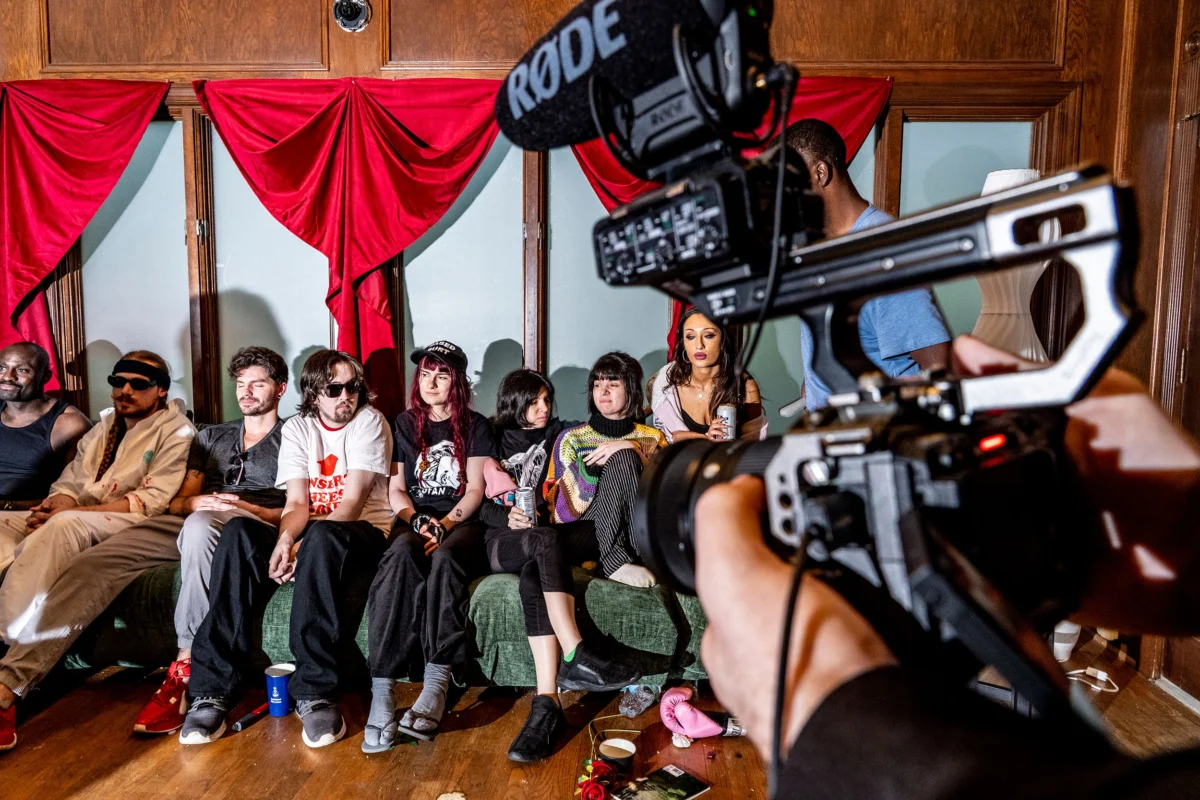
Fishtank Live is described by its creators as a "fully monitored smart house." Unlike traditional reality programs like Big Brother or The Real World, which utilize edited packages to craft narratives, Fishtank operates as a continuous, unedited feed available on its own proprietary website and the streaming platform Kick. The house is rigged with dozens of high-definition CCTV cameras, microphones, and speakers, leaving only the bathrooms as private spaces.

The participants, referred to as "fish," are typically six to ten young adults who agree to live in the house for several weeks. The rules are draconian: no internet access, no cellular phones, no controlled substances, and virtually no privacy. The environment is intentionally designed to be disorienting. Windows are frequently frosted to prevent contestants from tracking the passage of time, and the interior decor is often a jarring mix of primary colors and unsettling, AI-generated artwork.
The production is managed from a control room located in the mansion’s basement. Here, a team of producers monitors every movement, toggling between camera feeds and managing the "gamification" elements that define the show’s revenue model. This control center is less of a professional studio and more of a digital bunker, cluttered with computer monitors, energy drinks, and, as noted by law enforcement during the Sandy Springs raid, firearms kept for self-defense against obsessive fans.

The Architects of Chaos: Sam Hyde and Jet Neptune
To understand the ethos of Fishtank, one must look at its primary creator, Sam Hyde. A graduate of the Rhode Island School of Design, Hyde rose to notoriety through his sketch comedy group Million Dollar Extreme (MDE). His Adult Swim series, World Peace, was famously canceled in 2016 following allegations of hidden alt-right messaging and Hyde’s own history of provocative public stunts. Blacklisted from mainstream media, Hyde pivoted to a subscription-based independent model, cultivating a fiercely loyal and often aggressive fanbase.
Hyde’s philosophy centers on a "right-wing Andy Kaufman" style of performance art—designed to provoke, offend, and deconstruct social norms. Fishtank was originally conceived as a parody of reality TV, a "Hell House" where the goal was not to find love or fame, but to endure psychological attrition.

While Hyde provided the initial spark and star power, the day-to-day operations have transitioned to 28-year-old showrunner Jet Neptune. A former video editor and rapper, Neptune views Fishtank as a response to the "normalized stalking" of the digital age. He argues that if fans are already using technology to track celebrities’ private jets, the logical next step is to create a space where that invasive impulse is monetized and consented to by the subjects.
The Monetization of Trolling and the "Trash Economy"
The financial structure of Fishtank is perhaps its most innovative—and controversial—feature. While traditional television relies on advertising revenue, Fishtank is powered by direct audience interaction. Viewers do not just watch the show; they "live in the walls."

Through the "Fishtoys" system, fans pay significant sums to influence the lives of the contestants. A message blared through the house speakers can cost between $30 and $60. These messages are largely uncensored, allowing fans to bombard the "fish" with insults, slurs, and psychological triggers 24 hours a day. More expensive "disadvantages" can be purchased to further torment participants:
- The Rose ($50): A gift of appreciation.
- The Letter ($100): A direct communication to a contestant.
- Bedsnatcher ($800): Forces a contestant to sleep on the floor for the night.
This model has proven remarkably lucrative. With a production budget of less than $1 million, the show’s producers claim a valuation of over $30 million. Recent seasons have attracted more than 500,000 regular viewers. The show has also begun to secure corporate sponsorships from companies like Sticker Mule and Backyard Butchers, signaling a shift where brands are increasingly willing to associate with "extreme" content to capture the attention of a demographic that has largely abandoned traditional media.

In a literal manifestation of what Hyde once called the "trash economy," the production even sells debris from the house—splintered wood from broken doors or chunks of drywall—as "mystery boxes" for hundreds of dollars.
The Participants: NEETs and the Search for Meaning Through Pain
The casting of Fishtank differs significantly from the "aspirational" casting of network reality TV. Producers specifically seek out individuals they describe as "NEETs" (Not in Education, Employment, or Training). These are often shy, socially isolated young adults who spend a disproportionate amount of time online.

For many of these participants, the house represents the first time they have experienced communal living or significant public attention. However, that attention is often predatory. The show’s challenges are designed to break down the participants’ dignity and mental fortitude. These include:
- The Rice Challenge: Counting thousands of individual grains of rice on a dirty floor.
- The Most Traumatic Life Story Challenge: Compelling contestants to share their deepest pains for the amusement of the audience.
- Physical Altercations: Producers have been known to engage in "boxing matches" with contestants, often resulting in genuine injury.
The psychological toll is evident. Contestants have been documented having nervous breakdowns, engaging in self-degrading behavior, and, in some cases, being removed for becoming legal liabilities. One contestant, Jimmy Downey, was removed after a physical altercation involving a croquet mallet. Another, a survivor of the Parkland school shooting named Vimp, reported being relentlessly mocked by viewers who told her she "should have been the one killed."

Despite this, some former contestants, like Letty from Season 1, claim the experience was transformative. Letty, who was unemployed and depressed before the show, argued that withstanding the "torture" helped her gain self-esteem and launched a successful independent streaming career. This "exposure therapy" for the personality is a recurring defense used by the show’s producers.
Broader Implications: The Rise of "Chudtech"
Media analysts have begun to categorize Fishtank as part of an emerging content ecosystem known as "Chudtech." This term refers to interactive, often right-leaning digital platforms that monetize humiliation, social alienation, and the breakdown of traditional broadcast standards.

The success of Fishtank highlights a growing divide in media consumption. While mainstream platforms like Meta and YouTube have historically moved toward stricter moderation, a parallel infrastructure of "free speech" platforms (such as Kick, Rumble, and Minds) has allowed for the rise of content that would be unairable on cable television.
The implications of this shift are twofold. First, it suggests that there is a massive, underserved market for "unfiltered" content that rejects the perceived sanitization of modern media. Second, it raises profound ethical questions about the duty of care in the digital age. When humiliation is the product and the "interactivity" is essentially paid harassment, the line between entertainment and abuse becomes dangerously thin.

Conclusion: The Future of the Tank
As Fishtank Live concludes its most recent season, the production shows no signs of slowing down. Jet Neptune has expressed ambitions to scale the project, envisioning a year-long "spaceship" simulation held in a massive warehouse where the cast must work as a team under even more intense surveillance.
The Sandy Springs police incident serves as a reminder of the real-world friction caused by such "borderless" entertainment. While the officers ultimately left the mansion without making arrests, the event underscored the volatile nature of a fanbase that views the real world as just another "feed" to be manipulated.

Whether Fishtank is a visionary look at the future of interactive media or a regressive slide into digital gladiatorial combat remains a subject of intense debate. What is clear, however, is that the "glass walls" of the tank are expanding. In an era where privacy is increasingly commodified and attention is the ultimate currency, the world inside the Fishtank may soon be indistinguishable from the world outside it. For the producers, the goal remains a "happy ending" hidden within a "cake of horror," but for the participants and the public, the true cost of that ending has yet to be fully calculated.