


The 78th Primetime Emmy Awards, scheduled for broadcast on September 14, 2026, represent a pivotal moment for the Television Academy as the organization grapples with shifting industry economics, regulatory pressures, and a significant overhaul of its category structures. While the Academy Awards often command the spotlight for cinematic achievements, the scale of the Primetime Emmys remains unparalleled in the television industry, with 23 awards slated for the main telecast and approximately 100 additional honors to be distributed during the Creative Arts Emmy ceremonies the preceding week. This year’s proceedings are particularly fraught, marked by the disqualification of high-profile performers and a consolidation of variety categories that pits long-time titans of late-night television against the institution of sketch comedy.
Structural Revisions and the Variety Category Merger
The most consequential change for the 2026 season is the reintegration of the variety talk and variety scripted (formerly sketch) categories. This marks a return to a unified format that has fluctuated significantly since the category’s inception in 1951. Historically, the Television Academy has struggled to balance disparate formats within a single field. In the early 1970s, the Academy briefly separated talk shows, such as The Tonight Show Starring Johnny Carson, from musical and sketch programs like The Carol Burnett Show. However, for nearly four decades following the mid-1970s, the category remained a single entity, often leading to incongruous matchups where traditional talk shows competed against musical specials and avant-garde comedy.
The 2015 decision to split the field into "Variety Talk Series" and "Variety Sketch Series" was intended to provide a more level playing field. This era saw the rise of Inside Amy Schumer and Key & Peele, followed by a dominant six-year winning streak by Saturday Night Live. Concurrently, HBO’s Last Week Tonight with John Oliver became a juggernaut in the talk category, securing seven consecutive wins before being reclassified into the scripted variety category in 2023, where it earned three additional trophies.
The 2026 merger forces a direct confrontation between John Oliver’s research-heavy HBO program, the traditional network formats of The Late Show and Jimmy Kimmel Live!, and the sketch-based production of Saturday Night Live. Industry analysts suggest this consolidation may be a response to the shrinking number of eligible late-night programs on linear television, as networks continue to trim budgets and reduce the frequency of original broadcasts.
The Disqualification of Jon Hamm and Rule 16
In addition to category shifts, the Television Academy has enforced a rigorous new eligibility requirement regarding guest performances. Under the updated regulations, any performer previously nominated as a lead or supporting actor for a specific role is ineligible for a guest actor nomination for that same character in subsequent seasons. This rule was implemented to address perceived "category fraud" or "double-dipping," where major stars would return for brief cameos to secure additional awards in less competitive fields.
A notable victim of this rule change in 2026 was Jon Hamm. Apple TV+ submitted Hamm for a Guest Actor in a Drama Series nomination for his work on The Morning Show. However, because Hamm had previously received a Supporting Actor nomination for the same role in 2024, the Academy disqualified the submission. While Hamm remains a contender for other projects this year, the disqualification underscores the Academy’s commitment to rigid role classification. This follows the 2021 victory of Claire Foy, who won an Emmy for a guest appearance in The Crown after having previously won the Lead Actress Emmy for the same role in 2018—a scenario the new rule is specifically designed to prevent.
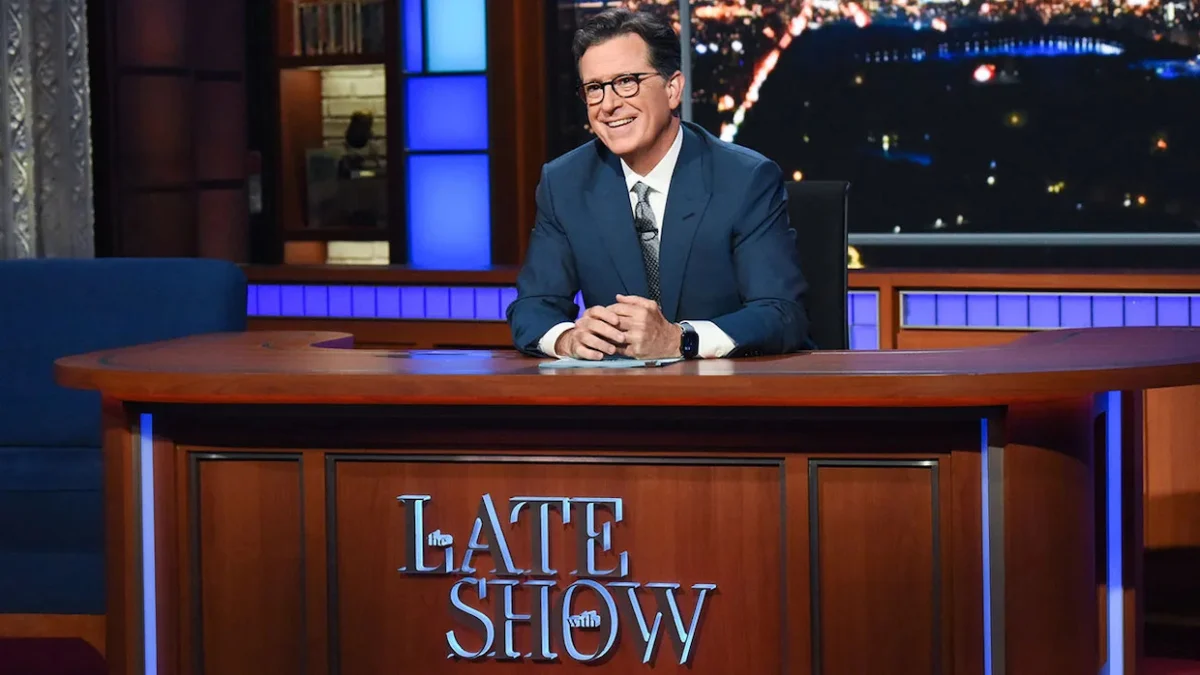
The Cancellation of The Late Show with Stephen Colbert
The narrative surrounding this year’s Emmy race is inextricably linked to the seismic shifts within Paramount Global. On May 21, 2026, The Late Show with Stephen Colbert concluded its 11-season run following CBS’s decision to cancel the franchise. This move ended a 33-year lineage of late-night programming at the Ed Sullivan Theater that began with David Letterman in 1993.
The cancellation occurred shortly after the acquisition of Paramount by Skydance Media, led by David Ellison. Official statements from the network cited a $40 million annual operating deficit as the primary driver for the decision. However, the move has been met with skepticism by media critics and industry insiders. Colbert has been a vocal and consistent critic of the current administration, leading to speculation that the cancellation was a strategic move by the new leadership to mitigate political friction.
Despite his termination, Colbert’s final season has been viewed as a critical triumph. The show earned its first Talk Series Emmy in September 2025, and Colbert himself received a standing ovation from his peers during the ceremony. The 2026 Emmys serve as a "swan song" for the 11-time Emmy winner. Voters may view a vote for The Late Show not only as a recognition of Colbert’s career but as a symbolic statement against the corporate and political pressures currently reshaping the media landscape.
The Brief Suspension of Jimmy Kimmel Live!
The political volatility of the 2025-2026 television season was further highlighted by the temporary removal of Jimmy Kimmel Live! from the airwaves. On September 17, 2025, ABC pulled the show following a monologue in which Kimmel made controversial remarks regarding political activist Charlie Kirk. The incident triggered an immediate response from the Federal Communications Commission (FCC), with Chairman Brendan Carr reportedly exerting pressure on the network.
The situation was exacerbated by internal threats from Nexstar Media Group and Sinclair Broadcast Group, which operate numerous ABC affiliates. Both organizations suggested they would cease broadcasting the program if Kimmel remained on the air. However, the suspension lasted only one week. A massive public backlash and organized threats of audience boycotts forced a reversal. Kimmel returned on September 23, 2025, to record-breaking figures: the episode drew 6.26 million linear viewers, and the subsequent monologue garnered 26 million views across social media platforms within 48 hours.
Kimmel’s resilience in the face of political and regulatory pressure has made him a formidable contender in the Variety Series category. Despite 12 consecutive years of nominations, Kimmel has yet to win the top prize in this field. The "rallying effect" of his recent controversy could provide the necessary momentum to secure a victory.
The Enduring Legacy of Saturday Night Live and The Daily Show
Amidst the turbulence of the late-night talk shows, Saturday Night Live (SNL) continues to maintain its status as a cornerstone of American comedy. Now in its 51st season, the show is coming off a highly celebrated 50th-anniversary milestone. While the series has historically been less targeted by political administrations than its talk-show counterparts—owing in part to its legacy of hosting political figures from both parties—it remains a sharp cultural satirist.
The 51st season saw the departure of Bowen Yang, a four-time Emmy nominee and a central figure in the show’s recent revitalization. Despite the loss of Yang, the series has thrived by pivoting toward more absurdist humor while maintaining its live-performance edge. Furthermore, the successful launch of SNL UK, produced in London under the guidance of Lorne Michaels, has expanded the brand’s global footprint and reinforced Michaels’ influence within the Television Academy.
Similarly, The Daily Show has found a stable rhythm following the return of Jon Stewart for Monday night broadcasts. The hybrid model, featuring a rotating cast of correspondents for the remainder of the week, has kept the program relevant in a fragmented media market. The show previously won the Talk Series Emmy during Trevor Noah’s tenure and remains a favorite for the fifth nomination slot in the newly merged category.
Analyzing the Political and Financial Pressures on Late-Night Television
The 2026 Emmy Awards are taking place against a backdrop of significant industry contraction. The transition from linear broadcasting to streaming-first models has decimated the traditional advertising revenue that once supported high-budget late-night productions. The reported $40 million loss for The Late Show is emblematic of a wider trend where the costs of producing 200 episodes of topical television per year are increasingly difficult to justify for parent companies focused on debt reduction and streaming profitability.
Simultaneously, the regulatory environment has become more aggressive. The involvement of the FCC in content disputes involving late-night hosts represents a shift in how the "Equal Time" rule and general decency standards are leveraged in a polarized political climate. For Academy members, many of whom reside in the more liberal-leaning hubs of Los Angeles and New York, the Emmy ballot has become a tool for professional and political expression.
Conclusion: A Referendum on the Future of the Genre
As the September 14 ceremony approaches, the race between Colbert, Kimmel, and Oliver is more than a simple competition for a gold statuette; it is a referendum on the future of topical comedy. A win for Colbert would serve as a definitive endorsement of his brand of political satire in the face of corporate cancellation. A win for Kimmel would validate his defiance against regulatory overreach. Meanwhile, a win for John Oliver would confirm the continued dominance of the deep-dive, premium cable format over traditional network structures.
Regardless of the winners, the 2026 Emmys will be remembered for the way they mirrored the tensions of the era. The Television Academy’s decisions this year—from the merger of categories to the strict enforcement of performance rules—reflect an institution trying to maintain its relevance in a rapidly evolving and increasingly scrutinized media environment. The results of the 78th Primetime Emmy Awards will likely resonate far beyond the theater, potentially drawing the ire or praise of the highest levels of government and signaling the next chapter for the American variety series.