

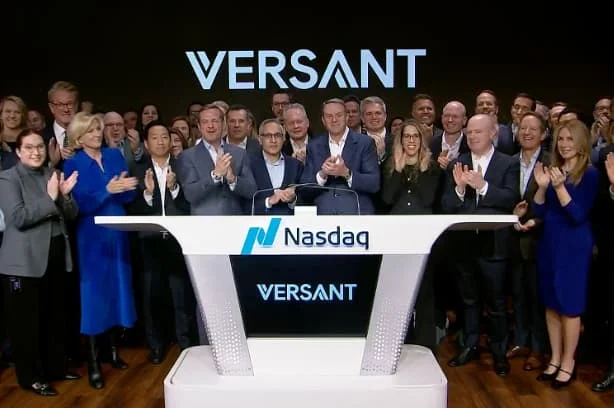
Versant Media Group, the newly independent media entity recently spun off from Comcast Corporation’s NBCUniversal, released its first-quarter 2026 financial results on Thursday, marking its inaugural performance report as a standalone public company. The report, which covers the period ending March 31, 2026, highlights a complex transition period for the media giant as it navigates the persistent decline of traditional cable television while aggressively expanding its digital footprint and content licensing revenue. Despite a modest decline in overall revenue, the company’s performance exceeded Wall Street’s expectations, triggering a positive market reaction that saw Versant’s stock price climb nearly 10% during Thursday’s trading session on the Nasdaq.
The financial results underscore the structural challenges facing the legacy media industry, specifically the erosion of the traditional pay-TV bundle. However, Versant executives pointed to significant growth in digital platforms and a massive surge in content licensing as evidence that the company’s strategy to diversify its revenue streams is gaining momentum. As the parent company of major networks including CNBC, MS NOW, and the Golf Channel, as well as entertainment staples like USA Network, E!, Syfy, and Oxygen, Versant remains a dominant force in both news and entertainment, even as it pivots toward a more digital-centric future.
Financial Overview and Market Performance
For the first quarter of 2026, Versant Media Group reported total revenue of $1.69 billion, representing a slight 1% decrease compared to the $1.71 billion reported in the same quarter of the previous year. While the top-line figure showed a marginal contraction, it surpassed the consensus estimate of $1.62 billion projected by analysts polled by LSEG. This "beat" was largely attributed to the robust performance of the company’s licensing and platform segments, which helped offset the anticipated decline in linear television distribution.
Net income attributable to Versant was $286 million, or $1.99 per share, a 22% decrease from the prior year. The company attributed this decline to several factors associated with its transition to an independent entity, including higher administrative costs related to being a public company and increased interest expenses stemming from the debt structure established during the spin-off from Comcast. These costs were partially mitigated by a lower effective tax rate during the quarter.
Adjusted EBITDA (Earnings Before Interest, Taxes, Depreciation, and Amortization) fell 7% year-over-year to $704 million. However, when viewed through the lens of "standalone adjusted EBITDA"—a metric designed to compare the current performance of the portfolio against its hypothetical performance as an independent company in the previous year—the figure actually rose by approximately 5%. This improvement was driven by disciplined cost management, including a reduction in entertainment programming expenses and lower selling, general, and administrative (SG&A) costs.
The Linear Struggle and Advertising Stabilization
The core of Versant’s business remains its linear distribution segment, which accounts for more than 80% of its current revenue. During the first quarter, linear distribution revenue fell 7% to $1.01 billion. The company noted that this decline was primarily the result of a shrinking subscriber base as consumers continue to "cut the cord" in favor of streaming services. While Versant was able to implement rate increases with cable and satellite providers, these hikes were not enough to fully compensate for the loss of total households.
Advertising revenue also saw a decline, dropping 5% to $368 million. While a decrease in ad spend is rarely viewed positively, industry analysts noted that this performance represented a significant stabilization compared to the first quarter of 2025, when the same portfolio of networks saw a 12% plunge in advertising revenue. The moderation of this decline suggests a strengthening market for live news and sports, which remain the "sticky" elements of the linear bundle.
Versant’s strength in live programming was a focal point of the earnings call. The company highlighted viewership gains for CNBC and MS NOW, as well as the continued relevance of the Golf Channel. As advertisers increasingly seek out "appointment viewing" that cannot be easily skipped or time-shifted, Versant’s portfolio of live news and sports assets provides a critical defensive moat against the broader decline of entertainment cable.
Explosive Growth in Licensing and Digital Platforms
The standout performer in the Q1 report was the content licensing division, which saw revenue skyrocket by 113.5% to $121 million. This massive jump was fueled by high-profile deals, most notably the licensing of the "Keeping Up With the Kardashians" library and related spin-off content to Disney-controlled Hulu. This move illustrates Versant’s willingness to act as an "arms dealer" in the streaming wars, leveraging its deep library of intellectual property to generate high-margin revenue from third-party platforms.
Simultaneously, Versant’s "Platforms" business—which encompasses digital-first brands like Fandango and GolfNow, along with nascent direct-to-consumer (DTC) initiatives—grew by 9.5% to $192 million. CEO Mark Lazarus emphasized that this growth was largely organic, particularly within the GolfNow and Fandango ecosystems, which benefit from transactional revenue and specialized digital subscriptions.

Lazarus articulated a long-term vision for the company that involves a fundamental rebalancing of its financial foundation. Currently, the company is heavily weighted toward pay-TV, but the executive team has set a target to eventually reach a 50/50 split between legacy linear revenue and digital, platform, and transactional revenue. "We are working to make sure we grow revenue diversification within each of our verticals," Lazarus told investors, signaling that the company is less concerned with the total number of subscribers and more focused on the total revenue generated across all distribution formats.
Chronology of the Spin-off and Standalone Debut
The first-quarter results represent the culmination of a strategic pivot that began in late 2024. In November 2024, Comcast Corporation announced its intention to spin off its cable networks into a new, independent company. The decision was viewed by market analysts as a way for Comcast to insulate its high-growth divisions—such as Xfinity broadband, Universal Theme Parks, and the Peacock streaming service—from the secular decline of the cable industry.
Versant Media Group officially began trading on the Nasdaq in early 2026. The spin-off was designed to give the new entity the agility to pursue its own mergers and acquisitions (M&A) strategy and to manage its own capital allocation without the constraints of a larger parent corporation. The Q1 report is the first tangible evidence that the "leaner and more focused" approach is yielding results, particularly in terms of operational efficiency.
Strategic M&A and Capital Allocation
A significant portion of the earnings call was dedicated to Versant’s future growth through potential acquisitions and the acquisition of sports rights. As an independent company with a relatively light debt load, Versant is positioned to be a consolidator in a fragmenting media landscape. CEO Mark Lazarus confirmed that the company is "looking in a variety of areas" for potential deals, though he did not specify targets.
CFO and COO Anand Kini reinforced this message, noting that while M&A is a core component of the strategy, the company maintains a "very high threshold" for any potential deal. "We’re going to look when there’s opportunities that are inorganic, but they have to fit within our markets and strategies," Kini said. He emphasized that the company’s current priority is maintaining a healthy balance sheet while maximizing organic growth.
In the meantime, Versant is focusing on returning value to its shareholders. The company declared a quarterly cash dividend of 37.5 cents per share, payable on July 22. Furthermore, Versant announced a $100 million accelerated share repurchase agreement, set to begin immediately. During the first quarter, the company already repurchased nearly 2.7 million shares of Class A common stock, leaving roughly $900 million in remaining authorization. This aggressive buyback strategy signals management’s confidence in the company’s undervalued stock and its robust cash flow generation.
Broader Industry Implications and Future Outlook
Versant’s performance serves as a bellwether for the broader "mid-tier" media sector. As the industry bifurcates between massive "walled gardens" like Disney and Netflix and smaller, niche-focused players, Versant is attempting to carve out a space as a premium provider of news, sports, and specialized entertainment.
The success of the "Kardashians" licensing deal suggests that Versant’s path to the 50/50 revenue split will be paved with more such agreements. By decoupling its content from its own distribution platforms where necessary, Versant can maximize the lifecycle value of its IP. However, the company also faces the challenge of building its own direct-to-consumer scale. Lazarus acknowledged that while high subscriber counts are a goal, the primary metric for success will be "revenue diversification" and the ability to monetize audiences across various touchpoints, whether that be a ticket purchase on Fandango or a premium subscription on a news app.
Looking ahead to the remainder of 2026, Versant will likely face continued pressure in its linear segment as more consumers migrate to digital alternatives. However, the stabilization of advertising trends and the explosive growth in licensing provide a buffer. Investors will be watching closely to see if the company can secure additional high-value sports rights, which would further solidify its position as a "must-have" for any remaining cable bundles or emerging digital "skinny" bundles.
The 10% jump in stock price following the earnings release suggests that the market is beginning to buy into the Versant narrative: that a legacy media company can successfully transform itself by leaning into its core strengths—news and sports—while ruthlessly optimizing its cost structure and aggressively pursuing new digital revenue streams.
Disclosure: Versant Media Group is the parent company of CNBC.