


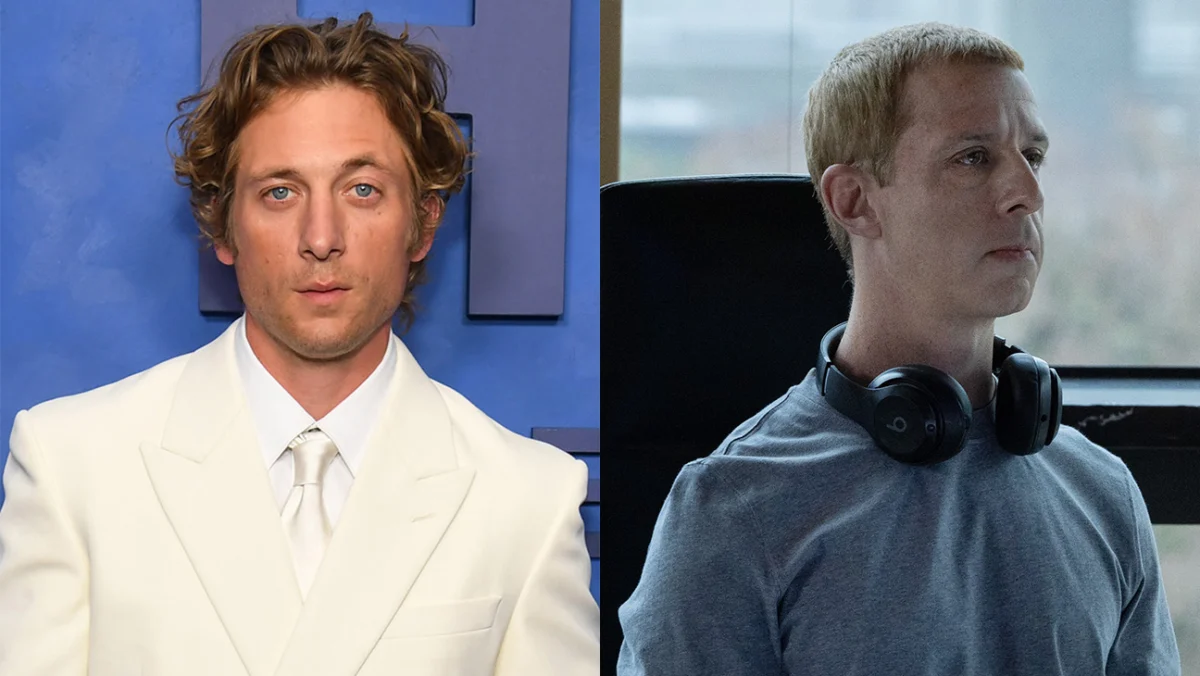
The highly anticipated sequel, The Social Reckoning, is poised to re-ignite public discourse around the complex legacy of social media, and early glimpses are already generating buzz, particularly concerning Jeremy Strong’s transformative portrayal of Meta CEO Mark Zuckerberg. Even co-star Jeremy Allen White, known for his Emmy-winning role in FX’s The Bear, found himself surprised by Strong’s vocal embodiment of the tech magnate, a testament to the rigorous preparation for which Strong is renowned. As the film prepares for its October 9 theatrical release, White offered his initial impressions and shared insights into the project’s profound thematic underpinnings, particularly its exploration of social media’s societal consequences.
A Co-Star’s Candid Reaction to Strong’s Zuckerberg
Jeremy Allen White, currently promoting the fifth and final season of The Bear in New York City, took a moment to discuss his involvement in The Social Reckoning. The film, which promises to delve into the darker facets of the digital age, features White in a pivotal role alongside Strong. However, due to the nature of the production schedule, the two actors had no direct overlap on set. This meant that White’s first exposure to Strong’s interpretation of Zuckerberg was, like the general public’s, through the recently released trailer.
"Jeremy and I spent zero time together filming — we were totally separate," White disclosed to The Hollywood Reporter. "So the first I heard was the trailer with you guys, but it’s incredible." This separation underscores the individual intensity Strong brings to his characters, often immersing himself completely in the role. White, an Emmy winner himself, was quick to laud Strong’s dedication and talent. "I thought it was great, but that’s what I expect of Jeremy. He’s so talented. He works so hard. It makes perfect sense to me." This endorsement from a peer highlights the industry’s respect for Strong’s methodical approach to acting, which often involves extensive research and psychological immersion, making his portrayal of such a globally recognized figure a subject of keen interest. Strong’s commitment to character, previously exemplified by his nuanced performance as Kendall Roy in Succession, suggests that his Zuckerberg will be a deeply researched and perhaps unsettlingly authentic depiction, pushing beyond mere impersonation to capture the essence of a man at the center of unprecedented technological and ethical debates.
From Genesis to Reckoning: The Evolution of a Digital Saga
The Social Reckoning serves as a spiritual and narrative successor to the critically acclaimed 2010 film, The Social Network. That Oscar-winning movie, directed by David Fincher and penned by Aaron Sorkin (who won an Academy Award for his screenplay), chronicled the tumultuous early days of Facebook. Starring Jesse Eisenberg as Zuckerberg, Andrew Garfield as co-founder Eduardo Saverin, and Armie Hammer as the Winklevoss twins, the original film became a cultural touchstone, defining a generation’s understanding of Facebook’s controversial origins, its rapid ascent, and the legal battles that shadowed its creation. It masterfully captured the ambition, betrayal, and intellectual property disputes inherent in the birth of a global phenomenon.
Seventeen years later, Sorkin returns to both write and direct the sequel, signaling a deliberate continuation of his thematic exploration. The choice to have Sorkin helm the project not only ensures a consistent narrative voice but also allows for a deeper dive into the ethical quagmires that have since engulfed social media platforms. Jesse Eisenberg, who previously inhabited the role of Zuckerberg with a memorable blend of awkward genius and detached ambition, confirmed in earlier interviews that he would not be returning for the sequel, paving the way for Strong to offer a fresh, contemporary interpretation of the tech titan. This casting decision itself highlights the narrative shift: while Eisenberg’s Zuckerberg was the ambitious architect of a new world, Strong’s portrayal is expected to reflect a figure grappling with the unforeseen, and often negative, consequences of that creation.
Thematic Shift: From Innovation to Implication
While The Social Network focused on Facebook’s meteoric rise, The Social Reckoning shifts its gaze to the profound societal consequences and controversies that have plagued social media as it has matured. The film is set to explore the intricate web of issues that have transformed platforms like Facebook (now Meta) from revolutionary communication tools into sources of global concern regarding data privacy, misinformation, mental health, and political polarization. This thematic pivot reflects a broader societal maturation in understanding the double-edged sword of digital connectivity.
In this new narrative, Jeremy Allen White plays Jeff Horwitz, a Wall Street Journal reporter whose real-life investigations played a crucial role in exposing some of Facebook’s darkest secrets. Horwitz famously collaborated with former Facebook employee Frances Haugen, portrayed in the film by Mikey Madison. Haugen emerged as a whistleblower in 2021, leaking tens of thousands of internal company documents—dubbed "The Facebook Files"—to the Wall Street Journal. These documents revealed that Facebook was aware of the harmful impacts of its platforms, including Instagram’s negative effects on teen mental health and its role in spreading misinformation and inciting violence, yet often prioritized profit over user safety. The collaboration between a dedicated journalist and a courageous whistleblower forms the narrative spine of The Social Reckoning, painting a vivid picture of the relentless pursuit of truth against a backdrop of corporate secrecy and immense power. The film aims to dramatize the real-world implications of these revelations, bringing to the screen the human cost of unchecked technological expansion.
A Chronology of Social Media’s Unraveling
To fully grasp the context of The Social Reckoning, it’s essential to trace the trajectory of Facebook and the broader social media landscape:
- 2004: Facebook is founded by Mark Zuckerberg, initially for Harvard students.
- 2006: Facebook opens to the general public; the news feed is introduced.
- 2010: The Social Network is released, chronicling Facebook’s controversial origins and legal battles, and cementing its image in popular culture.
- 2012: Facebook reaches 1 billion users; IPO values the company at over $100 billion. Instagram is acquired.
- 2014: WhatsApp is acquired for $19 billion.
- 2016: U.S. presidential election sees widespread concern over misinformation and foreign interference on social media platforms.
- 2018: The Cambridge Analytica scandal erupts, revealing that the data of millions of Facebook users was improperly harvested and used for political advertising, leading to intense scrutiny over data privacy. Zuckerberg testifies before Congress.
- 2020: The COVID-19 pandemic accelerates social media usage, but also amplifies concerns about health misinformation and platform accountability.
- 2021: Frances Haugen leaks "The Facebook Files" to the Wall Street Journal, exposing internal research on Instagram’s harm to teen girls, the platform’s role in political polarization, and its failure to curb hate speech. Haugen testifies before Congress and international bodies, calling for regulation. Facebook rebrands its parent company to Meta Platforms, signaling a strategic shift towards the metaverse.
- 2022-2023: Meta faces ongoing antitrust scrutiny, significant financial challenges in its metaverse division, and continued pressure regarding content moderation and user safety.
- October 9: The Social Reckoning opens in theaters, aiming to encapsulate these complex developments into a compelling cinematic narrative.
This timeline highlights the dramatic shift from the optimistic innovation portrayed in The Social Network to the era of accountability and profound ethical dilemmas that The Social Reckoning seeks to address.
Supporting Data: The Digital Goliath and Its Shadow
The narrative of The Social Reckoning is firmly rooted in the staggering scale and pervasive influence of social media today. Consider the following data points that underscore the film’s relevance:
- Global Reach: As of 2023, Meta Platforms (Facebook, Instagram, WhatsApp) boasts over 3.98 billion monthly active users across its family of apps, representing roughly half of the world’s population. Facebook itself still has nearly 3 billion monthly active users.
- Economic Power: Meta Platforms reported revenues exceeding $134 billion in 2023, with a market capitalization often fluctuating in the hundreds of billions of dollars. This immense financial power grants these companies significant lobbying influence and resources to shape regulatory debates.
- Time Spent Online: The average internet user spends approximately 2.5 hours daily on social media platforms. For younger demographics, this figure is often higher, leading to concerns about addiction and displacement of other activities.
- Mental Health Impact: Numerous studies, including internal research revealed by Haugen, indicate a correlation between heavy social media use and negative mental health outcomes, particularly among adolescents. Issues like body image dissatisfaction, anxiety, and depression have been linked to platform algorithms that prioritize engagement over well-being.
- Misinformation and Polarization: Research from organizations like the Pew Research Center consistently shows that a significant portion of news consumption occurs via social media, making these platforms potent vectors for the spread of misinformation and the exacerbation of political polarization. Algorithms designed to maximize engagement can inadvertently create echo chambers, reinforcing existing biases.
- Public Trust: Surveys frequently reveal low levels of public trust in social media companies, with a majority of users expressing concerns about data privacy, content moderation, and the platforms’ overall impact on society.
These statistics provide a stark backdrop to the film’s exploration of social media’s "reckoning," demonstrating that the issues it tackles are not theoretical but deeply embedded in the fabric of modern life.
Jeremy Allen White’s Reflection: A Strengthening of Convictions
For Jeremy Allen White, immersing himself in the world of Jeff Horwitz and Frances Haugen did not fundamentally alter his perception of social media but rather solidified his existing concerns. "I don’t know if it changed," he stated. "I think I have always held similar feelings to what we’re trying to provoke with the film, so I don’t think it changed my mind in any way. But it definitely strengthened my opinions. There’s a lot of proof about the addictive aspects of this stuff, and we should all take a step back."
White’s comments resonate with a growing chorus of voices, from policymakers to mental health experts, who advocate for a more mindful approach to digital engagement. His role as a journalist committed to uncovering truth in the face of corporate power likely provided a tangible connection to the ethical dilemmas inherent in social media’s design and operation. The actor’s personal reflection underscores the film’s broader objective: to provoke critical thought and encourage audiences to re-evaluate their relationship with the omnipresent digital tools that shape their daily lives. It suggests that The Social Reckoning isn’t just a historical dramatization but a contemporary commentary designed to challenge ingrained habits and assumptions about technology.
Broader Impact and Implications for Public Discourse
The Social Reckoning arrives at a pivotal moment, as governments worldwide grapple with how to regulate powerful tech companies. The film’s release is likely to reignite public debate on several critical fronts:
- Tech Accountability: By dramatizing the "Facebook Files" and the efforts of whistleblowers and journalists, the film will reinforce calls for greater transparency and accountability from social media giants. It could empower advocates pushing for stricter data privacy laws, algorithmic transparency, and independent oversight mechanisms.
- The Future of Journalism: The film highlights the crucial role of investigative journalism in a democratic society, particularly in an era where information is abundant but truth can be elusive. White’s portrayal of Horwitz could inspire renewed appreciation for fact-based reporting.
- Social Media Literacy: The narrative is expected to deepen public understanding of how social media algorithms work and their potential psychological and societal impacts. This could foster greater media literacy, encouraging users to critically assess the information they consume and the platforms they engage with.
- Cultural Legacy of Sorkin: Aaron Sorkin’s return to this narrative demonstrates his enduring commitment to examining the moral and ethical dimensions of American power and innovation. Following The Social Network‘s success, The Social Reckoning faces the challenge of not only matching its predecessor’s critical acclaim but also providing a compelling and timely update to one of the most significant technological stories of our era.
As The Social Reckoning prepares for its theatrical debut, the anticipation is palpable. With Jeremy Strong’s potentially definitive portrayal of Mark Zuckerberg and Jeremy Allen White’s grounded performance as a truth-seeking journalist, the film promises not only gripping drama but also a timely and essential examination of the digital world’s enduring challenges. Sony Pictures’ The Social Reckoning opens in theaters on October 9, inviting audiences to confront the complex legacy of the interconnected age.