The international landscape of contemporary Japanese cinema is currently experiencing a transformative period of critical and commercial resurgence. While established masters like Hirokazu Kore-eda and Ryusuke Hamaguchi have become staples of the global festival circuit, a new generation of filmmakers is beginning to command similar levels of intellectual scrutiny. At the forefront of this movement is Sho Miyake, a director whose career has been defined by a meticulous, quiet observation of human behavior and social dynamics. His latest feature, Two Seasons, Two Strangers, represents a significant milestone in this trajectory, having secured the prestigious Pardo d’oro (Golden Leopard) at the 76th Locarno Film Festival. This achievement not only solidifies Miyake’s standing among his peers but also signals a deepening Western interest in the nuanced, character-driven narratives that define modern Japanese independent film.
The Evolution of Sho Miyake’s Cinematic Language
Sho Miyake’s journey to international acclaim began at the Film School of Tokyo, an institution known for fostering idiosyncratic voices. His early output demonstrated a preoccupation with memory, youth, and the specificities of Japanese geography. In 2012, Miyake released two low-budget features that set the stage for his future explorations: Playback and Good for Nothing. The former, often compared to the works of Alain Resnais, utilized a non-linear approach to delve into the fragmented memories of youth, while the latter focused on high-school boys in Hokkaido, Miyake’s native prefecture.
The director’s breakthrough into broader critical consciousness occurred with the 2018 release of And Your Bird Can Sing. This summer romance, lauded for its naturalistic performances and evocative atmosphere, explored the complexities of group dynamics—a recurring theme in Miyake’s oeuvre. He followed this success with Small, Slow But Steady (2022), a rhythmic portrait of a deaf female boxer that garnered international praise for its sensitive handling of disability and its tactile, celluloid-driven aesthetic. His 2024 work, All the Long Nights, continued this trend, focusing on the quiet interactions between two lonely employees at a science toy company. Each project has seen Miyake refining his mise-en-scène, moving closer to a mastery of the "everyday" that recalls the golden age of Japanese cinema while remaining firmly rooted in the present.
Adapting a Cult Legend: The Yoshiharu Tsuge Connection
Two Seasons, Two Strangers serves as a bold departure and a stylistic homage, structured as a diptych adaptation of two stories by the legendary manga artist Yoshiharu Tsuge. Tsuge is a figure of immense cultural weight in Japan, though his work remains relatively niche in the West. He is a pioneer of the "gekiga" (dramatic pictures) movement and the "I-manga," a genre characterized by autobiographical reflection and surrealist undertones. Miyake’s choice to adapt "A View of the Seaside" and "Mister Ben of the Igloo" highlights a desire to bridge the gap between literary manga and contemporary cinema.
In an interview regarding his relationship with Tsuge’s work, Miyake noted that his first encounter with the artist occurred during his university years. He described the works not as mainstream entertainment but as "subcultural" touchstones with a fan base that appreciates their unique, often challenging, expressive forms. By adapting these stories, Miyake sought to find a cinematic equivalent to Tsuge’s ambition, aiming for a "core-level adaptation" rather than a superficial recreation of the panels. To achieve this, Miyake introduced a meta-narrative framework, casting the protagonist as a screenwriter named Li, played by Shim Eun-kyung. This creative choice allows the film to reflect on the act of creation itself, mirroring how Tsuge often projected himself into his own manga characters.
Structural Diptych: Summer, Winter, and the Meta-Narrative
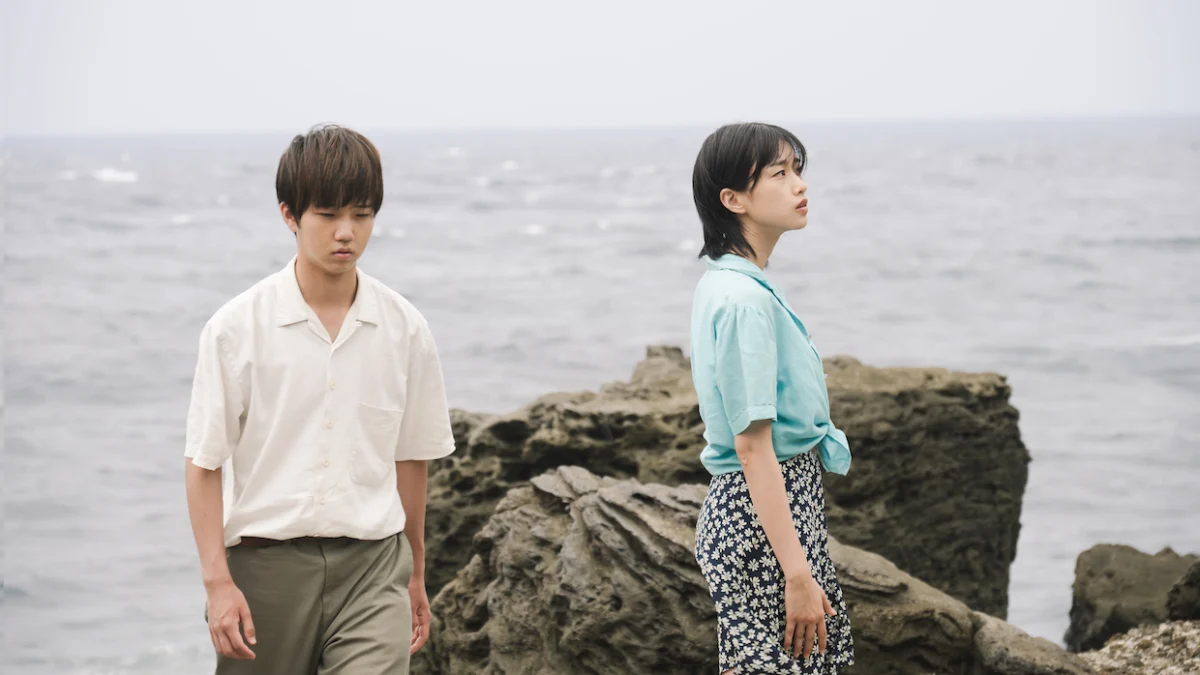
The film is meticulously divided into two distinct halves, contrasted by season, tone, and narrative reality. The first segment, the "film-within-a-film," follows two young strangers whose lives intersect at a sun-drenched island resort. This section is characterized by a vibrant palette and a sense of romantic possibility. However, the narrative is abruptly interrupted by a transition to a classroom setting, where the fictional director and the screenwriter, Li, conduct a Q&A session. This sequence serves as a pivot point, grounded in the reality of the characters’ professional lives.
The second half follows Li as she travels to a snowy, rural town in search of creative inspiration. This segment is markedly more "down-to-earth," as Li stays at a dilapidated inn managed by Benzo, a brusque character played by Shinichi Tsutsumi. The contrast between the two halves—the warmth of the summer island versus the stark, snowy isolation of the winter inn—allows Miyake to explore dualities in human experience. During his discussions on the film’s structure, Miyake pointed to specific recurring motifs, such as a dead fish seen in summer versus a grilled fish in winter. He noted that the same object could evoke ominous foreshadowing in one context and humor in another, illustrating the "richness of film expression" and the subjective nature of interpretation.

Influences and Intellectual Foundations
Miyake’s approach to filmmaking is deeply informed by his intellectual background, particularly his relationship with the late film critic and scholar Shiguéhiko Hasumi. Hasumi, a towering figure in Japanese film criticism and former president of the University of Tokyo, was a mentor to Miyake. The director has credited Hasumi with providing his foundational understanding of film history and teaching him "how to love films and to watch and see them truly for what they are."
This influence is evident in Miyake’s focus on gestures and the physical presence of actors within the frame. His collaboration with Hasumi on the essay film John Ford and Throwing further refined his interest in the small, often overlooked details of a performance. In Two Seasons, Two Strangers, this manifests in the "awkward conversations" between Li and Benzo. Miyake emphasized that these interactions, while difficult to parse, are the source of the humor found in Tsuge’s original work. By having his actors perform these lines with earnestness, Miyake captures the friction of human connection that is often lost in more conventional storytelling.
Global Reception and Distribution Data
The critical trajectory of Two Seasons, Two Strangers has been marked by significant milestones at major international venues. Following its Pardo d’oro win at Locarno, the film was selected for the New Directors/New Films festival, a prestigious showcase co-presented by Film at Lincoln Center and the Museum of Modern Art (MoMA) in New York City. This selection is often a harbinger of a director’s long-term viability in the North American market, as the festival has historically introduced audiences to filmmakers like Pedro Almodóvar and Spike Lee.
The film’s theatrical presence has continued with screenings at specialized venues such as the Metrograph in New York. The data regarding its festival run suggests a targeted strategy to position Miyake as a high-art auteur. According to industry analysts, the success of Japanese independent films in the 2020s is partly due to a "curation effect," where major festivals act as gatekeepers for streaming platforms and boutique distributors looking for prestige content. Miyake’s win at Locarno places him in the company of directors like Hong Sang-soo and Lav Diaz, further elevating the global profile of Japanese indie cinema.
Broader Impact and Implications for Japanese Cinema
The rise of Sho Miyake and the success of Two Seasons, Two Strangers have broader implications for the Japanese film industry. For several decades, the Japanese domestic market was dominated by "media mix" projects—films tied to popular anime or television franchises. However, the international acclaim garnered by Miyake, Hamaguchi, and others suggests a robust return to the "art-house" tradition that defined Japanese cinema in the 1950s and 60s.
Miyake’s work also reflects a shift in how Japanese filmmakers engage with their geography. By moving his narratives from the urban density of Tokyo to the rural prefectures of Hokkaido or snowy island outposts, Miyake explores a Japan that is often invisible in mainstream exports. His personal move from Tokyo to a rural area has informed this perspective, allowing him to depict the "outer prefectures" not as mere backdrops, but as essential characters in his stories.
As Two Seasons, Two Strangers continues its international run, it serves as a testament to the power of quiet, contemplative cinema. By weaving together the legacy of Yoshiharu Tsuge, the intellectual rigor of Shiguéhiko Hasumi, and a modern sensitivity to human loneliness and happenstance, Sho Miyake has crafted a work that is both a tribute to the past and a blueprint for the future of Japanese filmmaking. The film’s ability to find "deep moments" in the "shallow interactions" of travel resonates with a global audience increasingly seeking authenticity in an era of digital disconnection. Miyake’s journey from a Hokkaido-born student to a Golden Leopard winner underscores a vital truth in contemporary cinema: that the most specific, local stories often possess the most universal reach.