


Thai director Sompot Chidgasornpongse’s debut feature film, "9 Temples to Heaven," offers a poignant and often humorous exploration of the evolving relationship between Buddhism, family, and societal change in Thailand. The film delves into the complex interplay of tradition and modernity, presenting a compelling narrative that resonates with a growing generational divide concerning religious practice and its role in daily life. While temples have historically served as cornerstones of faith and community hubs in Thai society, the film illustrates a significant shift where younger generations increasingly perceive Buddhism as a philosophical framework and a personal choice, rather than a prescribed obligation. This nuanced perspective is masterfully woven into a road movie that blends family drama and comedic elements, providing a window into a critical moment of transition within Thailand.
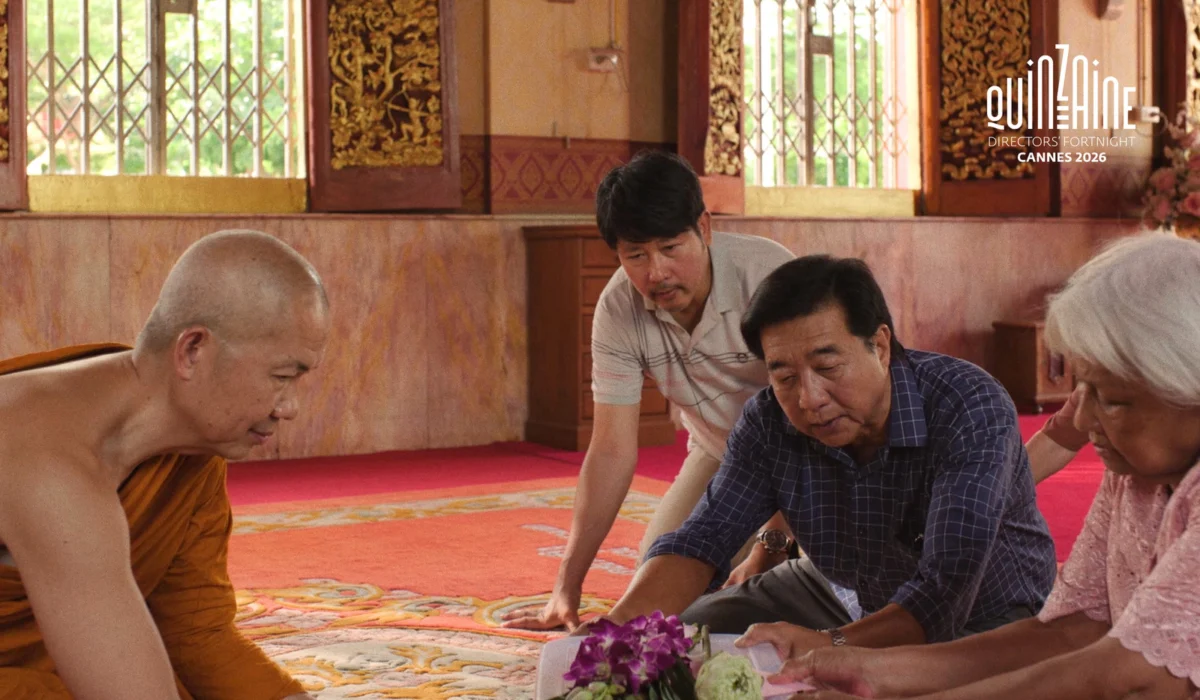
The narrative centers on Sakol, a devout son grappling with a prophecy foretelling his mother’s imminent death. Driven by a desire to accrue merit, prolong her life, and ensure her favorable karma, Sakol embarks on an ambitious quest to visit nine temples within a single day. This pilgrimage, however, is met with reluctant enthusiasm by his mother, a woman more inclined towards the comforts of her home, her beloved television game shows, and the familiar serenity of her couch. Undeterred, Sakol mobilizes his entire family, securing two vans for the arduous journey. What unfolds is not a harmonious spiritual expedition but a microcosm of familial friction, where deeply entrenched conflicts and long-held grievances begin to surface amidst the sacred landscapes.
As the journey progresses and the physical toll on Sakol’s aging mother becomes increasingly apparent, her exhaustion and desire for rest become palpable. Her grandson, Koon, a young man seemingly detached from the fervent religious underpinnings of the excursion, begins to question the very essence and purpose of their undertaking. Sakol, noticing Koon’s quiet reserve and apparent lack of active participation in prayer, is quick to admonish him for what he perceives as a deficiency in faith and familial support. However, Koon’s sentiment of empathy for his grandmother is not isolated. The elder matriarch’s weariness eventually leads to her quiet refusal to leave the confines of the van, a symbolic act of resistance against a tradition she no longer fully embraces or has the energy to uphold.
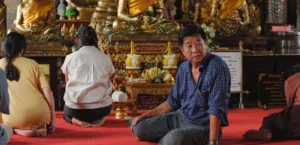
Chidgasornpongse’s directorial approach is characterized by deliberate pacing, long takes, and meticulous audiovisual design, effectively establishing the film’s thematic core from its opening moments. A compelling framing device depicting the preparation and conclusion of what initially appears to be a funeral service immediately sets a tone of introspection. Cinematographer Jonathan Ricquebourg skillfully captures the inherent grace and architectural splendor of the temple, focusing initially on the serene statues and grand interiors. This visual reverence is then subtly undercut by the introduction of an elderly man meticulously rehearsing a funeral oration. This scene serves as the film’s first understated yet potent signal of dissonance and underlying unease.
The subsequent sequence further amplifies this thematic exploration. A young man is observed mechanically arranging plastic chairs for the impending congregation, a stark contrast to the elder’s continued recitation of the oration. This visual juxtaposition highlights a perceived duality: while faith and its established institutions are presented as sources of grace and stability in people’s lives, the ceremony itself gradually reveals itself to be a ritualistic performance, repeated countless times with a diminishing sense of genuine spiritual engagement. This mirrors the familial pilgrimage that follows, where the act of seeking merit through visiting temples appears to have become an automated gesture, a lingering echo of a deeper, more profound spiritual connection that has perhaps faded from collective memory.
This recurring motif of automated faith and the search for authentic meaning permeates the film. While Koon’s skepticism is perhaps the most overt manifestation of this evolving perspective, an undercurrent of uncertainty also pervades Sakol’s own faith. Surachai Ningsanond’s portrayal of Sakol is particularly effective in conveying his internal conflict. He strives to be a devoted son, driven by love and a sense of duty, yet he also endeavors to set a commendable example for his children through his words and actions. Simultaneously, he seeks to embody the image of a pious Buddhist, but his prayers and charitable acts often appear as rote exercises, as perfunctory as the actions observed in the film’s opening scenes. Ironically, the heated exchanges between Sakol and Koon often reveal more about their shared anxieties than their divergent viewpoints. Both father and son frequently exhibit a sense of desperation, dissatisfaction, and at times, palpable fear, suggesting a shared experience of spiritual or existential emptiness that transcends their generational differences.
Despite the underlying spiritual and familial tensions, "9 Temples to Heaven" is undeniably a touching and frequently humorous film. This is particularly evident in the portrayal of Sakol’s mother. Her profound exhaustion and weariness render her seemingly detached from the constant squabbles that swirl around her. Yet, paradoxically, she gradually emerges as the quiet spiritual anchor of the family. Through poignant anecdotes from her past and her understated yet deeply resonant responses to her son’s persistent urging to continue the pilgrimage, she offers moments of profound reflection. In one particularly moving scene, her grandson, Koon, recognizing the potential scarcity of remaining time with his beloved grandmother, discreetly records her voice on his smartphone, a desperate attempt to preserve a precious memory. In these instances, "9 Temples to Heaven" transcends mere storytelling to become a profound philosophical and spiritual meditation. The film avoids becoming trite or overly sentimental, with Chidgasornpongse’s screenplay remaining firmly grounded in the complexities of human emotion, vulnerability, and inherent weakness.
The film’s narrative is deeply rooted in the socio-cultural context of contemporary Thailand, a nation where Buddhism has historically played an integral role in shaping individual identity and collective life. According to a 2018 Pew Research Center study, approximately 93% of Thailand’s population identifies as Buddhist. However, this demographic dominance does not preclude a diversification of religious practice and belief. The film taps into a broader trend observed across many societies: the generational recalibration of faith in the face of secularization, globalization, and the pervasive influence of digital media. For older generations, temples often represent a tangible link to ancestral traditions, a source of communal support, and a spiritual anchor in an often unpredictable world. The act of making merit, as depicted in the film, is a deeply ingrained cultural practice aimed at accumulating positive karma for oneself and loved ones, often with the belief that it can influence well-being and longevity.
However, for younger Thais, growing up in an era of rapid technological advancement and increased exposure to diverse global perspectives, traditional religious structures can appear less compelling or relevant. Buddhism, with its emphasis on mindfulness, ethical conduct, and personal enlightenment, offers an appealing framework for navigating the complexities of modern life, independent of institutional dogma. This shift can lead to a perceived disconnect between the expectations of older generations, who may view religious observance as a familial duty, and the younger generations, who prioritize personal conviction and individual interpretation.
The film’s exploration of this generational divide is further illuminated by the practicalities of modern life impacting traditional practices. The sheer logistical challenge of visiting nine temples in a single day, while a symbol of Sakol’s dedication, also highlights a potential disconnect from the realities of aging and the physical limitations of his mother. The rental of two vans, a modern logistical solution, underscores the adaptation of traditional pursuits to contemporary means, yet the core conflict remains rooted in differing perspectives on the why and how of religious engagement.
The implications of this generational shift extend beyond individual families to the broader societal fabric of Thailand. As younger generations increasingly adopt a more personalized approach to spirituality, the role and relevance of traditional Buddhist institutions may be subject to re-evaluation. This could manifest in various ways, including changes in temple attendance, evolving forms of religious expression, and a greater emphasis on the philosophical and ethical teachings of Buddhism over ritualistic practices. The film subtly suggests that this transition, while potentially fraught with conflict, is also an opportunity for deeper understanding and connection within families, as individuals confront their beliefs and the legacies they inherit.
"9 Temples to Heaven" stands as a compelling testament to the vitality of contemporary Thai cinema, particularly in its astute examination of spirituality and its compassionate portrayal of the human condition. Sompot Chidgasornpongse has crafted a film that is at once quiet, perceptive, and profoundly humane. The family’s journey, though ostensibly a spiritual quest, becomes a vehicle for unearthing long-suppressed familial conflicts and, ultimately, for revealing the enduring emotional bonds that connect its members. It is a film that speaks to universal themes of faith, family, and the search for meaning in an ever-changing world, offering a thoughtful reflection on the enduring power of human connection amidst the complexities of modern life and shifting spiritual landscapes. The film’s success lies in its ability to capture the subtle nuances of human interaction and the universal quest for peace and understanding, making it a significant contribution to cinematic discourse on faith and family in the 21st century.