The Craiova International Shakespeare Festival, a cornerstone event in the global theatrical calendar, has once again opened its doors to groundbreaking interpretations of the Bard’s enduring works. This year, a particular highlight has been the arrival of the KAKUSHINHAN Theatre Company from Japan, presenting their compelling production, "Titus Andronicus: Reborn." Under the visionary direction of Ryunosuke Kimura, the company has approached Shakespeare not as a relic of the past, but as a vibrant, breathing entity of language, gesture, raw emotion, and profound inquiry. Their guiding philosophy, to "create words and bodies that will live on 400 years from now," finds potent resonance in Shakespeare’s most visceral tragedy, a play often decried for its perceived excess but which continues to speak with chilling clarity on themes of revenge, inheritance, power, and the deeply human drive to transmute suffering into meaning.
Established by director Ryunosuke Kimura, KAKUSHINHAN has carved a niche for itself by engaging with classical texts through a lens of contemporary relevance and experimental artistry. The company’s commitment to pushing the boundaries of theatrical expression is evident in their ambitious reimagining of "Titus Andronicus." This production, adapted and directed by Kimura with a translation by Kazuko Matsuoka, masterfully synthesizes a diverse spectrum of Japanese and contemporary performance traditions. Elements of Noh theatre, Rakugo storytelling, dynamic dance, sacred ritual, evocative music, and cutting-edge theatrical experimentation are not mere embellishments but integral components that redefine the very architecture of tragedy. Consequently, "Titus Andronicus: Reborn" transcends a simple staging of Shakespeare’s bloodiest play; it emerges as a profound exploration of what endures after the exhaustive expenditure of violence, and whether the theatrical space can serve as a sanctuary for release rather than retribution.
A Cycle of Brutality Reimagined
At its core, Shakespeare’s "Titus Andronicus" chronicles an inescapable vortex of brutality. The play opens with the triumphant return of Roman general Titus from war, bringing with him not only prisoners but also profound grief, unyielding pride, and a rigid adherence to honor. His initial actions, driven by a perceived duty, inadvertently ignite a devastating chain of revenge that progressively engulfs not only his adversaries but also his own kin and the fabric of Roman society. Tamora, Queen of the Goths, transitions from victim to perpetrator, her narrative intertwined with that of Saturninus, Aaron, Lavinia, Lucius, and a host of other characters ensnared in a world where the lines between justice and retaliation blur into an indistinguishable mire.
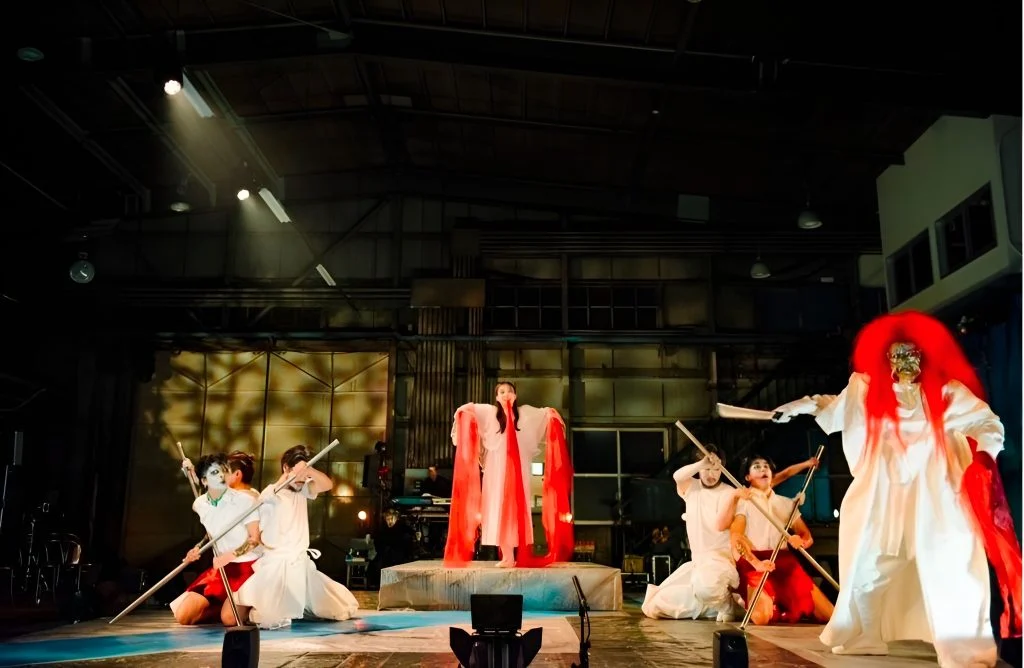
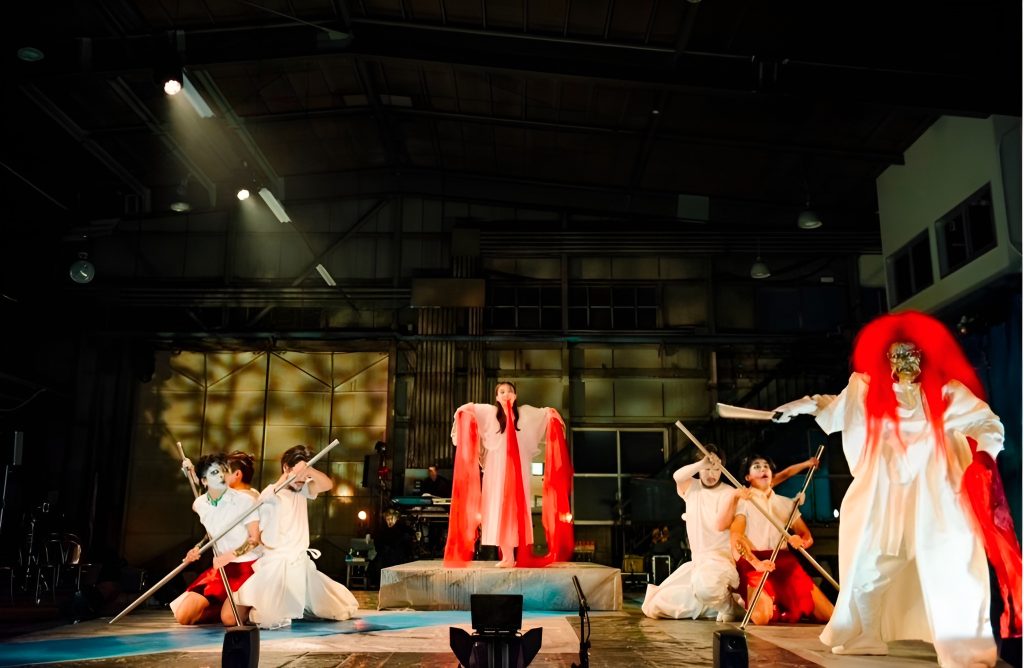
KAKUSHINHAN’s "Titus Andronicus: Reborn" refracts this grim narrative through a unique prism: the journey of a Boy. This young protagonist navigates the play’s blood-soaked landscape, guided by the spectral presence of a Raven. This Raven, an embodiment of Shakespeare himself and the accumulated wisdom of ages past, imbues the production with a contemplative, reflective structure. Rather than presenting violence as mere spectacle, the staging compels the audience to bear witness to the insidious transmission of cruelty across generations. The Boy is not a detached observer; he traverses a terrain saturated with blood, memory, and accusation, gradually apprehending that revenge has transcended its origins to become an autonomous, self-perpetuating mechanism. His presence, from his striking attire to his contemplative demeanor, stands as one of the production’s most arresting features. The eventual emergence of the Boy as an active participant in the unfolding drama introduces a compelling meta-narrative that permeates the entire production.
Blood as Metaphor: Memory, Inheritance, and Contamination
In "Titus Andronicus: Reborn," blood transcends its literal connotation of physical violence to become a potent symbol of memory, inheritance, burden, and contamination. Once spilled, it ceases to belong to a single body, spreading inexorably across the play’s world and transforming each act of revenge into a new form of entrapment. The visual manifestations of this symbolic blood are among the production’s most arresting elements, from the brutal depiction of Lavinia’s mutilation to its pervasive presence as a spectral cloud enveloping the entire narrative.
Perhaps the production’s most profound insight lies in its conceptualization of revenge not as a reactive emotional outburst but as an autonomous system. The characters, believing they act in the name of honor, grief, or justice, are in reality subservient to a structure that predates them and will outlast them. This cyclical nature of vengeance is amplified by the company’s innovative use of diverse performance styles.
Beyond Despair: Seeking Release Through Artistic Synthesis
Despite the overwhelming darkness, "Titus Andronicus: Reborn" steadfastly avoids succumbing to despair. In opposition to the inherited logic of violence, the production actively seeks an alternative voice, one that resonates across disparate cultures and historical epochs. The integration of Noh, Rakugo, contemporary music, and dance, even the inclusion of elements like golf and a narrator who directly addresses the audience in Romanian, urging them to capture photographic memories, injects a remarkably engaging modern sensibility into the narrative. These diverse traditions are presented not solely as markers of Japanese cultural identity but as manifestations of a universal human impulse: to give form to grief, to expose folly, to grant peace to the departed, and to transform private anguish into collective healing. In this light, the title "Reborn" signifies not merely the renewal of Shakespeare’s tragedy but also the potential for spiritual rebirth, an emergence that can only commence when humanity ceases to conflate vengeance with justice.
A Ritualistic Tapestry of Performances
The casting in "Titus Andronicus: Reborn" meticulously reinforces the production’s ritualistic and symbolic dimensions. Tsunao Yamai, a distinguished Noh performer and Kokuho, embodies Titus Andronicus, immediately situating the character within a tradition of controlled intensity, formalized suffering, and embodied memory. His transition from a "contemporary" Shakespearean portrayal to a deeply resonant Noh persona towards the play’s conclusion is a particularly memorable moment. Fuka Haruna delivers a powerfully poignant performance as Lavinia, her physically ravaged presence serving as a central catalyst for the play’s tragic trajectory. Miki Takii masterfully navigates the dual role of Tamora, portraying both a wounded mother and a destructive force. The ensemble cast, including Go Kijima as Saturninus, Mark Yudai Iwasaki as Bassianus, Rion Yanagimoto as Lucius, Ryo Morimoto as Martius, Natsuyama Tatsumoto as Quintus, Makoto Hikage as Mutius, and Seiji Miyagawa as Marcus, collectively constructs a world where familial bonds, political machinations, and relentless violence are inextricably intertwined. Hirokazu Tategata’s dual portrayal of Aaron and the God of Revenge is crucial, providing a direct embodiment of the animating force behind the tragedy. The overall acting approach, characterized by a deliberate excessiveness in both vocal delivery and physical movement, perfectly aligns with Kimura’s directorial vision, becoming a defining characteristic of the production.
Technical Prowess: Visualizing a Symbolic Landscape
The technical execution of "Titus Andronicus: Reborn" further solidifies the seamless fusion of classical text and contemporary theatrical language. Izumi Matsuoka’s set design, Maya’s costume design, and Hisato Iwasaki’s Noh mask design coalesce to create a visual universe rooted in symbolic resonance rather than strict realism. This pervasive sense of expressive exaggeration is mirrored in these elements, with the stark black of the Raven, the pristine white of the Romans, the vibrant motley of the barbarians, and the omnipresent, arresting red of blood contributing to a visually stunning tableau.
Naoyoshi Negoro’s lighting design plays a pivotal role in delineating the transitions between moments of profound human suffering, sacred ritualistic spaces, and an overarching mythic atmosphere. Koji Ozono’s music and sound design, complemented by Takashi Yoshida’s compositions, underscore the realization that this is not merely a narrative being recounted but a lament being profoundly enacted. The decision to feature a live musician performing all the score throughout the play is both impressive and functionally integral to the production’s immersive quality. Ami Rokuhara’s choreography is central to the production’s physical identity, particularly in how KAKUSHINHAN treats Shakespeare’s language as intrinsically linked to the body, with contemporary flourishes standing out prominently. While some temporal "lagging" was noted in the final acts, with the performance extending significantly beyond its advertised duration, this minor deviation does not detract from an overall production that remains captivating from its inception to its conclusion.
The Enduring Question: Shakespeare in the Modern World
What renders "Titus Andronicus: Reborn" so compelling is its refusal to either sanitize Shakespeare’s inherent violence or exploit it for cheap shock value. Instead, the production masterfully transforms the original’s cruelty into a profound meditation on repetition, memory, and the elusive possibility of release. The production’s internationalist perspective is equally significant. Deeply rooted in Japanese performance culture yet extending its gaze towards a shared human condition, it effectively bridges East and West, past and present, language and body, ritual and technology. In doing so, it powerfully encapsulates KAKUSHINHAN’s central inquiry: if Shakespeare were alive today, what urgent messages would he impart to the world?
The Craiova International Shakespeare Festival, which runs from May 15th to June 15th, 2026, serves as a vital platform for such cross-cultural dialogues. This year’s festival features a diverse lineup of international theatre companies, each offering unique perspectives on Shakespeare’s canon. KAKUSHINHAN’s participation underscores the festival’s commitment to showcasing innovative and thought-provoking interpretations that resonate with contemporary audiences. The success of "Titus Andronicus: Reborn" highlights the enduring power of Shakespeare’s narratives to transcend cultural and temporal boundaries, offering a mirror to the persistent human struggles with violence, power, and the search for meaning. The production’s nuanced exploration of these themes, combined with its innovative artistic approach, solidifies its status as a standout event at this year’s festival and a significant contribution to the ongoing conversation surrounding the relevance of classical theatre in the 21st century.