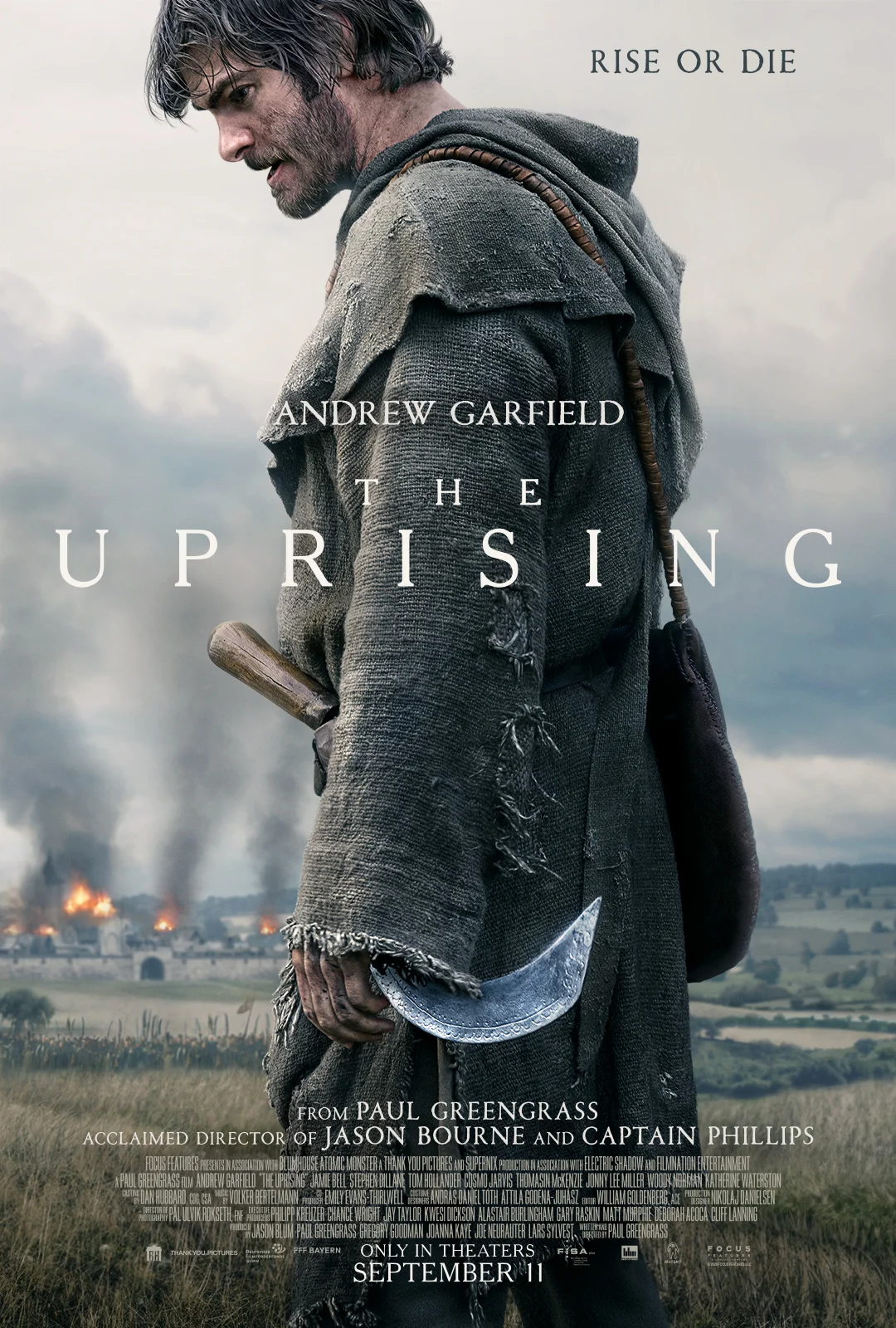
Focus Features has unveiled the official trailer for Paul Greengrass’s historical epic, "The Uprising," slated for a theatrical release on September 11th. The film boasts a formidable ensemble cast, including Andrew Garfield in the lead role, alongside Jamie Bell, Stephen Dillane, Tom Hollander, Cosmo Jarvis, Thomasin McKenzie, Jonny Lee Miller, Woody Norman, Katherine Waterston, and Sky Yang. The trailer offers a glimpse into a narrative of rebellion and defiance against a tyrannical monarchy, setting the stage for a significant cinematic event.
A Glimpse into Rebellion: Trailer Release and Narrative Premise
The newly released trailer for "The Uprising" positions Andrew Garfield as the central figure, portraying a legendary leader spearheading a fervent rebellion against the oppressive rule of King Richard II. The narrative unfolds against the backdrop of a war-torn England, where the protagonist rallies an army of common people to confront the formidable might of the King’s forces in a desperate struggle for justice and survival. This premise evokes classic tales of resistance against tyranny, a theme that has historically resonated with audiences across various cultures and eras.
The visual palette presented in the trailer suggests a gritty and visceral portrayal of medieval warfare, consistent with Paul Greengrass’s directorial style, known for its immersive and often hand-held camera work that lends a sense of immediacy to his action sequences. The ensemble cast, featuring a mix of established stars and emerging talent, further amplifies anticipation for the film. The inclusion of actors like Jamie Bell, Stephen Dillane, and Tom Hollander suggests a depth of character and potential for compelling performances that could elevate the historical drama beyond mere action.
Historical Context: The Shadow of Richard II’s Reign
To fully appreciate the thematic weight of "The Uprising," it is crucial to understand the historical period it aims to depict. King Richard II of England, who reigned from 1377 to 1399, ascended to the throne as a child and his reign was marked by significant political turmoil, including the Peasants’ Revolt of 1381 and the deposition of Richard himself by his cousin, Henry Bolingbroke. While "The Uprising" appears to be a fictionalized account inspired by such periods of unrest, it taps into a potent historical undercurrent of popular discontent and resistance against monarchical authority.
The Peasants’ Revolt, a pivotal event in English history, saw widespread popular uprising against economic hardship, heavy taxation, and the lingering effects of the Black Death. While the revolt was ultimately suppressed, it exposed deep-seated social tensions and the fragility of the established order. A film focusing on a rebellion against King Richard II could explore these themes of class struggle, the rights of the common people, and the consequences of autocratic rule. The trailer’s emphasis on an "army of the people" suggests a narrative that champions the collective strength of the populace against an entrenched power structure.
Paul Greengrass’s Vision: A Director’s Proven Track Record
Paul Greengrass’s involvement as director brings a significant weight of expectation. He is renowned for his distinctive cinematic approach, particularly evident in his Bourne series films ("The Bourne Supremacy," "The Bourne Ultimatum") and historical dramas like "United 93" and "Captain Phillips." His films often blend intense action sequences with profound human drama, characterized by a raw, documentary-like realism and a keen eye for capturing the emotional core of his characters.

Greengrass’s work has frequently explored themes of moral complexity, survival, and the struggle against overwhelming odds. "United 93" masterfully reconstructed the events of September 11, 2001, on United Airlines Flight 93, while "Captain Phillips" depicted the harrowing ordeal of a merchant mariner captured by Somali pirates. These films demonstrate his ability to immerse audiences in high-stakes scenarios and elicit powerful performances from his actors. The trailer for "The Uprising" hints at a similar intensity, suggesting that Greengrass will likely bring his signature kinetic style to the historical battlefield.
However, as the initial reception of the trailer suggests, there is also a recognition of the need for critical evaluation of any new directorial effort. While Greengrass has delivered critically acclaimed and commercially successful films, the landscape of filmmaking is constantly evolving, and audience expectations shift. The mention of "inconsistency in his work" in preliminary discussions indicates a nuanced view of his recent output, making "The Uprising" a potentially significant project for him to reaffirm his directorial prowess.
Andrew Garfield’s Role: A Charismatic Leader in the Making
Andrew Garfield, who has garnered critical acclaim for his versatile performances in films such as "The Social Network," "Hacksaw Ridge," and his return as Spider-Man in the Marvel Cinematic Universe, is tasked with embodying the charismatic and formidable leader of the rebellion. Garfield is known for his ability to convey deep emotional vulnerability and fierce determination, qualities that will be essential for portraying a figure who inspires an army and stands against a king.
His previous roles have often involved characters facing immense pressure and moral dilemmas, making him a natural fit for a historical epic centered on a fight for justice. The trailer’s brief glimpses of Garfield suggest a commanding presence, hinting at his capacity to carry the weight of a narrative focused on revolution and the stakes of freedom. The success of the film will undoubtedly hinge on his ability to convincingly portray the gravitas and conviction required of a legendary rebel leader.
The Ensemble Cast: A Tapestry of Talent
The supporting cast of "The Uprising" represents a significant draw for audiences and critics alike. Jamie Bell, known for his early breakthrough in "Billy Elliot" and his subsequent work in "The Adventures of Tintin" and "Rocketman," brings a wealth of experience in dramatic and physically demanding roles. Stephen Dillane, a veteran of stage and screen, has a distinguished history of portraying complex characters, notably as Stannis Baratheon in "Game of Thrones." Tom Hollander, recognized for his comedic timing and dramatic depth in films like "Pride & Prejudice" and "In the Loop," adds another layer of seasoned talent.
Cosmo Jarvis, who has impressed in "Lady Macbeth" and "Calm with Horses," and Thomasin McKenzie, a rising star seen in "Jojo Rabbit" and "Last Night in Soho," are poised to deliver standout performances. Jonny Lee Miller, with his extensive career spanning "Trainspotting" to "Elementary," and Woody Norman, a young actor who has already earned accolades for his performances, further enrich the ensemble. Katherine Waterston and Sky Yang round out a cast that promises a dynamic interplay of characters and a rich tapestry of human experience within the unfolding rebellion.
Release Strategy and Awards Season Implications
The chosen release date of September 11th for "The Uprising" is noteworthy. Positioned at the beginning of the fall film season, it signals Focus Features’ intent to present the film as a significant release. This timing often coincides with the lead-up to awards season, a period when studios strategically debut films with potential for critical acclaim and accolades.

The discussion surrounding the film’s awards potential highlights a common strategic consideration for studios. A premiere at a prestigious film festival like the Venice Film Festival, which often kicks off the fall festival circuit, could generate early buzz and critical attention. However, the September 11th release date presents a logistical challenge for traditional festival premieres, as it would precede or coincide with major events like Telluride, TIFF, and the New York Film Festival. This suggests that Focus Features may be banking on the film’s inherent quality and narrative strength to propel it into awards consideration without the typical festival launchpad, or perhaps they envision a more direct theatrical push supported by critical reviews that emerge shortly after release.
The potential for "craft nominations," as mentioned in preliminary discussions, refers to accolades in technical categories such as cinematography, editing, costume design, and sound. These are often awarded to films that excel in their technical execution, even if they do not secure nominations in major categories like Best Picture or Best Actor. Whether "The Uprising" can transcend these to become a broader awards contender remains to be seen, but its early release and ambitious scope indicate a degree of confidence from its distributors.
Broader Impact and Audience Engagement
The themes of rebellion against tyranny and the fight for justice are perennial and often find renewed resonance in contemporary society. While "The Uprising" is rooted in a historical setting, its exploration of these universal struggles can serve as a powerful commentary on current events and societal dynamics. The trailer’s emphasis on the "army of the people" fighting for justice and survival is a narrative that can inspire and provoke thought, encouraging audiences to consider the power of collective action and the enduring human desire for freedom.
The inclusion of embedded trailers and a call for audience engagement on social media platforms like X (formerly Twitter) underscores a modern approach to film marketing. By directly inviting viewers to share their reactions to the trailer, distributors aim to foster a sense of community and anticipation, leveraging word-of-mouth and online discussion to build momentum for the film’s release. This interactive approach allows for real-time feedback and can shape public perception as the release date draws nearer.
The success of "The Uprising" will ultimately depend on its ability to deliver a compelling narrative, strong performances, and the visceral filmmaking that Paul Greengrass is known for. As the September 11th release date approaches, audiences will be keenly watching to see if this historical epic can live up to its ambitious premise and deliver a cinematic experience that is both entertaining and thought-provoking. The film’s potential impact extends beyond mere entertainment, offering a potent reminder of the enduring struggle for justice and the power of collective human spirit in the face of oppression.