



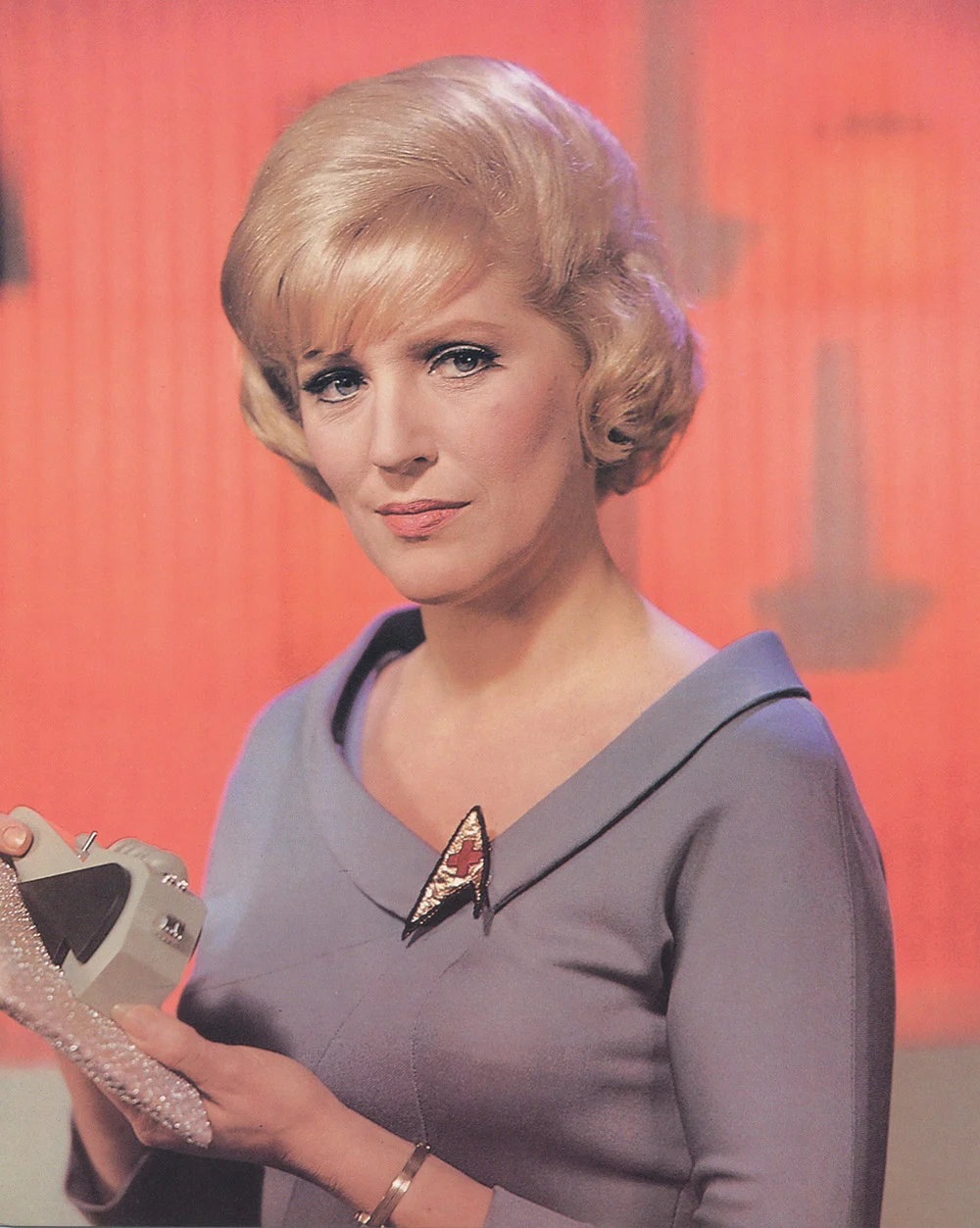
Majel Barrett Roddenberry remains the singular, gravitational center of the Star Trek universe, an actress whose influence spans the entirety of the franchise’s 60-year history. While often remembered as the spouse of creator Gene Roddenberry, her professional contributions were foundational, spanning four distinct recurring roles, a revolutionary approach to voice acting, and an enduring commitment to the fan community that preserved the franchise through its most precarious eras. Her trajectory from an Ohio-born theater aspirant to the "First Lady of Star Trek" serves as a microcosm for the evolution of women in science fiction television.
Early Career and the Desilu Foundation
Born Majel Leigh Hudec in 1932, she arrived in Southern California during the late 1950s with a sharp wit and a desire to master the craft of acting. Under the mentorship of Lucille Ball at Desilu Studios, Barrett developed a comedic timing and poise that would later define her performances. Her early television credits, including roles in Bonanza, The Untouchables, and Leave It to Beaver, established her as a reliable professional within the competitive landscape of mid-century Hollywood.
It was on the set of the military drama The Lieutenant in 1964 that she met Gene Roddenberry. Their professional collaboration quickly transitioned into a personal partnership that would alter the course of television history. As Roddenberry began developing the concept for a cerebral science fiction series, he cast Barrett as "Number One," the enigmatic, highly capable second-in-command of the USS Enterprise. In the pilot episode, "The Cage," Barrett portrayed a character whose cold, analytical efficiency defied the gender norms of 1960s television, marking a significant, albeit short-lived, milestone for female representation.
The Pivot: From Number One to Nurse Chapel
The subsequent rejection of the first Star Trek pilot by network executives at NBC remains one of the most studied pivots in media history. Internal records and interviews with contemporaries suggest that the refusal to accept a woman in a command position was a primary catalyst for the show’s requested retooling. Faced with an ultimatum to either remove the "pointy-eared alien" or the female commander, Roddenberry opted to retain Leonard Nimoy’s Spock.

Barrett’s response to this professional setback demonstrated the resilience that would characterize her career. Rather than exiting the franchise, she transitioned into the role of Nurse Christine Chapel, a character whose emotional depth provided a necessary counterpoint to the logical detachment of the Vulcan science officer. Simultaneously, she took on the voice of the Enterprise computer, creating an iconic, steady-state vocal identity that has persisted through six decades of technological evolution.
The Chronology of an Icon
- 1964: Barrett is cast as Number One in the initial Star Trek pilot, "The Cage."
- 1966–1969: Serving as Nurse Chapel, Barrett anchors the medical staff of the Original Series while voicing the ship’s computer.
- 1969: Barrett and Roddenberry marry in Japan, following the conclusion of the Original Series.
- 1970s–1980s: Barrett oversees Lincoln Enterprises, a pioneering venture in the distribution of franchise merchandise, ensuring the brand’s visibility during the decade-long hiatus.
- 1987–1994: Barrett introduces the character of Lwaxana Troi in Star Trek: The Next Generation, a role that showcased her ability to balance brassy comedy with profound dramatic weight.
- 2008: Barrett records her final performance as the voice of the Enterprise computer for the J.J. Abrams reboot film before passing away.
- 2024: The cremated remains of Majel and Gene Roddenberry are launched into deep space, symbolically reuniting them with the franchise they built.
Professional Dynamics and Legacy
Colleagues frequently cite Barrett’s "force of nature" personality as the key to her endurance. Jonathan Frakes, who worked closely with her on The Next Generation, noted that her self-identification as a "broad" was a badge of pride, reflecting a refusal to be constrained by the expectations of the era. Her influence extended behind the camera, where she functioned as an unofficial ambassador to the fandom.
Marina Sirtis, who portrayed Deanna Troi, recalled that Barrett’s influence on the cast was maternal and stabilizing. During a time when the Star Trek production environment was high-pressure, Barrett’s presence on set—often accompanied by Gene—provided a sense of continuity. Her ability to navigate the "men-only" spaces of the industry with intelligence and humor allowed her to maintain authority in a male-dominated environment without compromising her identity.
Technological and Cultural Impact
The implications of Barrett’s work reach far beyond traditional acting. Her voice, having been recorded extensively, became a blueprint for synthetic speech synthesis. The codename "Majel" for Amazon’s early Alexa development is a testament to the cultural ubiquity of her performance as the ship’s computer. Current efforts to digitize and preserve her voice for fan access, spearheaded by her son, Eugene "Rod" Roddenberry, highlight a continued commitment to the democratization of her legacy.
In the contemporary landscape of Star Trek: Strange New Worlds, the roles of Number One (played by Rebecca Romijn) and Nurse Chapel (played by Jess Bush) have been reimagined to fulfill the potential Barrett saw in them. Romijn’s discovery of Barrett’s original, annotated scripts—in which she manually corrected gendered pronouns—serves as a poignant reminder of Barrett’s quiet advocacy for equity. By crossing out "he" and replacing it with "she," Barrett was not merely reading lines; she was actively claiming space for the character she helped create.

Analysis of Institutional Influence
The longevity of Star Trek is often attributed to the scripts, the technology, and the ensemble cast, but the institutional memory provided by Barrett was arguably the franchise’s most vital asset. By overseeing merchandise and maintaining direct lines of communication with the fan community at conventions, she transformed Star Trek from a television series into a sustainable cultural institution.
Her refusal to harbor resentment over the "Number One" casting change allowed her to pivot effectively into other roles, such as Lwaxana Troi, which allowed for a more nuanced expression of her range. This adaptability provided the franchise with a bridge between the 1960s, the 1990s, and the modern streaming era.
Conclusion
Majel Barrett Roddenberry’s career was defined by an extraordinary capacity for transformation. Whether she was the stoic officer, the compassionate nurse, the diplomat mother, or the disembodied voice of the galaxy’s most famous ship, her contributions were consistently grounded in a sense of purpose. As current iterations of the franchise continue to deconstruct and expand upon her work, the industry acknowledges that the "First Lady of Star Trek" was, in reality, its most essential architect. Her legacy remains embedded in the cultural DNA of modern science fiction, proving that her impact was never limited to the screen, but rather, extended to the very framework upon which the entire Star Trek phenomenon was built.