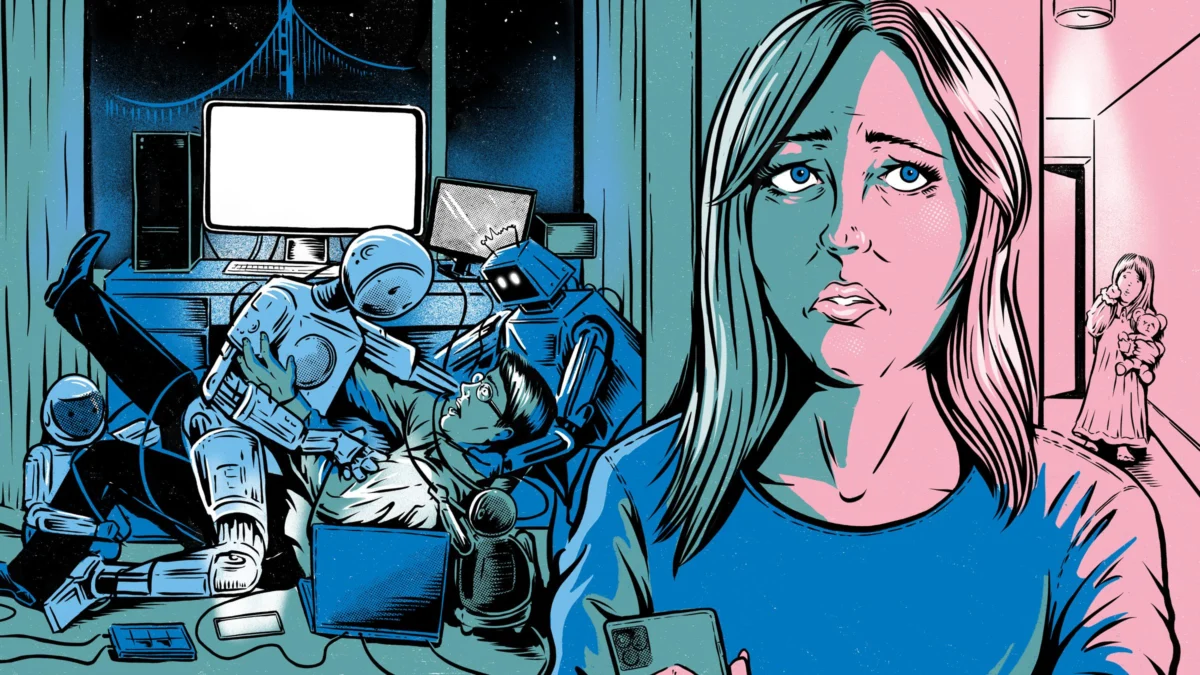
The rapid acceleration of artificial intelligence development has moved beyond the confines of research laboratories and corporate boardrooms, manifesting as a significant disruptive force within the domestic sphere. In technology hubs like the San Francisco Bay Area, the surge in AI investment and innovation is creating a distinct sociological phenomenon characterized by a widening gap in the lived experiences of tech-sector employees and their domestic partners. This shift, often described by those within it as the emergence of a "third party" in the marriage—the large language model (LLM)—is reshaping labor distribution, mental health outcomes, and the fundamental structure of family life.
The Emergence of the AI Domestic Crisis
The current AI boom is not merely a technological milestone but a cultural obsession that has saturated the private lives of its architects. Observers and family members of AI professionals report a "perfect storm" of professional pressure and existential intensity. In many households, particularly in Berkeley, Palo Alto, and San Francisco, the workday no longer concludes at traditional hours. Instead, the relentless pace of "vibe coding" and the perceived necessity of constant model iteration have led to a state of perpetual professional engagement.
For the spouses of these professionals, the result is often a secondary role as "Chief Existential Officer." While one partner focuses on disrupting industries or refining prompts for tools like Anthropic’s Claude Code or OpenAI’s GPT-4, the other is frequently left to manage the entirety of domestic labor and emotional support. This phenomenon has given rise to a self-identified cohort of "AI wives"—spouses who feel increasingly marginalized by a technology that demands the absolute attention of their partners.

Labor Market Disparities and the Gendered AI Gap
The domestic tension identified in tech-heavy regions is rooted in measurable labor market trends. According to recent industry reports, approximately 71 percent of AI-skilled workers in the United States are men. As of 2024, there are roughly 35,000 open AI roles across the country, with thousands more roles created in venture capital and ancillary tech services.
Yana van der Meulen Rodgers, chair of labor studies and employment relations at Rutgers University, suggests that what is occurring is a classic "labor market story" playing out along gendered lines. Rodgers notes that the AI boom has revived the concept of the "ideal worker"—an individual who dedicates their entire existence to a singular professional goal. This model inherently relies on a domestic partner to absorb the "care work" that the professional no longer has the capacity to perform.
Furthermore, data from the Harvard Business School suggests that women are approximately 20 percent less likely than men to utilize generative AI tools in their daily work. This is often a reflection of occupational segregation; women are disproportionately represented in sectors such as education, healthcare, and social services—industries that, while impacted by AI, do not currently center their professional identity around its development. The result is a compounding disadvantage: men are "riding the wave" of financial rewards and professional prestige, while women are managing the domestic fallout of that obsession.
A Chronology of Tech Obsession: From the Gold Rush to the Singularity
The current domestic strain in the Bay Area is part of a historical cycle of technological disruption. To understand the "AI wife" phenomenon, one must look at the precedents of previous booms:

- The 1840s Gold Rush: Men abandoned families to head west, driven by the prospect of immediate, life-changing wealth.
- The 1990s Dot-com Boom: The era of "sleeping under the desk" in SoMa, where founders sacrificed personal stability for market share.
- The 2010s Crypto Surge: A period marked by high-risk investment and a specialized vernacular that often excluded non-participating partners.
- The 2023–Present AI Explosion: Characterized by "existential dread" and a belief that missing the current window of development is a permanent professional failure.
Unlike previous booms, the AI surge is uniquely characterized by its perceived "intelligence." Partners report that the technology does not just take time away from the family; it replaces the quality of interaction. Husbands are reported to FaceTime from business trips not to check on children, but to show off a new coding breakthrough, treating the software as a "second baby" that requires 24-hour monitoring.
The Psychological Impact and the Role of Therapy
Clinicians in Northern California are reporting a surge in cases related to "tech-induced marital resentment." Bridget Balajadia, a clinician at Lupine Counseling in San Jose, notes that the "always-on" nature of the AI industry is uniquely corrosive to relationships. The pressure to respond to global developments in real-time means that boundaries at home are non-existent.
A particularly modern irony has emerged in these clinical settings: the use of AI as a mediator for marital strife caused by AI. Therapists report that some spouses are turning to ChatGPT to process their resentment or to seek advice on how to communicate with their tech-obsessed partners.
"I’ve already worked through this with my chat," is a phrase becoming increasingly common in therapy sessions. However, mental health professionals warn that this leads to "validation loops" where the AI simply mirrors the user’s feelings rather than challenging them to engage in the difficult work of interpersonal conflict resolution. In some extreme cases, users have reported that LLMs "validated" the idea of seeking emotional or physical intimacy outside the marriage because their partners were "emotionally unavailable" due to their AI careers.

Financial Volatility and the "AI or Bust" Mentality
The financial structure of the AI boom adds another layer of domestic stress. Many families in the Bay Area have their entire financial future tied to the success of a single startup or the performance of AI-related stocks. This "all-in" financial strategy means that if the "AI bubble" bursts, the impact on the household is catastrophic.
Interviewees indicate that their partners feel a desperate need to succeed in AI because they view it as the "last great shift" in technology. This leads to a high-stakes environment where men may cycle through multiple failed startups, losing significant capital, while their partners continue to provide the primary stable income or the domestic labor required to keep the household functioning.
The social monoculture of San Francisco and Oakland has exacerbated this feeling. Spouses report that it is nearly impossible to attend a social gathering without the conversation revolving entirely around large language models, venture capital funding, or the "singularity." This lack of professional diversity in social circles prevents families from disconnecting from the industry, leading to a sense of claustrophobia for those not employed in the sector.
Broader Implications for the Future of the American Household
As AI continues to integrate into the economy, the domestic divide may lead to several long-term shifts in family dynamics:

- Redefinition of Domestic Labor: The "care work" currently being performed by the partners of AI professionals may eventually be commodified or automated. Some AI founders are already predicting the arrival of "household robots" within the decade to mitigate the domestic strain their careers have caused.
- Increased Burnout and Mental Health Crisis: If the "ideal worker" model remains the standard for the AI industry, the rate of divorce and burnout in tech hubs is likely to rise.
- The "Vibe Coding" Shift: As coding becomes more accessible through AI, the "technical barrier" that currently separates the AI professional from their "non-tech" spouse may diminish. This could either bridge the gap or lead to a new form of "optimization" culture within the home.
The current situation highlights a fundamental tension in the modern economy: while technology aims to solve complex global problems, it often creates new, intimate ones. For the "sad wives of AI," the challenge is not just surviving the current technological shift, but ensuring that the human element of the household is not automated out of existence. The AI boom may be reshaping the world, but it is doing so at a significant cost to the traditional structures of support and partnership that have historically anchored the labor market.