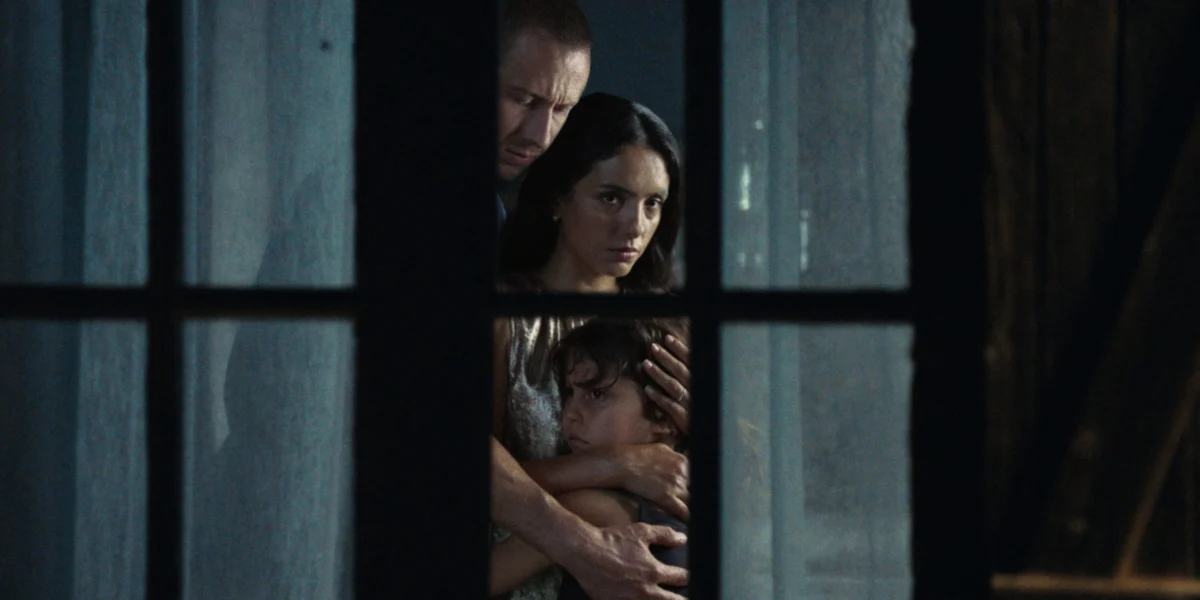
Léa Mysius’s "The Birthday Party," a film navigating the complexities of familial secrets and unexpected intrusions, made its competitive debut at the Cannes Film Festival, presenting a nuanced yet at times uneven exploration of psychological tension. Directed by Léa Mysius, who previously garnered attention at the festival with "The Five Devils," this latest offering adapts Laurent Mauvignier’s novel, bringing to the screen a story that delves into the fragile equilibrium of a family isolated on a remote marshland. The narrative centers on Thomas (Bastien Bouillon) and Nora (Hafsia Herzi), a couple whose secluded existence with their daughter Ida (Tawba El Gharchi) is disrupted by the arrival of a mysterious figure, Franck (Benoît Magimel), during preparations for Nora’s surprise birthday celebration. The film’s runtime of 103 minutes seeks to balance atmospheric dread with character-driven drama, a task that proves both ambitious and, at times, challenging to fully realize.
Genesis of a Tense Gathering: Cannes Context and Thematic Resonance
The 2022/23 Cannes Film Festival season, as indicated by the curated selection, has shown a directorial inclination towards thematic introspection, often reflecting societal anxieties and personal histories. In the wake of global lockdowns and a renewed focus on interpersonal dynamics, filmmakers have gravitated towards narratives exploring generational trauma, the psychological impact of isolation, and the power of memory and sensory experience. Mysius’s previous work, "The Five Devils," was noted for its innovative use of scent to navigate chronological shifts and familial burdens. "The Birthday Party," however, pivots from the fantastical to the grounded, employing a home invasion scenario as a catalyst to unearth buried secrets within a seemingly ordinary family unit. This thematic focus aligns with a broader trend observed at festivals, where stories grappling with the lingering effects of past events and the vulnerability of domestic spaces have resonated strongly with audiences and critics alike. The film’s adaptation of Mauvignier’s novel suggests a deliberate choice to translate literary suspense and psychological depth into a visual medium, a process that often involves navigating the inherent challenges of fidelity versus cinematic interpretation.
The casting of "The Birthday Party" brings together a compelling ensemble. Hafsia Herzi, known for her roles in films like "A Woman’s Life," embodies Nora, a character whose quiet apprehension becomes a focal point as the narrative unfolds. Benoît Magimel, a veteran of French cinema with a versatile range, takes on the pivotal role of Franck, an ex-convict whose presence injects immediate tension. Bastien Bouillon portrays Thomas, the husband and father navigating the escalating crisis, while Tawba El Gharchi as Ida represents the younger generation caught in the crosscurrents of familial history. The presence of Monica Bellucci as Cristina, the sole neighbor and a figure of limited social contact, adds a layer of intrigue and underscores the family’s isolation. The ensemble’s collective experience promises a layered performance, crucial for conveying the psychological underpinnings of the story.
Narrative Unfolding: The Isolated Family and the Uninvited Guest
The core narrative of "The Birthday Party" is rooted in the isolation of its protagonists. Thomas, Nora, and Ida reside in a remote marshland, a setting that immediately establishes a sense of vulnerability and limited external support. Their social circle is confined to Cristina, their neighbor, a relationship that, while present, offers little in the way of immediate recourse. The impending surprise birthday party for Nora is intended as a moment of joy and celebration, a deviation from their otherwise mundane existence. However, this planned festivity becomes the backdrop for an abrupt and unwelcome intrusion.
The arrival of Franck, an ex-convict who has been released from prison for a year, accompanied by a pair of henchmen, shatters the tranquility of the marshland dwelling. Franck’s motive is directly tied to Nora’s past, initiating a confrontation that forces the family to confront hidden truths and long-buried secrets. This setup positions "The Birthday Party" as a psychological thriller, where the threat is not merely physical but deeply entwined with the characters’ histories and the psychological toll of their past actions. The film’s premise suggests a deliberate exploration of how external pressures can unearth internal conflicts, transforming a domestic space into a stage for reckoning.
Adaptation Challenges and Mysius’s Approach
The transition from Laurent Mauvignier’s novel to the screen presents inherent challenges, particularly concerning the author’s distinctive literary style. Mauvignier’s prose is characterized by its flowing, often lengthy paragraphs with sparse punctuation, frequently shifting perspectives between characters. This technique, when applied to a home invasion plot, can create a powerful sense of urgency and immersion, mirroring the disorienting experience of the characters. The original text’s ephemeral success is attributed, in part, to this stylistic choice, which amplifies the narrative’s inherent tension.
Léa Mysius, in her adaptation, chooses to filter the narrative primarily through the perspectives of the two female protagonists: Nora and Ida. This directorial decision aims to highlight the generational impact of trauma and the complex relationship between mothers and daughters. The film draws parallels with Mysius’s previous work, "The Five Devils," in its scrutiny of generational trauma and the "sins-of-the-mother" trope, albeit within a more conventional home-invasion framework. While the screenplay endeavors to evoke a nebulous sense of stress through finer details—such as Thomas’s financial burdens, Cristina’s struggling artistic career, and the home invader’s mental health issues—the effectiveness of this approach is debated. The inclusion of an animated sequence, intended to push the film’s aspirations, is noted for its ambition but also for its perceived inability to maintain narrative momentum.
Character Dynamics and Performances Under Pressure
The central conflict of "The Birthday Party" is amplified by the dynamic between Nora and Franck. Their shared past, though explained with what is described as a "whimper," serves as the undercurrent of their confrontation. Benoît Magimel’s performance is highlighted as a source of adrenaline for the film, injecting a palpable menace that leans more towards a horror antagonist than a typical thriller villain. His quiet intensity is said to complement the film’s generally muted tone, contributing to the pervasive sense of unease.
The arrival of Franck’s henchmen further escalates the stakes. The brutal killing of the family dog early in the film serves as a stark warning of the danger posed by these characters, leaving no doubt about their ruthlessness. As more guests arrive for the party, the situation becomes increasingly fraught with tension. Franck’s efforts to maintain control to achieve his objectives clash with Thomas and Nora’s desperate search for a safe escape route. This dynamic creates a claustrophobic atmosphere, where the perceived safety of a social gathering devolves into a desperate struggle for survival.
Pacing, Atmosphere, and Cinematographic Choices
A significant point of discussion surrounding "The Birthday Party" is its pacing and the effectiveness of its suspense-building. The film is characterized as a "slow-burning thriller," with the anticipated violence taking a considerable amount of time to manifest. While this deliberate pacing aims to build psychological tension, it is also criticized for rendering the suspense elements as "irrelevant fodder," particularly when compared to the more immediate and visceral suspense found in the novel.
Despite these criticisms, Mysius’s direction is acknowledged for its maturity, with a keen eye for sharpening moods within each distinct room of the house. The use of implicit religious apparel is noted as an attempt to layer the narrative’s revelations. However, the screenplay is described as feeling "stuck in its first draft," failing to fully integrate these aesthetic choices into the narrative flow.
The film’s visual presentation is significantly enhanced by cinematographer Paul Guilhaume’s work. The shadow-heavy lighting contributes to the dark and oppressive atmosphere, particularly in the climactic confrontation set in an open field under moonlight. This visual approach effectively underscores the isolation and vulnerability of the characters during the film’s most intense moments.
Broader Implications: AI in Cinema and Festival Trends
Beyond the film’s narrative and thematic concerns, "The Birthday Party" has also drawn attention for its incorporation of artificial intelligence (AI) in a specific scene. During Ida’s viewing of a television program, a machine-manufactured anime sequence is presented. This moment has been contextualized within a larger discourse at the Cannes Film Festival regarding AI’s burgeoning role in the film industry. Discussions ranged from AI-generated short film programs to its use in documentaries and commercials.
The use of AI in "The Birthday Party" has been met with a degree of skepticism, with the question posed: "Would it have cost that much more to license an episode of ‘Bluey’ instead?" This suggests a concern that the integration of AI in this instance may stem from a desire for novelty or cost-saving rather than a truly essential narrative function. The broader implication is the industry’s ongoing debate about the ethical and creative boundaries of AI in filmmaking, and whether its application enhances or detracts from the artistic integrity of a project.
Conclusion: A Mature Yet Flawed Return to Cannes
As "The Birthday Party" closed out the 2026 Cannes Film Festival’s In-Competition strand, it represented a continuation of the festival’s engagement with complex thematic material. Léa Mysius’s return to the Croisette, while marked by its assured direction and a capable cast, is ultimately seen as a film that, despite its strengths, is hampered by unignorable flaws. The dissection of generational trauma and familial secrets remains a compelling core, but the film’s pacing issues and screenplay weaknesses create a muted experience that falls short of a truly celebratory cinematic event. The film’s potential for a more impactful and fulfilling experience is, in this assessment, obscured by the persistent narrative and structural challenges that prevent it from fully realizing its ambitious thematic goals.