



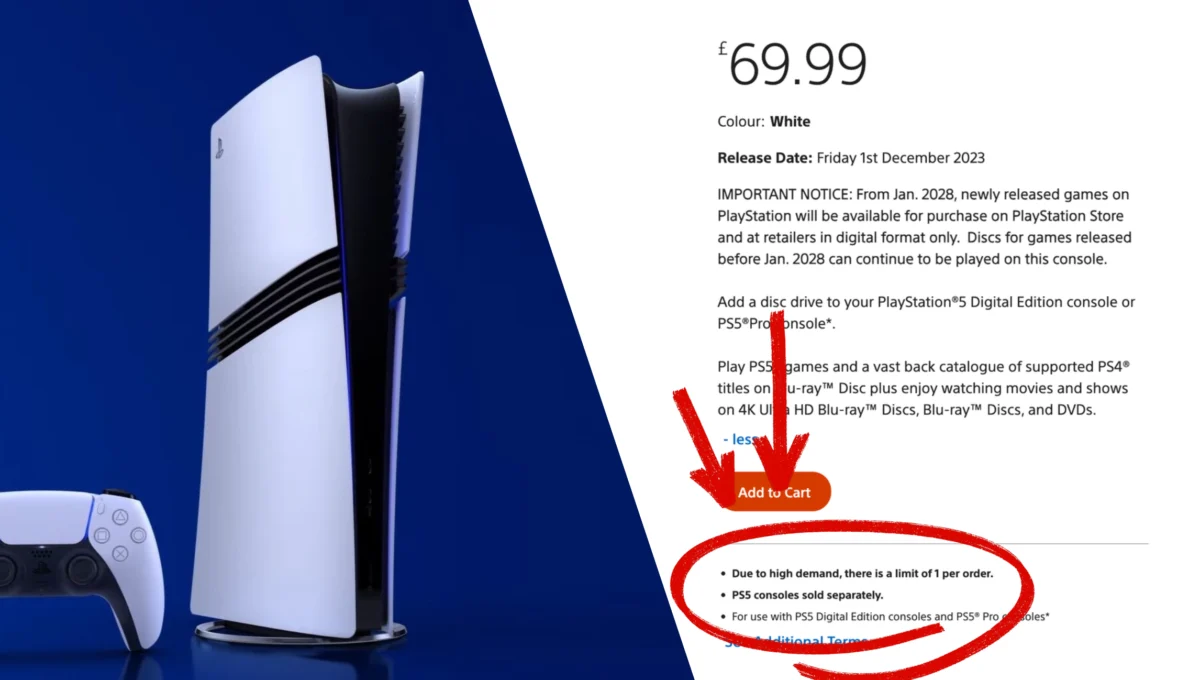
The global gaming landscape is currently witnessing a stark divergence between corporate strategy and consumer demand as Sony Interactive Entertainment continues to strictly ration its supply of attachable disc drives. This supply constraint persists despite the company’s recent confirmation that it will cease the production of physical software media by early 2028. The move to limit sales to "one per order" on the official PlayStation Store highlights a lingering appetite for physical media that appears to be outstripping Sony’s current logistical allocations, even as the manufacturer prepares to sunset the era of the game disc.
On July 1, Sony officially announced a definitive timeline for its transition to an all-digital ecosystem. Effective January 2028, all newly released software for the PlayStation platform will be distributed exclusively via digital channels. While physical retailers will continue to stock PlayStation products, these will manifest as digital download codes or "point-of-sale activated" (POSA) cards rather than traditional optical discs. This strategic pivot, which Sony attributes to shifting "consumer trends" and the streamlining of global supply chains, effectively signals that the anticipated PlayStation 6 will launch as a digital-only console, devoid of an internal disc drive.
The Supply Chain Paradox: High Demand for a Sunset Format
Despite the announced obsolescence of physical media, the demand for the PlayStation 5 attachable disc drive remains remarkably high. As of July 4, the PlayStation Store has maintained a restrictive purchasing policy, citing "high demand" as the primary reason for limiting customers to a single unit. This hardware accessory, retailing for approximately £69.99 ($79.99), was introduced alongside the "Slim" revision of the PlayStation 5 to provide modularity for consumers who still rely on physical libraries.
The irony of the situation has not been lost on industry analysts or the gaming community. Market observers note that Sony has been rationing these drives since at least November 2023, suggesting that the "high demand" is not a temporary surge but a sustained market reality. The persistence of this shortage for nearly two years indicates either a significant underestimation of the physical media market by Sony or a deliberate tightening of the supply chain to encourage digital adoption ahead of the 2028 deadline.
On community forums such as ResetEra, the reaction has been a blend of frustration and resignation. Users have pointed out the contradiction in Sony’s messaging: the company is justifying a digital-only future based on "consumer trends" toward digital downloads, yet it cannot produce enough hardware to satisfy those who still wish to use physical discs. This disconnect suggests that while digital sales do account for the majority of software revenue, a vocal and active minority—or perhaps a silent majority of hardware owners—still views physical compatibility as a vital feature.
A Chronology of the Digital Shift
The transition toward a digital-only PlayStation ecosystem has been a decade in the making, marked by several key milestones:
- November 2013: The PlayStation 4 launches, featuring a mandatory installation process for all disc-based games, effectively turning the disc into a physical "license key" rather than a medium from which the game is actively played.
- November 2020: Sony launches the PlayStation 5 with two distinct SKUs: a standard model with a disc drive and a "Digital Edition" at a $100 price discount, testing the waters for a disc-less future.
- October 2023: Sony unveils the PlayStation 5 "Slim," replacing the previous models with a single modular design. The disc drive becomes an optional, detachable peripheral.
- July 2024: Sony officially confirms the January 2028 cutoff for physical disc production, providing a three-and-a-half-year "sunset" period for collectors and retailers.
- January 2028: The projected date for the full transition to digital-only releases, coinciding with the mid-to-late lifecycle of the current generation and the potential arrival of next-generation hardware.
Market Data and Economic Incentives
The move to eliminate physical media is driven by powerful economic incentives. According to Sony’s recent financial reports, digital software sales and PlayStation Plus subscriptions now account for over 80% of total software revenue. By removing the physical disc, Sony eliminates several layers of costs, including manufacturing, packaging, shipping, and the "middleman" margins taken by retailers like GameStop, Best Buy, and Amazon.
Furthermore, a digital-only ecosystem grants Sony total control over the secondary market. Physical discs allow for the existence of a robust used-game economy, where consumers can trade, sell, or lend their games. In a digital-only environment, the "used game" ceases to exist, forcing consumers to purchase all software directly through the PlayStation Store at prices set by the publisher. This shift significantly increases the "Long Tail" revenue of a title, as prices can be maintained at a higher level for longer periods compared to the rapid price depreciation seen in the physical retail market.

Industry-Wide Trends: The "Project Helix" Comparison
Sony is not alone in this trajectory. Internal documents and industry reports suggest that Microsoft is pursuing a similar path with its next hardware iteration, currently referred to under the codename "Project Helix." Microsoft has already seen massive success with the Xbox Series S, a digital-only budget console that reportedly accounts for more than half of its current-generation hardware sales in several territories.
Rumors within the industry suggest that Microsoft is exploring a "digital entitlement" system, which would allow users to verify their existing physical disc libraries at participating retailers to receive a permanent digital license, thereby easing the transition to disc-less hardware. Whether Sony will implement a similar "legacy" program for its vast library of PS4 and PS5 discs remains to be seen, though the current notice on the PlayStation Store confirms that "Discs for games released before Jan. 2028 can continue to be played" on compatible hardware.
Implications for Preservation and Retail
The end of physical PlayStation discs carries significant implications for game preservation. Organizations dedicated to archiving video game history have long relied on physical media as a permanent, offline record of a game’s "1.0" state. As the industry moves toward digital-only distribution, the longevity of a game becomes tethered to the existence of the storefront and the servers that host the data. The closure of the PlayStation 3 and Vita storefronts—which Sony initially attempted in 2021 before reversing the decision due to public outcry—serves as a cautionary tale for the fragility of digital libraries.
For traditional retailers, the January 2028 deadline represents an existential threat to a core business model. Retail giants like Best Buy have already begun phasing out physical media in other categories, such as 4K Blu-ray movies and DVDs. Gaming was the final frontier for physical media at big-box retail. The shift to digital cards and codes will require these stores to reinvent their gaming departments or risk losing foot traffic entirely to online platforms.
Technical Analysis of the Attachable Drive
The hardware at the center of the current rationing—the PS5 Disc Drive (Model CFI-ZDD1)—is a sophisticated piece of equipment that requires an internet connection for initial "pairing" with the console. This DRM (Digital Rights Management) requirement has been a point of contention for technical enthusiasts, as it implies that if Sony’s verification servers were ever to go offline, the drive could not be registered to a new or factory-reset console.
The high demand for this specific peripheral suggests that many "Digital Edition" owners are opting to retroactively add disc compatibility, perhaps in response to the news of the 2028 deadline. Consumers appear to be "future-proofing" their setups, ensuring they have the hardware necessary to play their existing collections and any physical releases launched between now and the end of 2027.
Conclusion: The Final Chapter for Physical Media
Sony’s decision to ration disc drives while simultaneously announcing the end of discs creates a confusing period of transition for the PlayStation brand. While the company is clearly looking toward a streamlined, high-margin digital future, the current "high demand" for physical hardware proves that the consumer base is not moving as quickly as the corporate strategy dictates.
As 2028 approaches, the industry will be watching closely to see if Sony can resolve its hardware supply issues or if the rationing of disc drives is simply the first step in a managed decline of physical media. For the millions of players with shelves full of Blu-ray cases, the message from Sony is clear: the era of ownership is ending, and the era of the digital license is nearly here.