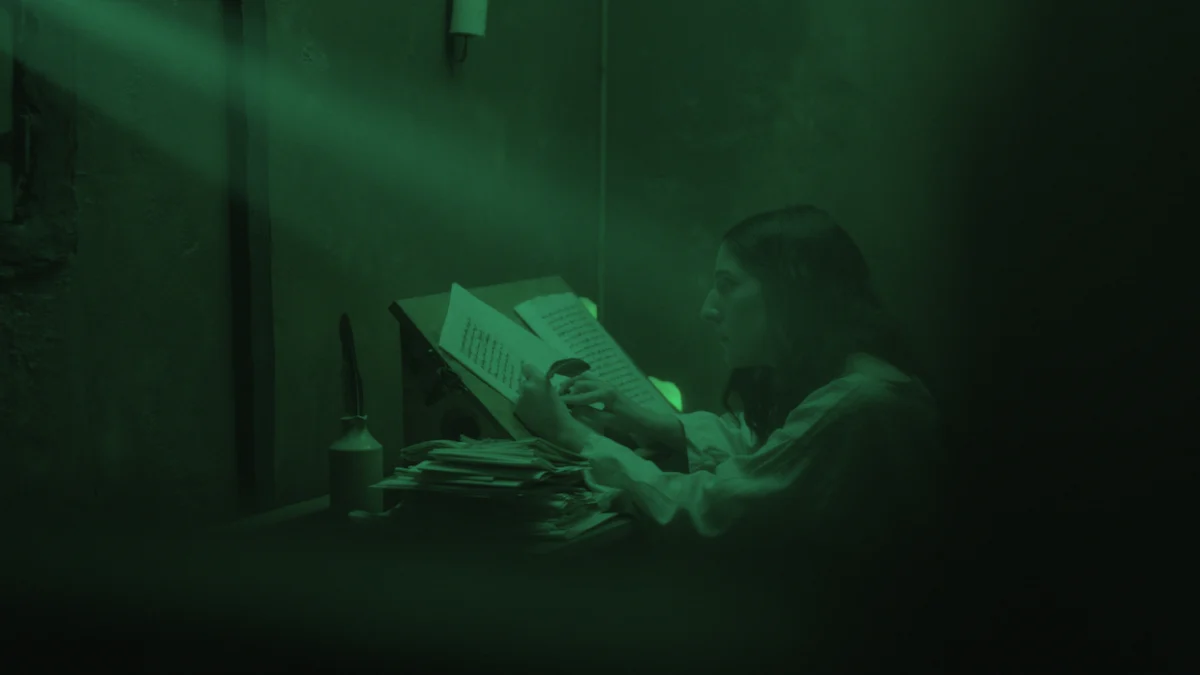
The independent film landscape in New York City has recently been marked by the arrival of Revelations of Divine Love, a 14th-century-set chamber piece directed by Caroline Golum. The film, which explores the life and spiritual legacy of Julian of Norwich, represents a significant intersection of historical research, tactile production design, and independent filmmaking philosophy. Following its world premiere at FIDMarseille 2025, the production has moved into a localized theatrical rollout, beginning with a run at Anthology Film Archives on March 27, facilitated by the distributor Several Futures. The film is scheduled for subsequent screenings at the Roxy Cinema on April 17 and the Spectacle Theater on April 24, signaling a concentrated effort to engage the city’s cinephile community and historical enthusiasts alike.
The Historical Significance of Julian of Norwich
At the center of the film is Julian of Norwich, portrayed by Tessa Strain. Julian, an English anchorite of the Middle Ages, is a figure of immense literary and theological importance. She is credited with writing the first known English-language book authored by a woman, titled Revelations of Divine Love (or Sixteen Revelations of Divine Love). The narrative of the film focuses on a pivotal moment in 1373 when, at the age of 30, Julian suffered a severe illness that brought her to the brink of death. During this period, she experienced a series of sixteen visions, or "showings," centered on the Passion of Christ and the nature of divine love.
Following her recovery, Julian requested to be formally "enclosed" as an anchorite, a type of religious hermit who lived in a permanent cell attached to a church—in her case, St. Julian’s Church in Norwich. This life of voluntary isolation allowed her to contemplate her visions and record them, initially in a "Short Text" and later in a much more expansive "Long Text" written decades later. Her work is noted for its optimistic theology, famously summarized in the phrase "All shall be well, and all shall be well, and all manner of thing shall be well," and its unusually maternal imagery for the divine.
Production Design and the Aesthetic of the Handmade
A defining characteristic of Golum’s adaptation is its "homespun" aesthetic, which rejects the sleek, computer-generated imagery typical of modern historical epics in favor of physical craftsmanship. The production utilized carved foam to replicate medieval stonework, miniatures to represent architectural scales, and meticulously crafted props and costumes that evoke the 14th century through a lens of artisanal dedication.
The film features titles created with digital calligraphy in the style of the Quay Brothers, further emphasizing a commitment to a specific, often surreal, visual grammar. Golum has cited the influence of Roger Corman, the legendary producer and director known for his efficient, high-impact filmmaking methods. This "high-effort" approach to low-budget filmmaking has garnered attention from established figures in the industry, most notably the Canadian surrealist director Guy Maddin. Maddin, whose career spans nearly four decades with works such as My Winnipeg and The Forbidden Room, has lauded the film’s "aggressive" take on the period piece, describing the result as both "beautiful and smart."
The Creative Dialogue: Golum and Maddin
The release of Revelations of Divine Love has been accompanied by a series of high-profile intellectual exchanges, including an interview between Golum and Maddin. Their discussion highlights a shared philosophy regarding the "trance-like" state of filmmaking and the obsessive nature of historical recreation. Maddin, known for his collage-like aesthetic and exploration of "dream logic," noted a parallel between the religious ecstasy of a mystic and the intense focus required to complete an independent film.
Golum’s research into the 14th century extends beyond the spiritual to the material realities of the era. During production discussions, she highlighted the pervasive nature of the Black Death, which first arrived in England in 1348. Although the film does not lean into "gore territory," the historical context of the plague informs the urgency and physical intensity of Julian’s visions. Golum noted that the trade networks of the time—including the Silk Road and the Hanseatic League—facilitated the movement of both goods and disease, a reality that medieval society managed through early concepts of quarantine (from the Italian quaranti, or forty days).
Comparative Analysis: The Medieval Church and Modern Technology
One of the more provocative analytical threads emerging from the film’s promotional cycle is Golum’s comparison between the medieval Roman Catholic Church and the modern internet. In her view, the Church in the 14th century functioned as a pervasive "network" that governed social behavior, time, and thought, much like the digital infrastructure of the 21st century.

"Even when you’re not on the internet, it’s still there and you’re still thinking about it," Golum observed, drawing a parallel to how a medieval peasant or merchant would relate to the Church. This comparison extends to the concept of "hallucinations" and "visions." While Julian’s experiences were framed through a theological lens, Golum points to modern anxieties regarding Artificial Intelligence and the "hallucinations" of large language models as a contemporary equivalent of grappling with information that exists outside of immediate, tangible reality. The film chooses to take Julian’s visions at face value, respecting the historical and spiritual logic of the 1300s rather than applying a retrospective psychological diagnosis.
Timeline of Development and Release
The journey of Revelations of Divine Love from conception to screen spans nearly a decade.
- Spring 2017: Caroline Golum first encounters the history of Julian of Norwich through a research paper by Dr. Lawrence Bond. This marks the beginning of a nine-year obsession with the subject.
- 2018–2023: Development and production phases, characterized by the labor-intensive fabrication of sets and props.
- July 2024: The film completes initial production and prepares for the festival circuit.
- 2025: World premiere at FIDMarseille, a prominent festival for international cinema and documentary-fiction hybrids.
- March 27, 2026 (Projected): The film opens at Anthology Film Archives in New York City.
- April 17, 2026: Scheduled screening and Q&A at the Roxy Cinema.
- April 24, 2026: Scheduled run at the Spectacle Theater.
The New York City release is particularly notable for its inclusion of cameos from the local film scene, featuring critics, programmers, and fellow directors. This "cinema stalwarts" presence roots the film in the very community that supports avant-garde and independent theatrical exhibition.
Institutional Support and Distribution
The distribution of Revelations of Divine Love by Several Futures reflects a growing trend in the independent sector where boutique distributors focus on high-concept, aesthetically distinct works that might be overlooked by larger streaming platforms. The selection of venues like Anthology Film Archives—founded by Jonas Mekas and others to preserve and exhibit essential cinema—positions Golum’s work within a lineage of experimental and uncompromising filmmaking.
The film has also found an audience in academic and niche settings, such as Brandeis University, where screenings have prompted discussions on the intersection of medieval history, gender studies, and religious mysticism. The interest from such institutions underscores the film’s utility as both a piece of art and a historical inquiry.
Impact and Future Directions
The critical reception of Revelations of Divine Love suggests a renewed interest in "tactile" cinema. As digital tools become more ubiquitous, filmmakers like Golum and Maddin are finding success by leaning into the "high-effort" nature of physical production. This approach creates a "sense of place and time" that resonates with audiences seeking an alternative to the standardized look of contemporary content.
Looking forward, Golum has indicated a departure from the medieval period for her next project. She is reportedly developing a satire of the "manosphere" styled after the comedic sensibilities of Jerry Lewis. This transition from 14th-century mysticism to contemporary gender politics via 1960s-style slapstick suggests a versatile and unpredictable career path, unified by a consistent commitment to obsessive, research-driven filmmaking.
For now, Revelations of Divine Love stands as a testament to the enduring power of Julian of Norwich’s words and the capacity of independent cinema to bridge the gap between the medieval past and the modern present. Through its use of foam stone and fever dreams, the film captures a unique moment in human history when the walls of a single room were wide enough to contain the entire universe.