John Leguizamo, an actor celebrated for a prolific career spanning four decades, has achieved what he describes as the "zenith" of his artistic journey with his pivotal role as Eumaeus in Christopher Nolan’s highly anticipated cinematic adaptation of The Odyssey. This transformative performance marks a significant departure from the typecast roles that have often defined his extensive filmography, positioning him at the heart of one of the year’s most ambitious blockbusters. The film, which has been met with extraordinary global fanfare, notably contains spoilers regarding key plot developments within Nolan’s interpretation of Homer’s epic.
Leguizamo’s career, a testament to resilience and versatility, has seen him navigate the complexities of Hollywood, often facing limitations imposed by industry perceptions. With notable recurring collaborations with visionaries like Baz Luhrmann (Romeo + Juliet, Moulin Rouge!) and Jon Favreau (Chef, The Mandalorian), Leguizamo has consistently demonstrated a profound acting range. However, he openly acknowledges the persistent challenge of being seen beyond predetermined molds. "It’s as if, because I’m a Latin man, I always have to play the villain or the aggressor or a perp," he reflects, highlighting a systemic issue prevalent in the entertainment industry where minority actors are frequently relegated to stereotypical portrayals.
His critical acclaim and numerous accolades, including Emmy and Tony Awards for his groundbreaking solo stage performances such as Latin History for Morons and Freak, have long underscored a depth and breadth of talent often underutilized on the big screen. These one-man shows, celebrated for their sharp wit, insightful social commentary, and deeply personal narratives, served as powerful reminders of Leguizamo’s capacity for nuanced storytelling and emotional vulnerability, qualities that Nolan evidently recognized and sought to harness for The Odyssey.
Nolan’s Vision: A Departure from Tradition
Christopher Nolan, an Oscar-winning director renowned for his ambitious narratives and technically innovative filmmaking, approached Leguizamo with a distinct vision for Eumaeus, a character he deliberately expanded from Homer’s original text. Nolan, whose filmography includes critically acclaimed blockbusters like Inception, Dunkirk, and Oppenheimer, is known for his meticulous attention to detail and his ability to reimagine established genres. His decision to cast Leguizamo in one of The Odyssey‘s most significant roles speaks volumes about his commitment to unconventional casting and character development.
In Nolan’s rendition, Leguizamo portrays Eumaeus, the steadfast and grief-stricken swineherd loyal to Odysseus (played by Matt Damon). Far from a peripheral figure, Eumaeus emerges as a central emotional anchor, grappling with his master’s prolonged absence and the looming threat to Odysseus’s family and kingdom. He astutely operates behind the scenes, offering sagacious counsel to Odysseus’s son, Telemachus (Tom Holland), on how to assert leadership, and strategically maneuvering to safeguard Odysseus’s wife, Penelope (Anne Hathaway), and their estate from the encroaching chaos in Ithaca. This portrayal allowed Leguizamo to explore a spectrum of emotions—loyalty, sorrow, hope, and quiet defiance—that have rarely been afforded to him in major studio productions.
The resultant performance has been widely lauded as "delicate, moving, heartbreaking," and critically positioned as the "heartbeat of the film." Particularly resonant are the scenes depicting Eumaeus’s profound emotional release upon Odysseus’s disguised return, where his suppressed grief and unwavering devotion surface with raw intensity. This intimate portrayal, Leguizamo notes, aligns more closely with his personal sensibilities than many of his previous screen roles.
The Genesis of a Career-Defining Role
The journey to this pivotal role began with a two-hour lunch between Leguizamo and Nolan, a meeting that profoundly impacted the actor. Nolan, known for his reserved public persona, engaged Leguizamo in a deeply personal conversation, sharing tales of his own life, aspirations, and struggles. This unexpected vulnerability from the acclaimed director fostered an immediate connection, laying the groundwork for Leguizamo’s casting. "Wow, this man is so present and so vulnerable," Leguizamo recounted, reflecting on the unusual candor that preceded the role offer.

When asked about Nolan’s specific choice for him, Leguizamo expressed his own curiosity. "I don’t know either!" he admitted, before speculating that Nolan might have perceived his inherent sense of loyalty, a virtue Leguizamo holds in high regard. "He’s the most loyal character in Western literature," Nolan reportedly told him, a description that deeply resonated with Leguizamo, who identifies loyalty as a cornerstone of Latin culture and a significant personal trait. This perceived alignment between character and actor undoubtedly informed Nolan’s unconventional casting decision, seeking an authenticity that transcended superficial ethnic markers.
Method Acting and Physical Transformation
To embody Eumaeus, Leguizamo immersed himself in an intense method acting process. Recognizing that Eumaeus is a largely underdeveloped character in Homer’s original epic, Leguizamo meticulously researched the limited available information online, delving into Greek vases and sculptures for behavioral clues. Nolan’s expansion of the character allowed Leguizamo significant creative freedom to build Eumaeus’s inner world.
The role demanded a profound physical transformation. Leguizamo was aged up considerably with intricate aging makeup, a process that took six hours on the first day, expertly applied by Luisa Abel. This involved specialized techniques to stretch and glue his skin to create wrinkles and age spots, combined with five hours of hair bleaching over two days, as both he and Nolan eschewed wigs.
Crucially, Eumaeus is portrayed as blind in Nolan’s film, a creative choice Leguizamo suspects might be a subtle nod to the traditionally blind Homer. To achieve this, Leguizamo wore specially fabricated, hand-painted lenses designed to simulate cataracts in both eyes. This visual impairment deeply influenced his performance. To prepare, Leguizamo studied a high school friend who is legally blind, and then engaged in immersive exercises, navigating his own home with the lights off, memorizing furniture and spaces to understand the nuances of movement and perception without sight. "I couldn’t really see," he affirmed, highlighting the authenticity of his portrayal.
Leguizamo’s method approach extends beyond research and physical imitation. He describes it as "going through something," not merely imitating an experience. On set, Nolan reportedly observed Leguizamo’s process with fascination, watching him "working myself into a mood. I’m talking to myself, jumping up and down, hitting myself, yelling, crying." This intense internal work, Leguizamo believes, fundamentally changed his acting, allowing him to tap into "really difficult, painful emotions from the depth of my soul."
The Rigors of Epic Filmmaking and Nolan’s Directorial Style
Filming The Odyssey was an epic undertaking, characterized by its grand scale and challenging practical demands. Leguizamo recalled shooting scenes on a 900-foot cliff, battling crashing winds and navigating treacherous terrain where even breaking plants could lead to blindness. Despite the inherent risks, he emphasized the meticulous safety measures provided by the stunt crews.
Amidst these colossal backdrops, Nolan maintained an intensely intimate directorial style. Unlike many contemporary directors who monitor performances from "Video Village" (a remote viewing station), Nolan adhered to an old-school approach, standing directly behind the IMAX camera. "He’s so present because he stands right behind the camera, old-school," Leguizamo explained. This direct engagement fostered a profound sense of being "seen" by the director, enabling Leguizamo to delve into moments of extreme vulnerability, even with a massive 300-pound camera looming over him in confined spaces like Eumaeus’s shack.
A particular highlight for Leguizamo was filming his fever-dream scene. Enduring freezing temperatures in minimal attire on the exposed cliffside, Nolan’s empathy shone through when he removed his own coat and draped it over Leguizamo. This gesture, witnessed by Matt Damon, even prompted a lighthearted complaint from Damon, "I’ve been in the ocean for six months being whipped around and you give him the coat!"—a moment that underscored the unique bond forged on set.

Global Acclaim and Industry Impact
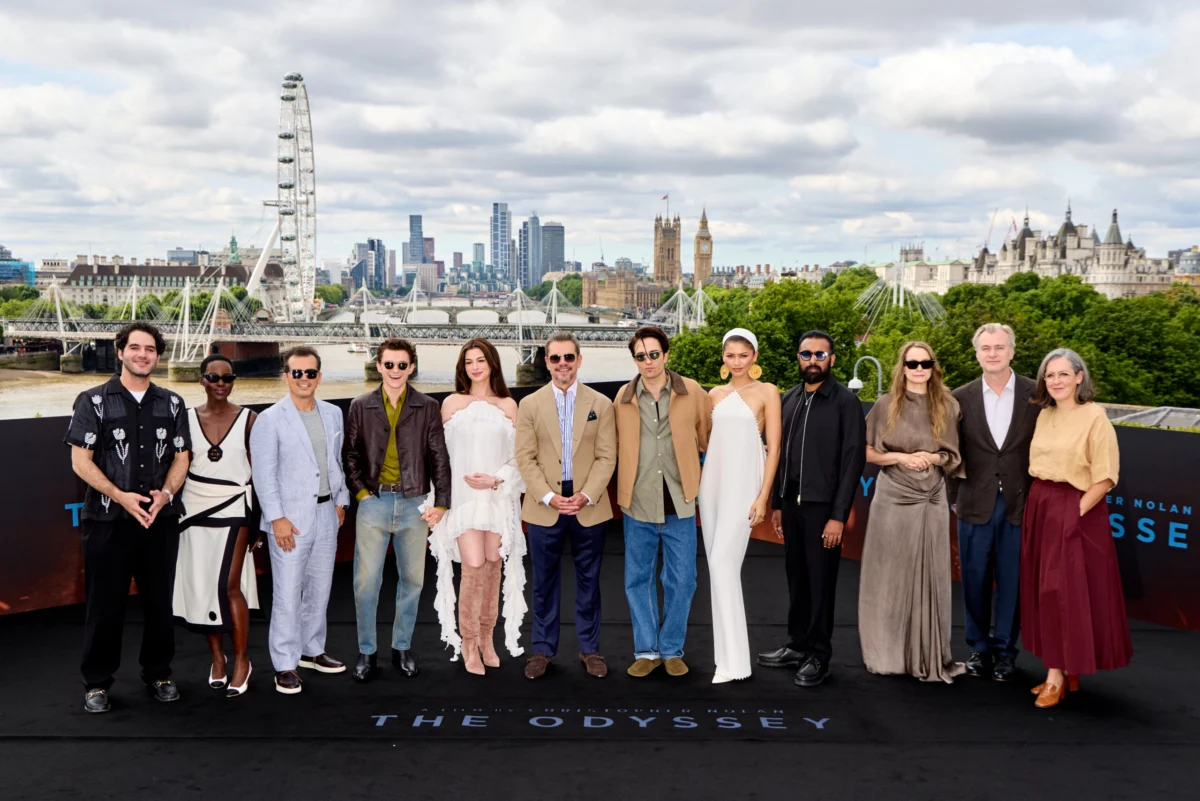
The global rollout of The Odyssey has been nothing short of spectacular, described by Leguizamo as "insane." The London premiere, a grand spectacle featuring a life-sized Trojan Horse and a star-studded lineup that included Lupita Nyong’o, Charlize Theron, Zendaya, Tom Holland, Anne Hathaway, Matt Damon, Robert Pattinson, Benny Safdie, Himesh Patel, and Samantha Morton, solidified the film’s status as a major cultural event. Leguizamo noted the challenge of fitting such an ensemble into a single red carpet photo, necessitating a "prom-style, sideways" arrangement.
Beyond the grand public events, Leguizamo cherished the more intimate moments with his castmates and Nolan. Dinners with Nolan, his wife Emma Thomas, and fellow stars, and casual interactions with Matt Damon and his family, or Zendaya and Tom Holland, provided glimpses into the genuine camaraderie that developed during production.
Perhaps one of the most significant implications of The Odyssey, particularly its casting, is its contribution to breaking down long-standing barriers in Hollywood. Leguizamo passionately praised Nolan for challenging the traditional "all white and all British-sounding" period piece paradigm. The inclusion of American accents and a diverse cast, he argues, makes the film "more accessible, feels more real." He drew parallels to the groundbreaking success of Lin-Manuel Miranda’s Hamilton, which demonstrated the power of "colorblind casting" to make historical narratives vital and relatable. Leguizamo emphasized, "We were all around back then. It wasn’t like we just appeared out of nowhere as a spontaneous generation," asserting the historical inaccuracy of exclusively white period dramas.
The Zenith: A Legacy Cemented
For John Leguizamo, this experience represents a profound personal and professional validation. To be chosen by a visionary like Christopher Nolan for such a significant and atypical role is, in his words, an "incredible compliment" that he will carry for life. "I feel so arrived, in a way," he stated, articulating a sense of fulfillment that comes from seeing his cumulative talent and hard work culminate in this "magnum opus."
The bond formed with Matt Damon, both on and off-screen, further enriched the experience. Their connection, evident in their continued friendship—Damon attending Leguizamo’s play, and their shared experience at a World Cup match—speaks to the authentic chemistry that translates to their characters’ deep loyalty.
Leguizamo’s portrayal of Eumaeus in The Odyssey is more than just another role; it is a testament to an actor’s unwavering commitment to his craft and a powerful statement on the evolving landscape of cinematic representation. By casting Leguizamo against type, Nolan not only delivered a compelling performance but also contributed to a broader industry shift, demonstrating that diverse talent can enrich universal stories and resonate with a global audience. This film undoubtedly solidifies Leguizamo’s legacy, not merely as a versatile actor, but as an artist whose enduring journey has finally found its true zenith.