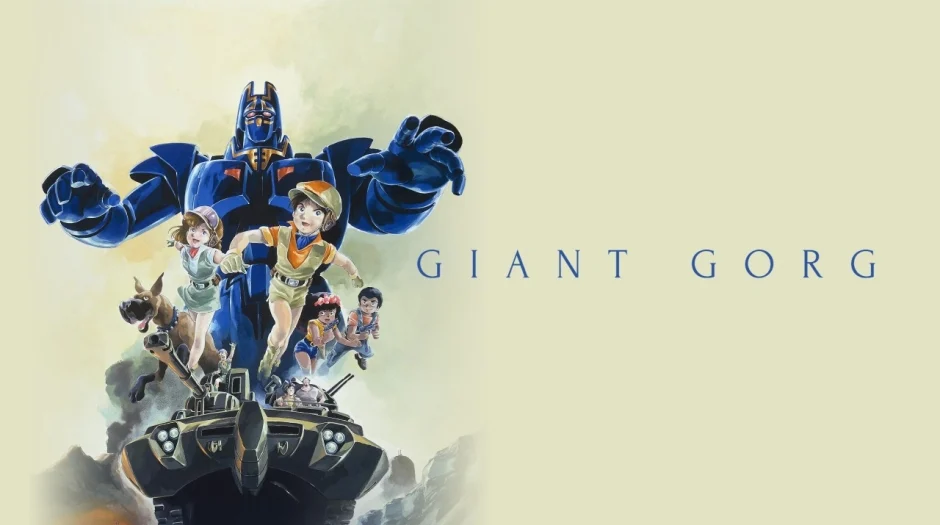
Forty-two years ago, on April 5, 1984, Japanese television audiences were introduced to Giant Gorg, an adventure serial that has since garnered a reputation for its “rip-roaring” action and unexpected narrative turns. The series, which centers on the bond between a giant robot and a young boy, shares thematic echoes with later acclaimed works like The Iron Giant, but its core adventurous spirit and dramatic confrontations draw more direct parallels to the classic tale of King Kong. Primarily set on a mysterious, volcanic island that rose from the sea off Samoa, Giant Gorg features its titular mecha in fierce battles against monsters, tanks, and helicopters, all while acting as a steadfast protector for its young human companion.
The series’ appeal extends beyond its high-octane plot. Initial interest was sparked by the attractive character designs and the impressive roster of anime luminaries involved, most notably director Yoshikazu Yasuhiko, a key figure in the foundational Gundam franchise. The initial presentation, particularly its opening sequence, suggested a straightforward children’s adventure, a genre that has historically produced some of animation’s most beloved works, from Studio Ghibli’s Laputa: Castle in the Sky to Nickelodeon’s Avatar: The Last Airbender. However, anime has a well-documented history of subverting audience expectations, often beginning with content suitable for younger viewers before introducing mature themes that can surprise international audiences. This was true even in 1984, a period when virtually all television anime was consumed by children and frequently targeted at them. Giant Gorg aired on Thursday evenings at 7 p.m. in Japan, a prime-time slot typically reserved for family-friendly programming.
This scheduling context makes the series’ “16+” rating on Crunchyroll particularly noteworthy. For the majority of its 26-episode run, the justification for such a mature rating remains elusive. While the series features a young boy, Yuu, handling a firearm and engaging in combat with enemy soldiers, this element, while perhaps uncommon in Western children’s programming, is not entirely out of line with the broader spectrum of anime from that era, where a 12+ rating might seem more appropriate.

The Unfolding Narrative: From New York to Austral Island
The narrative of Giant Gorg begins with 13-year-old Yuu arriving in New York City. His father, a scientist, has recently died under suspicious circumstances, officially ruled an accident but strongly implied to be otherwise. Yuu’s mother is notably absent from the story, a narrative convention that mirrors certain stylistic choices in early Disney productions where parental figures are often removed without explicit explanation. The series’ opening moments offer a stark and unflattering depiction of 1980s New York, showcasing a gritty subway environment where Yuu is quickly targeted by streetwise youths. This initial immersion into a world of urban decay and opportunistic characters sets a tone that, while pulpy, is undeniably engaging.
Yuu’s journey soon leads him to a derelict house where he encounters Dr. Wave, a somewhat bumbling associate of his father, and his spirited younger sister, Doris. Their reunion is short-lived, as they are immediately thrust into danger, pursued by antagonists seeking to uncover the secrets of a mysterious island. This island, designated New Austral Island, is a geologically recent formation that rose from the ocean floor near Samoa, having been submerged since the last Ice Age. As Yuu and his companions embark on a quest to this enigmatic location, they find themselves pursued by GAIL, a powerful and insidious "Evil Organization" with significant influence over the American government. The organization is led by a seemingly ruthless businessman, a character whose portrayal offers a degree of topical resonance. A rival group of mercenaries, led by the alluring "Lady Lynx" – a character reminiscent of Fujiko Mine from Lupin the Third – also enters the fray, adding another layer of intrigue and conflict. The heroes receive crucial assistance from "Skipper," a guide of immense physical stature and unwavering manliness, whose sudden appearance often feels as if he materialized directly from the unfolding action.
Despite its occasionally over-the-top character introductions and often absurd plot contrivances, the storytelling within Giant Gorg is remarkably robust. The series excels at maintaining sustained mysteries, building suspenseful sequences, and incorporating well-timed plot twists that punctuate the mayhem. Moments of genuine emotional depth are woven throughout the action, a testament to the quality of the adventure narrative that fans of classic children’s stories have come to expect.
The Emergence of Giant Gorg
The titular mecha, Giant Gorg, a sentient robot that is difficult not to anthropomorphize, does not make its full appearance until Episode 4, after Yuu reaches Austral Island and is momentarily separated from his newfound allies. Gorg’s initial intervention is dramatic: it rescues Yuu from a colossal mechanical cephalopod, a quintessential anime encounter. This scene is considered one of the series’ most compelling. Yuu’s initial terror at the sight of the colossal, non-verbal robot is palpable. Gorg communicates through low-pitched, metallic exhalations, a sound that evokes a sense of gentle power. The scene unfolds with a deliberate pace, reminiscent of the masterful storytelling found in the works of Mamoru Oshii or Hayao Miyazaki, and captures the awe-inspiring wonder akin to witnessing the stop-motion animation of Talos in Jason and the Argonauts.

However, Giant Gorg wisely avoids positioning its titular robot as an invincible force. Gorg is depicted as both fallible and vulnerable, often requiring the human characters to devise their own solutions to complex problems. This nuanced portrayal ensures that the stakes remain high, even with a giant robot on their side. The series features engaging episodes where children are forced into direct confrontations with soldiers, and a particularly memorable Episode 9 sees Yuu and another young character overcome their differences to battle a truly terrifying monster, a sequence characterized by its shockingly visceral animation.
A Shift in Tone: The Late-Series Shockwave
While many individual episodes offer satisfying and self-contained narratives, a significant shift occurs in the latter half of the series, propelling Giant Gorg onto a dramatically different trajectory. This development, particularly highlighted in Episode 17, introduces a level of intensity that surpasses even the fantastical elements of Laputa: Castle in the Sky. In a sequence that foreshadows the destructive climax of Miyazaki’s film, Giant Gorg presents a scene of overwhelming destruction, where a new metallic giant unleashes devastating force upon unsuspecting crowds. This depiction, drawing clear inspiration from the George Pal-produced 1953 film The War of the Worlds, predates Steven Spielberg’s 2005 adaptation by over two decades.
Further episodes deliver memorable set pieces, including a Lovecraftian landscape in Episode 18 and a lava-filled spectacle in Episode 19. The show’s most extended and ambitious action sequence is found in Episode 21, a battle on an army base. Though some modern viewers might perceive its animation as crude by contemporary standards, the episode is brimming with hyper-ambitious camera work and innovative visual ideas, such as a fight sequence rendered in sepia monochrome with flashes of color to punctuate gunfire. The series concludes with Episode 26, a finale that is both explosive and emotionally resonant, bringing the boy-robot partnership full circle from their initial, poignant meeting.
Perhaps the most enduring image for many viewers, however, appears much earlier in the series. When Gorg opens its chest cavity, revealing its human pilot, the audience expects the typical robot pilot scenario. However, the pilot, exposed to sunlight, crumbles to dust, a haunting image that leaves a lasting impression. This moment, and the subsequent scene where Yuu must deliver this news to the man’s next of kin, represents one of Giant Gorg’s most delicately handled and maturely rendered moments.

Influences and Creative Lineage
The directorial vision of Yoshikazu Yasuhiko is central to Giant Gorg. Yasuhiko’s extensive work on the original Mobile Suit Gundam in 1979, where he contributed significantly to character designs and layouts, has cemented his legacy in the mecha anime genre. The influence of Gundam is evident in Giant Gorg, particularly in the recurring theme of prolonged evasion from enemy forces. A more specific connection lies in the series’ chief antagonist, Rod Balboa. Voiced by Shuichi Ikeda in Japanese, Balboa shares striking similarities with Char Aznable, Ikeda’s iconic character from Gundam. This stylistic homage, animated by Sunrise, the same studio behind Gundam, suggests Balboa was conceived as another "Char clone," a character archetype that has been widely imitated across the Gundam franchise and beyond. Despite these parallels, Balboa possesses his own distinct backstory that shapes his motivations.
The series also features the vocal talents of Mayumi Tanaka as Yuu. Tanaka has since lent her voice to numerous iconic characters, including Pazu in Miyazaki’s Laputa, Krillin in Dragon Ball, and Monkey D. Luffy in One Piece. For Western audiences, however, the most recognizable connection may be the titular robot’s resemblance to King Kong. The enduring legacy of King Kong in Japan, dating back to the 1960s, is undeniable. From the ambitious, albeit ultimately unproduced, King Kong Vs. Prometheus concept by Willis O’Brien to the campy rubber-suit spectacle of King Kong Vs. Godzilla (1962), and the more benign portrayal in the 1966 Japanese-animated The King Kong Show, the giant ape has been a recurring figure.
Giant Gorg seems to draw most directly from the 1976 American King Kong remake, where the ape served as a symbol of nature rebelling against industrial might. The Vietnam War undertones present in the 1976 film are echoed in Giant Gorg’s jungle battles, where the audience is positioned firmly on the side of the giant protector as it confronts military forces. A soldier’s line in the final episode, “Since my time in ‘Nam, I’ve seen enough death to be sick of it!” further underscores this thematic parallel.
Character Dynamics and Controversial Content
Beyond the central boy-and-robot dynamic, Giant Gorg presents other notable characters. Argos, a hyper-capable Great Dane, offers a nod to Hanna-Barbera’s Scooby-Doo, though Argos’s combat prowess far exceeds that of the iconic cartoon canine. While Argos provides comic relief, his role gradually diminishes as the series progresses.

Conversely, the character of Doris, Yuu’s love interest, is often cited as a narrative weakness. Her role as an adoring, yet largely ineffectual, supporter to Yuu throughout the series is a point of criticism. Her frequent need for rescue, coupled with a lack of agency, contrasts sharply with a more capable, albeit minor, Black female character who demonstrates significant bravery and resourcefulness, even in the heat of battle. This disparity raises questions about the portrayal of female characters, particularly when compared to the strong female leads in Hayao Miyazaki’s adventure anime, where characters often face adversity together, forging bonds through shared peril. Doris, by contrast, often feels like a passive tagalong.
The series’ “16+” rating is ultimately justified by a shockingly violent and disturbing sequence in the final episodes. Without delving into explicit spoilers, the scene depicts a brutal and prolonged attack by a male character on a female character. The suddenness and graphic nature of this violence, particularly given the series’ prior tone, can be deeply unsettling. The aftermath of this incident further complicates its interpretation, defying easy categorization as simple misogyny or a crude attempt at "fridging" a character for narrative shock value. The scene’s ugliness and lack of clear thematic resolution leave viewers grappling with its purpose and implications. While it could be argued as an attempt at depicting adult themes within a children’s narrative, its execution has led to interpretations of creator immaturity and a potentially misogynistic worldview.
A Legacy of Ambiguity and Artistic Evolution
Giant Gorg remains a compelling, albeit occasionally perplexing, anime. It is a series that successfully blends thrilling adventure with moments of profound emotional depth, but also contains elements that challenge contemporary sensibilities. For those intrigued by director Yoshikazu Yasuhiko’s work, his later film Gundam: Cucuruz Doan’s Island (2022) offers a more accessible and thematically cohesive experience. This film, while part of the Gundam continuity, stands as a standalone fable of healing and connection, exploring a young pilot’s journey of self-discovery away from the battlefield. It celebrates the idea of finding family and belonging, a theme that, in its own way, resonates with the core human-robot companionship at the heart of Giant Gorg, even as it emphasizes the importance of stepping out of the robot and into the world. Giant Gorg ultimately endures as a testament to the diverse and often surprising landscape of anime storytelling.