


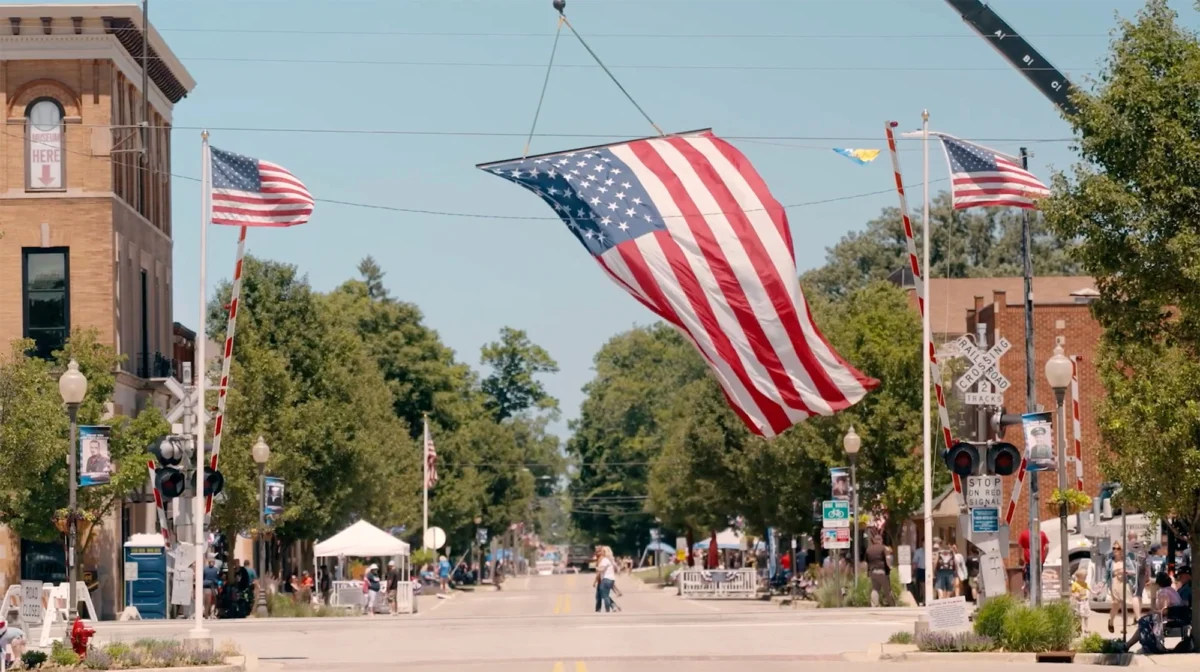
Abramorama has announced the official theatrical release of Flag Day, a compelling documentary film by the filmmaking duo Andrew and Melissa Shea, collectively known as Shea & Shea. Set to premiere in select theaters starting June 12, 2026, with a broader rollout to follow, the film offers a timely and deeply human portrait of community, identity, and tradition, strategically coinciding with the national observance of Flag Day on June 14th. This observational verité documentary centers on the small farming community of Three Oaks, Michigan, renowned as the host of the nation’s largest Flag Day parade, offering a granular perspective on civic life amidst an era characterized by profound political division.
The film’s premise, articulated by its creators, began as "an effort to listen closely to a community coming together around a shared tradition, and to better understand what that ritual reveals about who we are." This objective underpins Flag Day‘s narrative, which immerses viewers in the lives of a diverse cross-section of Three Oaks residents, including veterans, local business owners, marching band members, and volunteers. These individuals, for one weekend each June, orchestrate an event that serves as both a nostalgic tableau of American memory and a mirror reflecting the contemporary tensions within the nation. Through their stories, the documentary aims to reveal both the inherent beauty and the delicate fragility of community life in a period of increasing polarization.
Thematic Core: A Deep Dive into American Identity
At its heart, Flag Day is more than just a chronicle of a small-town parade; it is an ambitious inquiry into the foundational elements of American identity. The film directly grapples with the question of what truly binds Americans together today and whether these bonds can be effectively renewed in an environment often defined by ideological rifts. The filmmakers employ an observational, verité style, a documentary approach that minimizes overt intervention, allowing events to unfold naturally and capturing raw, unscripted moments of humor, conflict, and grace as the community meticulously prepares for its defining annual ritual. This stylistic choice is crucial, as it provides an unfiltered, ground-level portrait of civic engagement, presenting both the aspirational "good" and the uncomfortable "hard truths" inherent in the experience of being American.
The concept of "the flag is for all of us," a poignant line highlighted in the film’s promotional material, serves as a central thesis. In an age where national symbols can become contested terrain, Flag Day endeavors to reclaim the flag as a unifying emblem, transcending partisan divides. It posits that while interpretations of patriotism and national purpose may vary widely, the fundamental principles of community, shared history, and mutual respect remain vital for the nation’s cohesion. The documentary seeks to explore how a singular community’s dedication to a tradition like the Flag Day parade can illuminate broader national dialogues about unity, diversity, and belonging.
Three Oaks, Michigan: A Microcosm of America

The choice of Three Oaks, Michigan, as the setting is far from arbitrary. Located near Chicago, this small farming community has cultivated a unique legacy as the home of the nation’s largest Flag Day parade. This distinction elevates the town from a mere backdrop to a symbolic microcosm of America itself. The parade in Three Oaks is not merely a local event; it is a significant cultural institution that attracts participants and spectators from across the region, embodying a particular vision of American pride and communal celebration.
The history of the Three Oaks Flag Day parade dates back to 1913, when local businessman and philanthropist E.K. Warren, a Civil War veteran, initiated the tradition. Warren, known for his strong sense of patriotism, sought to create an event that would instill civic pride and commemorate the adoption of the Stars and Stripes. What began as a local celebration quickly grew in scale and reputation, fueled by community dedication and a steadfast commitment to honoring the national flag. Over the decades, the parade has evolved, reflecting changes in American society while retaining its core purpose. It has become a pageant of American aspiration and memory, a living testament to the power of tradition to unite people across generations and backgrounds. The scale of the event, with its marching bands, veteran groups, floats, and community organizations, transforms the quiet streets of Three Oaks into a vibrant tableau of national identity and local pride, drawing thousands of visitors annually. This long-standing tradition provides a rich, complex canvas for the documentary to explore how such rituals adapt, endure, and resonate in contemporary society.
The Genesis of a National Tradition: Flag Day History
To fully appreciate the significance of the Flag Day documentary, it is essential to understand the historical context of Flag Day itself. While the film focuses on a specific community’s observance, Flag Day is a national holiday with a rich, albeit somewhat informal, history.
The origins of Flag Day are often traced to various local celebrations in the late 19th century. The most commonly cited precursor is the effort of Bernard J. Cigrand, a Wisconsin schoolteacher, who in 1885 organized a "Flag Birthday" celebration for his students on June 14th, marking the anniversary of the Continental Congress’s adoption of the Stars and Stripes as the official flag of the United States in 1777. Cigrand passionately advocated for the national observance of Flag Day throughout his life.
Parallel efforts emerged in other parts of the country. In 1889, George Bolch, a kindergarten teacher in New York City, also initiated Flag Day exercises for his students. In Philadelphia, William T. Kerr founded the American Flag Day Association in 1893, tirelessly lobbying for official recognition. By the turn of the 20th century, many states had begun to recognize June 14th as Flag Day through gubernatorial proclamations, driven by a growing sense of national identity and patriotism, particularly in the wake of the Spanish-American War.
However, it was not until May 30, 1916, that President Woodrow Wilson issued a proclamation establishing June 14th as National Flag Day. Decades later, on August 3, 1949, President Harry S. Truman signed an Act of Congress designating June 14th of each year as National Flag Day, making it a permanent national observance. While it is not a federal holiday where most federal employees are given the day off, it is a significant day for patriotic displays and ceremonies across the nation, underscoring the enduring importance of the flag as a symbol of American ideals and unity. The film’s release timing, aligning with this national observance, aims to amplify its message and encourage broader public discourse.

Filmmakers’ Vision: The Verité Approach
Andrew and Melissa Shea, a husband-and-wife team with a track record of diverse documentary and narrative projects, bring a nuanced understanding of storytelling to Flag Day. Their previous works, including Santa Fe, Forfeit, Portrait of Wally, Wrestling Alligators, Buzz, and I’ll Be There, demonstrate an interest in exploring human experience through various lenses. For Flag Day, their decision to employ an observational, verité style is particularly significant.
Verité filmmaking, originating from French cinema verité, is characterized by its direct, unfiltered capture of reality. This approach eschews traditional interviews, voice-overs, and overt narrative structures in favor of allowing the subjects and events to speak for themselves. The camera becomes an unobtrusive observer, documenting life as it unfolds. This style requires immense patience, trust-building with subjects, and a keen editorial eye to shape a coherent narrative from unscripted footage. For Flag Day, this means viewers are not told what to think about the parade or the community; instead, they are invited to witness, absorb, and form their own conclusions based on the authentic interactions and experiences presented.
Shot by Margaret Byrne, the cinematography likely plays a crucial role in conveying the intimacy and immediacy inherent in the verité style. The filmmakers’ intent to "listen closely" to the community is directly facilitated by this method, allowing for a deeper exploration of the nuances of tradition, identity, and belonging without imposing external interpretations. This observational approach also enhances the film’s journalistic integrity, presenting a raw, unfiltered perspective on civic life that strives to hold both the inspiring and challenging aspects of the American experience in balanced view. The Shea & Shea team’s commitment to this method underscores their dedication to producing a humble yet powerful piece of storytelling, fostering empathy and understanding.
Navigating Division: The Film’s Contemporary Relevance
The Flag Day documentary arrives at a moment of pronounced political and social division in the United States. Surveys and analyses frequently highlight the widening ideological chasm, the erosion of trust in institutions, and the increasing difficulty in finding common ground across partisan lines. In this context, the film’s exploration of a community uniting around a shared tradition takes on profound contemporary relevance.
The film’s description explicitly states its setting is "in an era of deep political division," and it delves into "the tensions of our time." By focusing on a ritual like the Flag Day parade, which inherently evokes patriotism and national unity, the documentary creates a powerful juxtaposition. It asks viewers to consider how, even in a fractured society, traditions can serve as anchor points, providing continuity and a sense of shared purpose. The "hard truths of being American" that the film promises to reveal likely touch upon the complexities of identity, the different ways individuals interpret national symbols, and the underlying social dynamics that contribute to both cohesion and conflict within communities.

The stories of the diverse townspeople – veterans who have served the nation, local business owners invested in its economic fabric, and marching bands representing youthful aspiration – offer a mosaic of American experiences. Their collective effort to create the parade, despite any individual differences or disagreements, suggests a resilient undercurrent of civic engagement and a desire for communal harmony. The film thus becomes a meditation on the possibility of bridging divides, not by ignoring differences, but by emphasizing shared humanity and a common stake in the health of the community and the nation. It implicitly challenges audiences to reflect on their own roles in fostering unity and understanding.
Distribution and Anticipated Impact
Abramorama, known for its strategic and impactful distribution of documentary films, is handling the release of Flag Day. Their decision to release the film in theaters starting June 12, 2026, leading up to the national Flag Day on June 14th, is a deliberate strategy to maximize its cultural resonance. This timing ensures that the film’s themes are presented when national attention is naturally drawn to questions of patriotism and American identity.
The distribution strategy, beginning with select theaters and expanding across the country, indicates an aim to reach a broad audience, from those deeply invested in civic life and American history to individuals seeking insightful perspectives on contemporary social dynamics. Abramorama’s track record suggests that Flag Day will likely be positioned not just as a film, but as a catalyst for discussion, potentially accompanied by community screenings, panel discussions, and educational outreach programs.
The anticipated impact of Flag Day could be multifaceted. For residents of Three Oaks, it offers a cinematic validation of their enduring tradition and a chance to see their community reflected on a national stage. For broader American audiences, it provides a window into a specific cultural phenomenon that encapsulates universal themes of belonging, heritage, and the ongoing negotiation of identity in a complex society. In an environment often dominated by abstract political discourse, a film grounded in the lived experiences of ordinary people engaging in a tangible act of community building can offer a refreshing and potentially unifying perspective. The film’s official site, flagdayfilm.com, will serve as a central hub for information, screenings, and engagement opportunities, further extending its reach and potential influence.
Conclusion: A Call for Unity and Understanding
Flag Day arrives as a poignant and pertinent cinematic offering, inviting viewers to look beyond headlines and ideological skirmishes to the human core of American life. By meticulously documenting the preparations and celebrations of Three Oaks’ iconic parade, Andrew and Melissa Shea have crafted a narrative that is both specific to a place and universally resonant in its themes. The film’s commitment to verité storytelling, its deep dive into the historical and cultural significance of Flag Day, and its brave confrontation of contemporary divisions position it as a significant contribution to the ongoing national conversation about identity, community, and the enduring meaning of the American flag. In reminding us that "the flag is for all of us," Flag Day extends an invitation for introspection, empathy, and a renewed commitment to the bonds that, despite all challenges, continue to hold the nation together.