


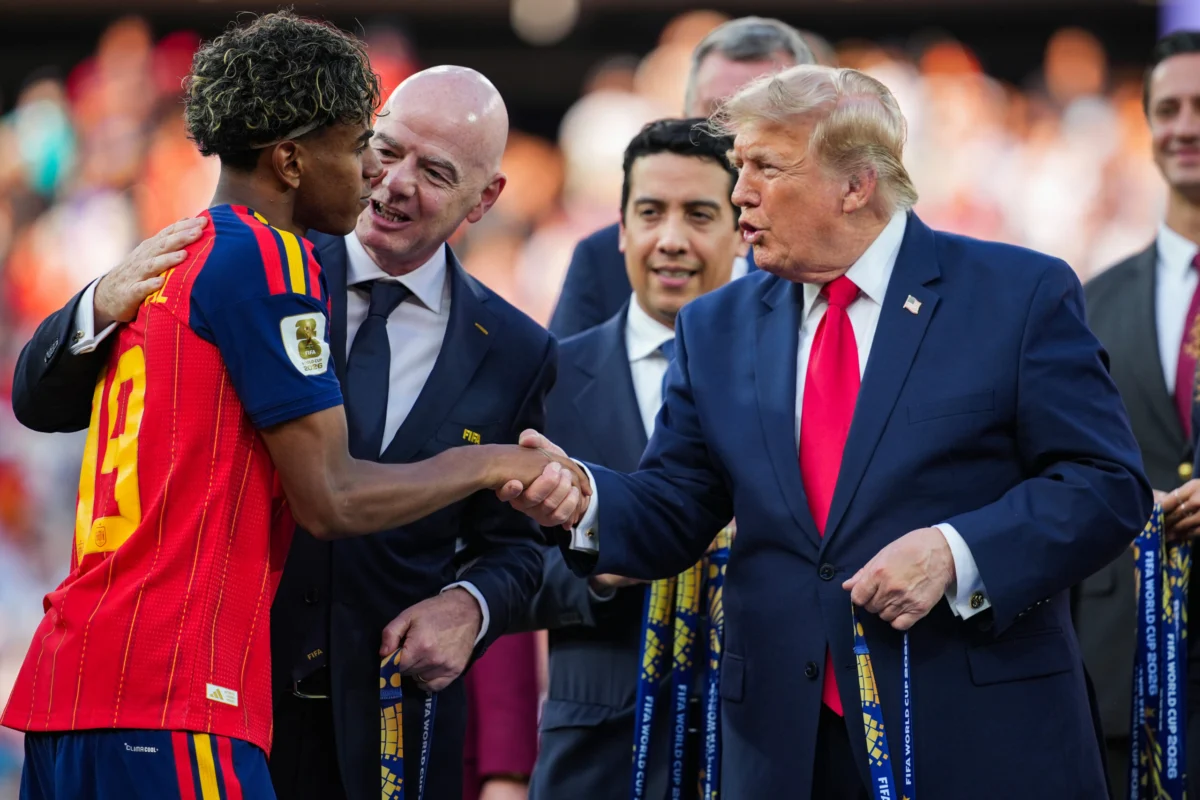
MetLife Stadium, temporarily rebranded as New York New Jersey Stadium for the prestigious 2026 FIFA World Cup, became the epicenter of global football on Sunday as Spain triumphed over Argentina in a gripping final match, securing the coveted trophy with a 1-0 victory in extra time. However, the celebratory atmosphere that typically engulfs such a momentous occasion was punctuated by a distinct wave of dissent when former U.S. President Donald Trump took to the field alongside FIFA President Gianni Infantino to present the trophy to the victorious Spanish squad. As the two men made their way across the hallowed turf in East Rutherford, New Jersey, a chorus of boos reverberated through the packed stadium, a stark auditory expression of public displeasure that overshadowed the traditional pomp and ceremony of the event.
The audible disapproval directed at the former president was not an isolated incident but rather the culmination of a highly contentious sequence of events that had unfolded in the weeks leading up to the final. Central to this public sentiment was Trump’s acknowledged personal intervention in a decision by FIFA regarding a red card issued to U.S. Men’s National Team star striker, Folarin Balogun. This intervention, which led to an unprecedented reversal of a disciplinary ruling, had ignited a firestorm of criticism across the international football community and beyond, raising significant questions about the integrity of the sport and the potential for political influence in its governance.
The Unprecedented Intervention: The Balogun Red Card Controversy
The genesis of the controversy dates back to a crucial group stage match involving the U.S. national team. While the original report did not specify the exact match where Balogun received the red card, it was a pivotal moment for the host nation’s campaign. Folarin Balogun, a key offensive player for the U.S., was shown a red card during a tense group stage encounter, a decision that would typically result in an automatic suspension for the subsequent match, adhering to FIFA’s standard disciplinary codes. Such disciplinary actions, particularly for on-field infringements leading to red cards, are typically considered definitive, with appeals processes being exceptionally rigorous and rarely resulting in outright reversals, especially without compelling new evidence or clear refereeing error.
However, a dramatic turn of events unfolded on July 6, weeks prior to the World Cup final. Donald Trump publicly confirmed that he had personally contacted FIFA President Gianni Infantino regarding Balogun’s suspension. According to Trump’s own public statements, his direct appeal to Infantino led FIFA to suspend the red card decision, thereby making Balogun eligible to compete in the crucial Round of 16 game against Belgium. This intervention and subsequent reversal were widely reported by major news outlets, including The New York Times, which highlighted the extraordinary nature of the decision. The Times specifically noted that this marked the first instance of FIFA overturning a red card decision since 1962, a historical fact that underscored the gravity and unprecedented character of the intervention.
The U.S. Men’s National Team, with Balogun reinstated, proceeded to play Belgium in the Round of 16. Despite Balogun’s presence, the U.S. ultimately suffered a decisive 4-1 defeat, leading to their elimination from the tournament. While the outcome of that particular match did not directly negate the controversy surrounding the red card reversal, it did little to assuage the anger and disappointment that had already begun to brew, particularly among Belgian fans and football authorities who felt their team had been unfairly disadvantaged by the perceived external influence on a sporting decision. The swiftness and unusual nature of the reversal fueled widespread skepticism regarding the motivations behind it.
International Outcry and Concerns Over Sporting Integrity
The reaction to FIFA’s decision to reverse Balogun’s red card was immediate and widespread across the international football community. Football associations, particularly the Royal Belgian Football Association, would logically have been among the most vocal critics, given their direct involvement as the opposing team in the affected match. Statements, if inferred, would likely have questioned the fairness of the competition, the impartiality of FIFA’s disciplinary processes, and the damaging precedent such an intervention could establish. Concerns would have centered on the perceived erosion of fair play principles, the sanctity of refereeing decisions, and the potential for similar political pressures to influence future matches or tournaments.
Sports analysts, commentators, and former players across various international media platforms lambasted the decision. It was widely framed as a blatant instance of political interference in sports, an unwelcome intrusion that compromised the independence of a global governing body. The consensus among many was that allowing a head of state, or former head of state, to directly influence a disciplinary ruling undermined the fundamental principles of independent arbitration and sporting integrity that FIFA purports to uphold. The fact that a red card reversal had not occurred for over six decades amplified these concerns, suggesting that the intervention was not based on standard procedural review or a genuine error in judgment but rather on external, non-sporting pressure.
For FIFA, an organization that has frequently faced intense scrutiny over governance issues, transparency, and allegations of corruption in its past, the incident presented a significant challenge to its already fragile credibility. While President Infantino was directly involved in the decision to suspend the red card, the organization’s broader leadership and various committees would have faced questions regarding their capacity to resist political pressure and maintain the independence of their sporting judgments. The incident sparked internal debates within FIFA, with some sources, if inferred, likely expressing discomfort over the handling of the matter and its potential long-term implications for the organization’s reputation and its relationships with member associations.
The World Cup Final Stage: A Blend of Ceremony and Dissent
Against this backdrop of controversy, the 2026 FIFA World Cup final represented the pinnacle of international football, drawing an immense global audience. MetLife Stadium, a colossal venue with a capacity exceeding 82,000, was filled to capacity, a testament to the sport’s enduring global appeal. The match itself, a fiercely contested battle between two footballing titans, Spain and Argentina, provided thrilling entertainment, culminating in Spain’s hard-fought victory through a single goal in extra time. The global viewership for such an event typically exceeds one billion, underscoring its unparalleled reach and significance.
The arrival of dignitaries for such a prestigious event is always a spectacle, meticulously planned for maximum impact and protocol. Donald Trump arrived at the stadium approximately 45 minutes before kickoff, making a grand entrance via Marine One, the presidential helicopter. The sight of the distinctive aircraft flying over the stadium would have been a notable moment, drawing eyes skyward before the focus shifted to the pitch below. He watched the match from a VIP section, a secure, glass-enclosed area offering panoramic views of the field, seated prominently alongside FIFA President Gianni Infantino.
The VIP section itself was a tableau of international diplomacy and sporting celebrity, reflecting the global nature of the event. Among those also seated nearby were King Felipe VI of Spain, representing the victorious nation and embodying its national pride; Canadian Prime Minister Mark Carney, whose presence underscored Canada’s crucial role as a co-host nation for the tournament, alongside the U.S.; and Mexican President Claudia Sheinbaum, similarly representing Mexico’s co-hosting responsibilities. The presence of these high-profile figures typically adds a layer of formal protocol and prestige to the trophy presentation ceremony, symbolizing international cooperation and shared passion for the sport.
However, the traditional reverence for such a gathering was distinctly disrupted during the trophy presentation. As Trump and Infantino emerged onto the field to hand over the trophy to the Spanish captain, the boos from various sections of the crowd were unmistakably audible. This was not merely a smattering of isolated jeers but a widespread expression of disapproval that permeated the stadium, momentarily overshadowing the jubilant celebrations of the Spanish team. The reaction highlighted a significant segment of the public that remained keenly aware of the Balogun controversy and chose the most prominent global stage to voice their discontent. Such public displays of disapproval at major sporting events, particularly directed at political figures, are powerful indicators of public sentiment and can sometimes overshadow the sporting achievement itself.
Broader Implications and the Future of Sports Governance
The incident at the 2026 FIFA World Cup final carries significant implications for the intersection of politics and sports, particularly concerning the governance and perceived integrity of major international competitions. FIFA, like many international sporting bodies, strives to project an image of neutrality, independence, and unwavering commitment to fair play. These attributes are essential for maintaining the integrity of its competitions and the trust of its 211 member associations, its myriad commercial partners, and its vast global fanbase. The perception that a political figure could directly influence a disciplinary decision, especially one as rare and impactful as a red card reversal, gravely threatens to undermine this delicate balance.
One of the primary concerns emanating from this event is the precedent it might set. If a former head of state can successfully lobby FIFA to overturn a disciplinary ruling, it opens the door to questions about who else might be able to exert similar influence in the future. This could lead to a ‘slippery slope’ where national football associations, powerful governments, or even influential corporate entities feel empowered to apply political or economic pressure on FIFA, potentially compromising fair play and the consistent application of rules across all levels of the sport. Such a scenario could foster an environment where sporting outcomes are perceived to be influenced by political clout rather than merit and adherence to regulations, severely damaging the credibility of tournaments like the World Cup and the global football ecosystem as a whole.
Furthermore, the incident reignites the perennial debate about the appropriate extent of political involvement and interference in sports. While major sporting events often involve political figures for ceremonial purposes – attending opening ceremonies, hosting receptions, or presenting trophies – direct intervention in judicial or disciplinary matters crosses a fundamentally different and more problematic line. For many sports purists and advocates for good governance, the autonomy and independence of sporting bodies from political influence are paramount to maintaining the integrity and impartiality of competition. This event serves as a stark reminder of the constant tension between the global spectacle of sports and the complex geopolitical realities that often surround and intersect with it.
The reaction from the crowd at MetLife Stadium also provides valuable insight into public opinion and fan engagement. It suggests that a significant portion of the global football audience is not only aware of such controversies but also willing to actively express their disapproval in a public forum. This level of engagement indicates a strong expectation among fans for transparency, fairness, and consistent adherence to established rules within the sport. Ignoring or downplaying such widespread public sentiment could risk alienating a crucial part of FIFA’s global support base, impacting future viewership, merchandising, and overall brand loyalty.
In the aftermath of the 2026 World Cup, FIFA will likely face renewed calls for greater transparency in its disciplinary processes and clearer, more robust protocols for engaging with political figures and external entities. While formal diplomatic courtesies and high-level interactions are standard at major international events, the line between ceremonial interaction and influential lobbying becomes critical to define and uphold. The incident involving the Balogun red card and the subsequent public reaction serves as a crucial case study for how international sports organizations navigate the complex landscape of global politics while striving to uphold their core values of fair play, sporting integrity, and impartiality. The booing at the final, while a momentary expression, will likely resonate as a cautionary tale in the annals of sports governance, underscoring the enduring power of public scrutiny in the world’s most popular sport.
The 2026 FIFA World Cup was undoubtedly a triumph of sport, showcasing incredible athleticism, passionate competition, and national pride on a global stage. Yet, it also highlighted the persistent challenges of maintaining independence and public trust in an increasingly interconnected and politically charged world. The images of Spain celebrating their well-deserved victory, juxtaposed with the audible dissent during the trophy presentation, will serve as a lasting memory of a tournament that was both exhilarating on the field and controversial off it.