



A chilling pursuit unfolds in the vast, unforgiving Australian outback as a grieving woman, grappling with profound personal tragedy, finds herself thrust into a desperate fight for survival against a predatory force of human origin. The film "Apex," directed by Baltasar Kormákur and written by Jeremy Robbins, plunges audiences into a harrowing narrative that attempts to blend visceral survivalism with the psychological terror of a "most dangerous game" scenario. While the production boasts a formidable cast led by Charlize Theron, Taron Egerton, and Eric Bana, and a concise 96-minute runtime, the film’s ambitious reach ultimately exceeds its grasp, leaving a complex tapestry of potent performances interwoven with narrative shortcomings.
The Genesis of Despair: A Mountain Tragedy
The initial act of "Apex" establishes a foundation of raw human emotion and physical extremity. Sasha, portrayed by Charlize Theron, is depicted as a woman defined by her relentless drive and an unyielding pursuit of her limits. This is vividly illustrated in a harrowing opening sequence where she and her partner, Tommy (Eric Bana), are caught in a treacherous mountain ascent. The unforgiving natural environment, a recurring motif throughout the film, becomes an active participant in their struggle. A sudden, storm-induced rockslide precipitates a catastrophic event: Tommy falls, a victim of Sasha’s inability to maintain her grip under immense pressure. This moment of failure serves as the emotional bedrock of the narrative, imbuing Sasha’s subsequent actions with the weight of profound guilt and an unspoken vow of atonement.
This tragic incident, occurring approximately five months prior to the main narrative, sets the stage for Sasha’s desperate quest for catharsis. The film’s director, Baltasar Kormákur, known for his unflinching portrayals of human endurance against the elements in films like "Everest," seems intent on translating this familiar thematic territory into a more localized and psychologically intimate nightmare. However, the transition from the stark grandeur of the mountains to the sprawling Australian outback marks a significant shift in the film’s visual and narrative trajectory.
The Outback’s Embrace: Grief and Shifting Tides
The Australian outback, a landscape of immense beauty and stark desolation, becomes Sasha’s chosen sanctuary, or perhaps her self-imposed exile. She traverses the wilderness in a van, seeking solace in the natural rhythms of a national park, a stark contrast to the vertical battle she previously faced. The cinematography initially captures this vastness with an arresting beauty, depicting Sasha as a solitary, vulnerable figure dwarfed by the sheer scale of her surroundings. This visual representation underscores her internal isolation and the monumental task of processing her grief.
However, as the narrative pivots from a meditation on loss and resilience to a high-stakes thriller, the film’s visual language begins to falter. Kormákur employs a dizzying camera style and an often jarring, sickly yellow-green filter that, rather than enhancing the tension, obscures the environment’s inherent splendor. This aesthetic choice, while perhaps intended to convey Sasha’s disoriented mental state, renders the viewing experience unnecessarily arduous and detracts from the natural majesty that could have amplified the sense of isolation and danger. The film’s shift in genre feels abrupt, leaving the audience to question the initial contemplative mood that had been so carefully established.
The Predator Emerges: A Twisted Game of Survival
The film’s trajectory irrevocably changes with the introduction of Ben, portrayed by Taron Egerton. Ben is not a creature of the wild in the traditional sense, but a far more insidious threat: a human predator who weaponizes charm and a deeply unsettling demeanor. Egerton delivers a performance of remarkable, almost primal energy. His movements are described as simian-like, and his vocalizations, often screeching like a bird, serve as a chilling signal of his presence and his predatory intent.
It soon becomes apparent that Ben is not hunting for sustenance or sport in the conventional sense. His quarry is human, and his engagement with his victims is not merely about the kill, but about a macabre "ritual." The revelation that he derives a perverse sense of playfulness from hunting other human beings is undeniably disturbing, particularly as the film introduces elements that hint at a cultish dimension to his activities. This aspect of the narrative, while intended to elevate the stakes and the horror, unfortunately, leads to a significant stumble in the script. The film pauses its momentum to delve into Ben’s motivations and past actions, but this exposition feels underdeveloped. The audience is left wanting a more robust backstory that would lend psychological depth to Ben’s character, making his descent into such depravity more comprehensible. Instead, the script’s sudden pivot into a more abstract form of "weirdness" clashes jarringly with the grounded action and survivalism established earlier. Writer Jeremy Robbins struggles to imbue Ben with the kind of psychological nuance that would elevate him beyond a one-dimensional antagonist, leaving the potential for a truly compelling villain largely untapped. The film, in its haste to get to the chase, bypasses opportunities for deeper character exploration.
Theron’s Triumph: Resilience in the Face of Adversity
Amidst the film’s narrative and stylistic inconsistencies, Charlize Theron’s performance remains a steadfast anchor. Her portrayal of Sasha is a masterclass in conveying profound grief and unwavering determination. The film effectively hones in on Sasha’s journey towards finding closure, even under the most extreme and harrowing circumstances. A particularly poignant scene sees Sasha forced to scale a sheer mountain face without any climbing gear, a powerful visual allegory for her internal struggle. This act transcends mere physical survival; it becomes a symbolic conquest of her own guilt, a way to finally process the trauma of letting Tommy fall.
Theron’s commitment to the physical demands of the role is, as always, beyond reproach. She has, over the past decade, solidified her position as a titan of the action genre, consistently delivering performances that are as physically demanding as they are emotionally resonant. Her previous roles, from the gritty intensity of an undercover agent in "Atomic Blonde" to the stoic, world-weary immortality of an ancient warrior in "The Old Guard," and most notably, the indomitable Imperator Furiosa in "Mad Max: Fury Road," showcase a career built on sheer force of will and an unparalleled ability to elevate action cinema. In "Apex," even within a flawed project, she imbues Sasha with a grounded authenticity that prevents the character from devolving into a mere archetype.
The Power of Water: Innovative Set Pieces and Lingering Questions
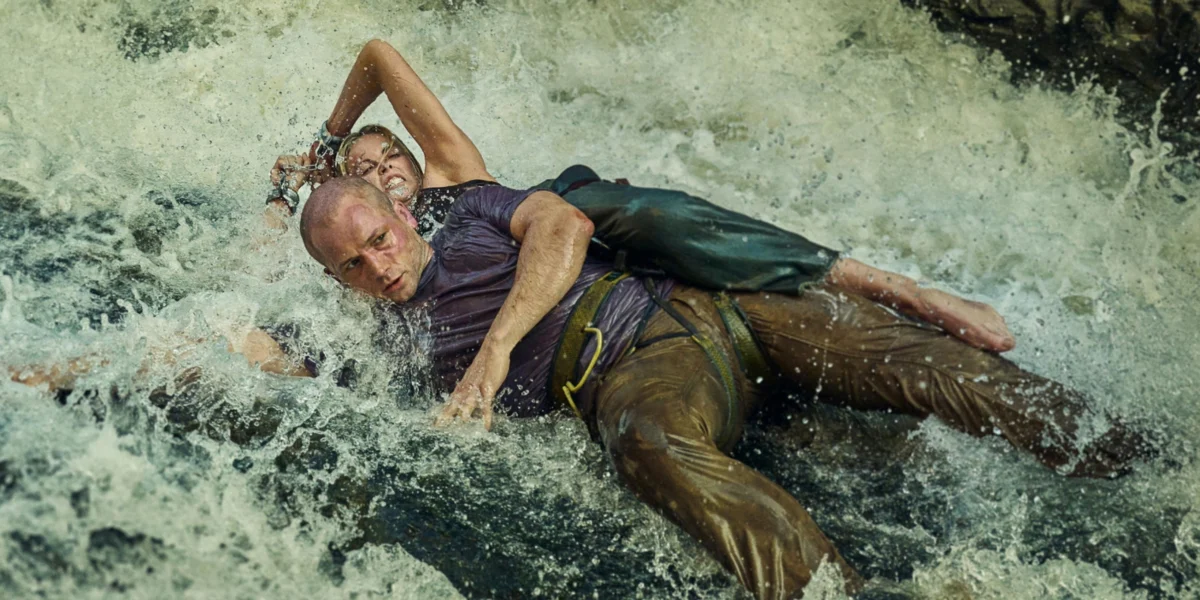
Despite its narrative shortcomings, "Apex" does offer moments of inventive action, particularly in its creative use of water as a central set piece. In a genre often dominated by terrestrial chases and barren landscapes, the film’s decision to utilize the dynamic and crushing power of rapids as a primary arena for survival is noteworthy. Sasha is forced to navigate the treacherous currents while simultaneously evading her pursuer, adding a unique layer of peril to the chase sequences.
This innovative approach to action, combined with Theron’s unwavering physical commitment, highlights the film’s strengths. However, it also raises a pertinent question about the actress’s career trajectory. One hopes that Theron, a performer of such immense talent and versatility, does not find herself perpetually trapped in a cycle of interchangeable action roles, however compelling her performances within them may be. Theron and Egerton undoubtedly deliver a masterclass in physical performance, showcasing the raw power of their craft. Yet, "Apex" itself, despite its aspirations and the formidable talent on display, ultimately fails to reach the cinematic summit it clearly aimed for.
Broader Implications and Industry Context
The film "Apex" arrives in a landscape increasingly saturated with survival thrillers and "most dangerous game" narratives. While its Australian outback setting offers a fresh backdrop, and the performances of its leads are commendable, its struggle to coalesce its thematic ambitions with a cohesive narrative arc is a recurring challenge in the genre. The film’s reliance on Taron Egerton’s unsettling presence and Charlize Theron’s physical prowess suggests a strategy of leaning heavily on star power to compensate for script deficiencies.
The implications of such a production extend beyond individual film criticism. For directors like Kormákur, who have a proven track record in high-stakes survival dramas, "Apex" represents a less successful foray into a more psychological and genre-bending territory. The writer, Jeremy Robbins, faces the challenge of demonstrating a capacity for deeper character development and nuanced plotting in future projects. The film’s relatively short runtime of 96 minutes, while often a positive attribute for maintaining pacing, here may have contributed to the rushed development of its antagonist and the abrupt shift in tone.
The film’s potential impact on the careers of its stars is also a consideration. For Charlize Theron, it reinforces her status as a premier action lead, capable of carrying such demanding roles. However, it also underscores the ongoing industry trend of casting established actors in physically demanding roles, sometimes at the expense of developing new talent or more complex character studies. For Taron Egerton, "Apex" offers a departure from his more comedic or dramatic roles, showcasing a darker, more menacing side that, while effectively unsettling, is not fully explored to its potential.
The critical reception and audience engagement with "Apex" will likely hinge on viewers’ tolerance for its narrative unevenness and their appreciation for the raw, physical performances at its core. The film serves as a testament to the enduring power of the Australian wilderness as a cinematic setting, capable of both breathtaking beauty and profound terror. However, it also serves as a reminder that even the most stunning landscapes and the most talented actors cannot entirely salvage a story that fails to fully flesh out its central conflicts and characters. The "deadly game" played out in "Apex" is a tense one, but its ultimate impact is diminished by the shadows of what could have been.