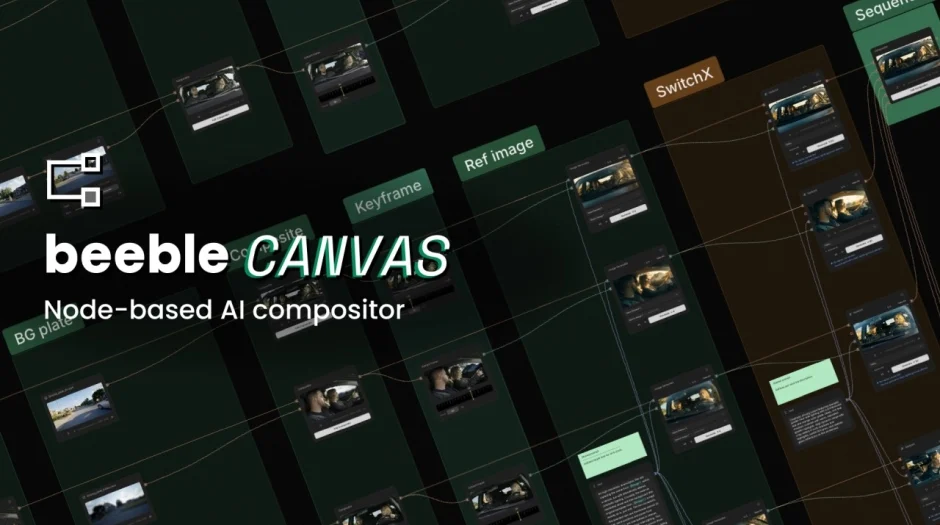
Beeble, a trailblazing deep-tech company specializing in AI-powered relighting solutions, has officially launched Canvas, its highly anticipated node-based AI compositing environment. This powerful toolset is meticulously engineered to address the intricate demands of complex VFX, post-production, and virtual production workflows. Designed for a diverse range of users including filmmakers, major studios, creative agencies, and individual content creators, Canvas integrates cutting-edge AI video models, sophisticated compositing utilities, and advanced visual workflow automation into a singular, cohesive production system. The platform promises to facilitate controllable, iterative pipelines, empowering teams to refine and scale their creative output across multiple shots with unprecedented efficiency and consistency.
The introduction of Canvas marks a significant evolution for Beeble, moving beyond its established standalone AI tools to offer a comprehensive production workflow platform. This strategic expansion is designed to foster scalable AI-assisted content creation, a critical need in today’s rapidly advancing media landscape. The platform’s core functionality lies in its ability to allow artists to construct intricate node graphs. These graphs enable the seamless integration of a wide array of visual elements, including live-action footage, foundational background plates, meticulously crafted masks, crucial reference images, and dynamically generated AI elements. This powerful combination empowers artists to explore and compare multiple visual variations across entire shot sequences, accelerating the creative process and ensuring artistic coherence.
Core Functionality and Technological Innovation
At the heart of Canvas lies native access to Beeble’s proprietary AI models. Key among these are SwitchX, a robust engine for video-to-video transformation, and SwitchLight, designed for the generation of physically based rendering (PBR) passes such as normal maps. The platform also incorporates integrated AI rotoscoping tools, significantly streamlining the often time-consuming process of isolating and manipulating elements within footage. Furthermore, Canvas demonstrates remarkable flexibility by supporting external generative and utility AI models. This interoperability allows artists to fluidly blend AI-generated content with traditional compositing techniques within a unified visual interface, opening up new avenues for artistic expression and technical execution.
The node-based architecture of Canvas is a cornerstone of its design, providing a visual programming paradigm that mirrors established workflows in the VFX industry. This approach offers a high degree of control and transparency, enabling artists to precisely manage the flow of data and the application of effects. By assembling these node graphs, users can orchestrate complex sequences of operations, from basic color correction and layering to advanced AI-driven transformations and material generation. The system’s ability to automate repeatable workflows is another significant advantage. This feature allows for batch processing of iterations and ensures scene consistency across projects, eliminating the need to painstakingly rebuild workflows for each individual shot. This automation is particularly valuable for large-scale productions where efficiency and uniformity are paramount.
The introduction of Canvas comes at a time when the demand for efficient and powerful AI tools in visual effects and content creation is at an all-time high. Industry reports from firms like Grand View Research indicate that the global visual effects market is projected to grow at a compound annual growth rate (CAGR) of over 9% from 2023 to 2030, driven by the increasing demand for high-quality visual content in film, television, gaming, and advertising. Beeble’s Canvas directly addresses this growing market need by offering a solution that enhances both the creative and technical aspects of VFX production.

Developer and Studio Integration: The SwitchX API
In parallel with the launch of Canvas, Beeble has also unveiled the SwitchX API. This developer-focused offering is designed to empower studios and third-party developers to seamlessly integrate Beeble’s advanced AI relighting and video transformation capabilities directly into their existing custom production pipelines and proprietary software environments. The availability of an API signifies a commitment to fostering an ecosystem where Beeble’s core AI technologies can be leveraged in bespoke workflows tailored to the unique needs of individual studios. This move is strategically important, as many large VFX houses and animation studios rely on heavily customized toolchains built over years of development. By providing an API, Beeble allows these organizations to benefit from its AI innovations without forcing a complete overhaul of their established infrastructure.
The SwitchX API is expected to enable a new wave of AI-driven customization within the industry. Studios can now develop custom tools that utilize SwitchX for tasks such as rapid scene relighting, style transfer for video assets, or the generation of specific visual effects elements, all while maintaining control over their proprietary data and workflows. This level of integration is crucial for maintaining a competitive edge in the fast-paced world of visual effects production, where efficiency and unique artistic outcomes are highly valued.
Beeble’s Strategic Vision and Company Background
Beeble, founded in 2022, is a deep-tech company with a clear focus on developing AI-powered relighting solutions. Its genesis can be traced back to five AI researchers with extensive backgrounds in game development, a field that has long been at the forefront of pushing the boundaries of real-time rendering and visual fidelity. This foundational expertise in graphics and AI has positioned Beeble to tackle some of the most computationally intensive and artistically nuanced challenges in visual effects.
The company has already demonstrated its innovative capabilities with earlier product releases. Notably, Beeble launched its AI-powered Background Remover last month, a tool that garnered significant attention for its efficiency and accuracy in isolating subjects from their backgrounds. This prior success underscores Beeble’s commitment to delivering practical, AI-driven solutions that directly address common pain points in post-production workflows.
Beeble’s growth trajectory has been supported by substantial investment. The company has successfully raised $4.75 million in seed funding. This capital infusion has been instrumental in fueling the research and development necessary to bring sophisticated platforms like Canvas to market. The funding is a testament to the investor confidence in Beeble’s technology and its potential to disrupt the VFX and content creation industries. The company’s core mission revolves around generating physically based rendering maps from video, a technology that has profound implications for achieving photorealistic results and streamlining asset creation pipelines.
Industry Context and Expert Commentary
The launch of Canvas arrives at a pivotal moment for the integration of artificial intelligence into creative workflows. While AI has been a buzzword for years, its practical application in high-end visual effects and virtual production is still in its nascent stages. Tools like Beeble’s Canvas are crucial for bridging the gap between theoretical AI capabilities and tangible production benefits.

"Professional VFX workflows demand precision, flexibility, and iteration," stated Hoon Kim, Co-founder and CEO of Beeble. "Canvas brings AI models, compositing tools, and workflow automation into a single visual environment where artists can experiment, iterate, and build production-ready results faster." This statement highlights the company’s understanding of the core needs of its target audience and its ambition to provide a solution that directly addresses these requirements. The emphasis on iteration and speed is particularly relevant in an industry where tight deadlines and the need for continuous refinement are commonplace.
The implications of Beeble Canvas extend beyond mere efficiency gains. By democratizing access to advanced AI capabilities and integrating them into a user-friendly node-based environment, Canvas has the potential to lower the barrier to entry for sophisticated VFX work. This could empower smaller studios and independent creators to produce content that was previously only achievable by large, well-funded post-production houses.
Broader Impact and Future Outlook
The broader impact of Beeble Canvas is likely to be felt across multiple sectors of the media and entertainment industry. In filmmaking, it can accelerate the creation of complex visual effects, enabling directors and cinematographers to achieve more ambitious artistic visions within budget and schedule constraints. For advertising agencies, it offers a pathway to generating highly customized and visually striking content more rapidly. In the realm of virtual production, where real-time rendering and compositing are critical, Canvas could provide invaluable tools for live compositing and on-set visual refinement.
The company’s ongoing development of AI-powered tools, coupled with its strategic approach to integration through APIs, suggests a long-term vision for becoming a central player in the AI-driven content creation ecosystem. As AI technology continues to advance, platforms like Canvas will become increasingly essential for artists and studios looking to harness its power to push the boundaries of visual storytelling. The ability to seamlessly integrate diverse AI models, combine them with traditional techniques, and automate complex workflows positions Beeble as a significant innovator in the evolving landscape of digital media production. The success of Canvas will likely pave the way for further advancements in AI-assisted creativity, transforming how visual content is conceived, created, and consumed.