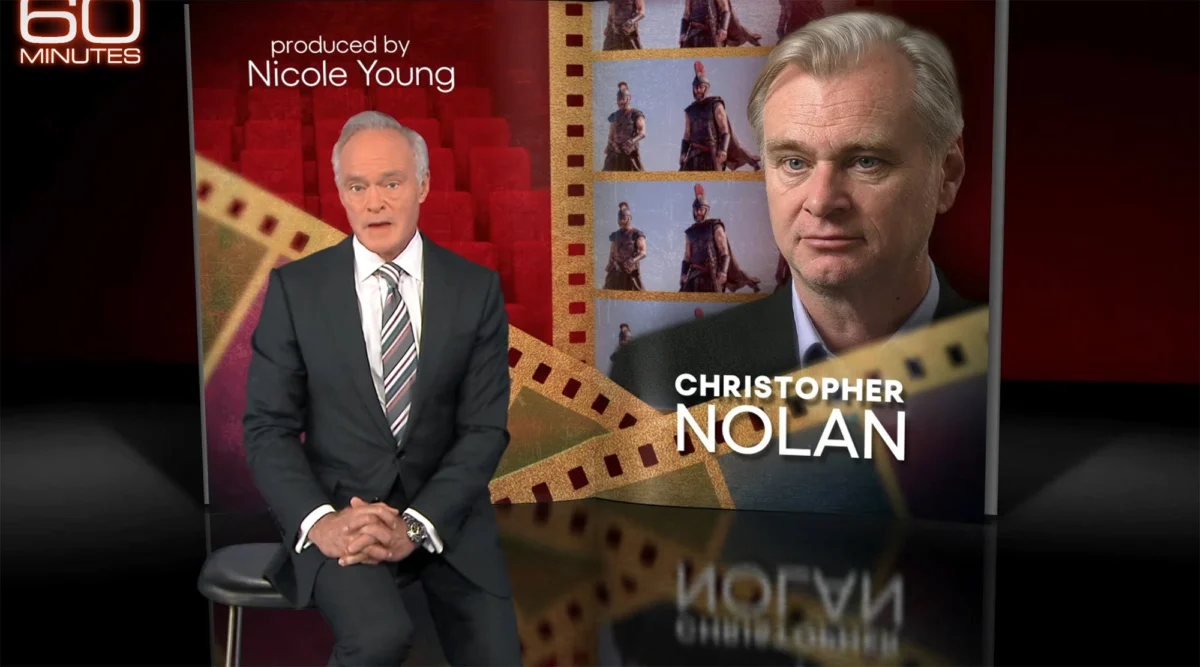
Renowned British filmmaker Christopher Nolan, celebrated for his complex narratives and visually ambitious blockbusters, provided an uncharacteristically expansive and personal interview on the iconic CBS news program 60 Minutes this past Sunday, May 18, 2026. The in-depth segment, broadcast as part of the promotional campaign for his highly anticipated epic, The Odyssey, offered audiences a rare opportunity to delve into the mind of one of contemporary cinema’s most enigmatic auteurs. The interview, which quickly became a focal point of discussion across film and media circles, showcased Nolan articulating his filmmaking philosophy and the intricate processes that define his work, departing significantly from his historically guarded public persona.
The Unveiling of Nolan’s Creative Process
The 60 Minutes feature, which aired on the eve of the summer blockbuster season, was strategically timed to amplify anticipation for The Odyssey, set for a global release on July 17, 2026. Despite its promotional impetus, the segment transcended mere advertising, offering genuine insights into Nolan’s artistic motivations. A key quote from the interview resonated particularly strongly: "When I’m writing, I’m visualizing the film as an audience member. As somebody experiencing the story. Then when I direct the story, I’m trying to take the audience there." This statement encapsulates Nolan’s immersive approach to storytelling, highlighting his commitment to crafting experiences that transport viewers directly into the narrative’s heart.
For a director who has meticulously maintained a degree of privacy throughout his illustrious career, often preferring his films to speak for themselves, this extensive 60 Minutes dialogue marked a notable shift. Nolan has long been perceived as a filmmaker who shies away from prolonged media exposure, leading to a certain mystique surrounding his personal life and creative origins. The interview, however, peeled back some of these layers, revealing a thoughtful, articulate, and deeply passionate individual who, despite his reputation for intellectual rigor, possesses an evident love for the craft of cinema. The correspondent noted Nolan’s unexpected candor and willingness to "geek out" about movies, a portrayal that stands in contrast to the often serious and cerebral image projected by his filmography. Industry analysts quickly pointed to this as a strategic move by Nolan and his production company, Syncopy, to connect with a broader audience ahead of what is poised to be one of the year’s biggest cinematic events.
A Director’s Evolution: From Independent Roots to Blockbuster Acclaim

Christopher Nolan’s journey to becoming a preeminent force in Hollywood is a testament to a consistent vision and an unwavering commitment to cinematic spectacle combined with intellectual depth. Born in London in 1970, Nolan’s early fascination with filmmaking manifested in short films created with his father’s Super 8 camera. His feature debut, Following (1998), a low-budget neo-noir thriller, hinted at the non-linear narratives and complex psychological themes that would become his trademarks. This was quickly followed by Memento (2000), a critically acclaimed psychological thriller told in reverse chronological order, which earned him an Academy Award nomination for Best Original Screenplay and cemented his reputation as an innovative storyteller.
The director’s filmography since has been a carefully curated collection of ambitious projects that consistently push the boundaries of mainstream cinema. From revitalizing the superhero genre with The Dark Knight Trilogy (2005-2012), which grossed nearly $2.5 billion worldwide, to crafting mind-bending sci-fi epics like Inception (2010) and Interstellar (2014), Nolan has consistently delivered both critical and commercial success. His unique blend of practical effects, IMAX cinematography, and intricate plotting has cultivated a devoted global fanbase. His recent historical drama, Oppenheimer (2023), further showcased his versatility, earning him his first Academy Award for Best Director and solidifying his status as a master craftsman capable of tackling diverse genres with profound impact. This trajectory underscores the significance of The Odyssey as his next major endeavor – a director at the peak of his powers tackling one of Western literature’s foundational texts.
The Epic Undertaking of ‘The Odyssey’
The Odyssey, Nolan’s latest cinematic opus, promises to be an adaptation unlike any seen before. The film centers on Odysseus, the legendary Greek king of Ithaca, portrayed by Oscar-winner Matt Damon, as he embarks on his arduous decade-long journey home following the Trojan War. The narrative faithfully depicts his encounters with a pantheon of mythical creatures and formidable challenges, including the cyclops Polyphemus, the enchanting Sirens, the sorceress Circe, and the perilous straits of Scylla and Charybdis, all culminating in his long-awaited, fraught reunion with his wife, Penelope, played by Anne Hathaway.
Adapting Homer’s epic poem, a work of profound literary and cultural significance dating back to the 8th century BCE, presents an immense challenge. Previous attempts to bring The Odyssey to the screen have varied in scope and success, but Nolan’s reputation for grand scale and meticulous detail suggests a definitive cinematic interpretation. His screenplay, an adaptation of the ancient text, is expected to infuse the mythological narrative with his characteristic themes of time, perception, memory, and the human struggle against overwhelming forces. The choice of Hoyte van Hoytema as cinematographer, a frequent collaborator known for his breathtaking visuals in films like Interstellar and Oppenheimer, guarantees a visually stunning experience. The score, composed by the acclaimed Ludwig Göransson, who won an Oscar for his work on Oppenheimer, is anticipated to provide a powerful sonic landscape to match the epic’s grandeur. Produced by Emma Thomas, Nolan’s long-time creative partner and wife, through their Syncopy banner, The Odyssey is positioned as a monumental cinematic event, with Universal Pictures handling its worldwide distribution. The trailers released thus far – the stunning first trailer in 2025 and the riveting second trailer in early 2026 – have already generated considerable buzz, showcasing Nolan’s signature blend of scale, suspense, and emotional depth.
The Strategic Power of the ’60 Minutes’ Platform

The decision to feature Christopher Nolan on 60 Minutes is a calculated strategic move with significant implications for the film’s marketing and Nolan’s public image. 60 Minutes, which first aired in 1968, remains one of the most respected and watched news programs in American television history, consistently drawing millions of viewers weekly. Its reputation for in-depth, no-holds-barred interviews and investigative journalism lends an unparalleled gravitas to any subject it covers. For a film like The Odyssey, an original epic in an era dominated by established franchises, securing such a prominent platform is invaluable.
The show’s demographic often includes an older, more discerning audience that might not be as engaged with typical viral marketing campaigns or social media hype. An appearance on 60 Minutes elevates the film’s profile beyond the traditional movie-going demographic, imbuing it with a cultural significance that transcends mere entertainment. For Universal Pictures, this segment represents a high-impact, high-credibility endorsement, signaling to the public that The Odyssey is not just a film, but a cultural event worthy of serious attention. The interview’s widespread coverage, amplified by online clips and social media discussions, ensures its reach extends far beyond its initial broadcast, contributing to a sustained promotional narrative leading up to the film’s release.
Broader Implications and Industry Outlook
Nolan’s rare candidness on 60 Minutes could signify an evolving approach to his public engagement. As his films become increasingly ambitious and require larger global marketing efforts, a more open dialogue with the public may become a strategic necessity. This shift, however, appears to be carefully managed, preserving the intellectual integrity and artistic focus that defines his brand.
The success of The Odyssey will also be closely watched by the industry as a barometer for the appetite for original, auteur-driven blockbusters in the current cinematic landscape. In an era where studios often prioritize intellectual property with pre-existing fanbases, Nolan consistently proves that original concepts, executed with vision and scale, can command massive audiences. His previous film, Oppenheimer, defied conventional wisdom by becoming a global phenomenon, grossing over $950 million worldwide on a relatively modest budget for a historical drama, further solidifying his unique position in Hollywood. The anticipation for The Odyssey, driven by Nolan’s track record and now bolstered by this unprecedented media exposure, suggests it could follow a similar path to critical acclaim and commercial triumph.
As July 17, 2026, approaches, the cinematic world holds its breath for what promises to be a landmark achievement. Christopher Nolan’s 60 Minutes interview has not only provided a deeper understanding of the man behind the camera but has also intensified the anticipation for his most ambitious retelling of an ancient legend yet. It serves as a powerful reminder of the enduring allure of masterful storytelling and the unique magic that Christopher Nolan continues to bring to the silver screen.