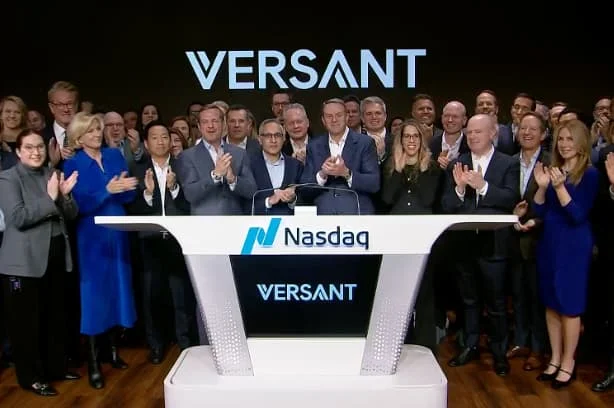
Versant Media Group (NASDAQ: VSNT) published its inaugural quarterly earnings report on Thursday, marking its first comprehensive financial disclosure since transitioning into an independent, publicly traded entity. The results, covering the fiscal quarter ended March 31, 2026, provided a nuanced look at a legacy media portfolio navigating the volatile transition from traditional cable distribution to a digital-first future. Despite persistent headwinds in the linear television sector, the company’s stock surged approximately 10% in premarket trading as investors reacted favorably to a significant revenue beat and aggressive capital return initiatives.
The report arrives just months after Versant officially separated from Comcast’s NBCUniversal, a strategic move designed to allow the media assets to operate with greater agility while Comcast focuses on its core connectivity and theme park businesses. Versant’s debut on the Nasdaq earlier this year was met with cautious optimism, and Thursday’s filing suggests that while the "cord-cutting" phenomenon continues to erode traditional margins, the company’s niche focus on live news, sports, and high-value content licensing is providing a necessary buffer.
Financial Performance and Revenue Streams
For the first quarter, Versant reported total revenue of $1.69 billion. This figure represents a modest 1% decline compared to the same period in the previous year, when the assets were still under the Comcast umbrella. However, the result significantly outperformed Wall Street’s expectations; analysts polled by LSEG had projected revenue of roughly $1.62 billion. The beat was largely attributed to a massive surge in content licensing and steady growth in the company’s digital platform segment.
Net income attributable to Versant was $286 million, or $1.99 per share, a 22% decrease from the prior year. Management attributed this decline to the inherent costs associated with operating as a stand-alone public company, including increased administrative overhead and interest expenses related to the debt structure established during the spin-off. These costs were partially mitigated by a lower effective tax rate during the quarter.
A key metric for the company, Adjusted EBITDA (earnings before interest, taxes, depreciation, and amortization), fell 7% year-over-year to $704 million. However, when viewed through the lens of "stand-alone adjusted EBITDA"—a metric designed to compare the current independent operations against the historical performance of the same assets—the figure actually rose by 5%. This improvement was driven by a disciplined approach to entertainment programming expenses and a reduction in selling, general, and administrative (SG&A) costs.
The Linear Challenge and the Digital Pivot
The core of Versant’s business remains its portfolio of cable networks, which includes heavyweights such as CNBC, MS NOW, the Golf Channel, USA Network, E!, Syfy, and Oxygen. This segment, referred to as linear distribution, remains the company’s primary engine, accounting for more than 80% of total revenue. However, the sector continues to face structural challenges.
Linear distribution revenue fell 7% during the quarter to $1.01 billion. Versant officials noted that the decline was primarily driven by a shrinking subscriber base as consumers continue to migrate away from traditional pay-TV bundles. While the company was able to partially offset these losses through rate increases negotiated with cable and satellite providers, the downward trend in volume remains a primary concern for long-term sustainability.
Advertising revenue also saw a downturn, falling 5% to $368 million. While a decline is rarely a positive signal, management pointed out that this represented a stabilization compared to the previous year, which saw a 12% drop in ad spend. The relative improvement suggests that Versant’s focus on live, unscripted content—specifically news and sports—is helping to retain advertisers who value "appointment viewing" in an era of on-demand streaming.
In contrast to the linear struggles, the content licensing division emerged as a standout performer. Revenue from licensing jumped a staggering 113.5% to $121 million. This growth was fueled by a landmark deal with Disney-controlled Hulu, which acquired the rights to the extensive library of "Keeping Up With the Kardashians" and its associated spin-offs. This transaction underscores the value of Versant’s library and its ability to monetize legacy content across rival platforms.
Strategic Vision: Rebalancing the Portfolio
The first-quarter results highlight the urgency of CEO Mark Lazarus’s long-term strategy. Currently, Versant is heavily weighted toward the declining pay-TV market, but the executive team has set an ambitious goal to rebalance the revenue mix. The objective is to reach a 50/50 split between traditional linear revenue and a combination of digital, platform-based, and transactional revenue.
The "Platforms" business, which includes the movie ticketing site Fandango, the tee-time booking service GolfNow, and various direct-to-consumer digital units, showed promising momentum. Revenue in this segment grew 9.5% to $192 million. By leveraging these transactional platforms, Versant aims to create a more resilient ecosystem that is less dependent on the whims of the traditional cable bundle.
"We are executing our strategy by extending the reach of our brands, deepening our connection with audiences, and scaling our digital platforms," CEO Mark Lazarus stated in the earnings release. "This performance across Platforms and our core brands reinforces our confidence in evolving the business over time and delivering long-term shareholder value."
Shareholder Returns and Capital Allocation
One of the primary arguments for the spin-off was that a leaner, more focused Versant could more effectively return capital to its investors. On Thursday, the company reaffirmed this commitment. Versant declared a quarterly cash dividend of 37.5 cents per share, payable on July 22 to shareholders of record as of July 1. This marks the second consecutive quarter the company has issued a dividend since its inception.
Furthermore, Versant announced a $100 million accelerated share repurchase (ASR) agreement, set to begin immediately. This follows a proactive first quarter in which the company repurchased nearly 2.7 million shares of Class A common stock. As of March 31, the company maintains a remaining share repurchase authorization of approximately $900 million. Analysts suggest that the company’s "light debt load" relative to its peers in the media space provides the financial flexibility necessary to maintain these aggressive buybacks even as it invests in digital transformation.
Chronology of the Versant Spin-Off
The path to Thursday’s earnings report began in late 2024, when Comcast leadership first signaled a willingness to explore a separation of its cable networks. The media landscape had shifted dramatically, with streaming giants like Netflix and YouTube capturing the lion’s share of consumer attention, leading to a valuation gap between Comcast’s high-growth broadband business and its steady but declining cable assets.
- November 2024: Comcast officially announces the plan to spin off its cable networks into a new independent company.
- January 2026: Versant Media Group begins trading on the Nasdaq under the ticker VSNT, marking the formal completion of the spin-off.
- March 31, 2026: Versant concludes its first full fiscal quarter as a stand-alone entity.
- May 2026: The company releases its first quarterly earnings, beating revenue expectations and triggering a stock rally.
Market Context and Industry Implications
Versant’s performance is being closely watched as a bellwether for the broader "mid-tier" media industry. Unlike giants such as Disney or Warner Bros. Discovery, which have invested billions in proprietary streaming services like Disney+ and Max, Versant has adopted a more surgical approach. By focusing on live sports (Golf Channel), business news (CNBC), and political discourse (MS NOW), Versant is betting that specialized, high-engagement content will remain valuable even as the broader entertainment landscape fragments.
The massive licensing deal for "Keeping Up With the Kardashians" also signals a shift in industry philosophy. While many media companies previously sought to keep their best content exclusive to their own streaming platforms, Versant’s willingness to license to Hulu suggests a "content arms dealer" strategy that prioritizes immediate cash flow and reach over platform exclusivity.
Industry analysts suggest that Versant’s successful first quarter may encourage other conglomerates to consider similar divestitures. By hiving off legacy assets into independent companies, parent corporations can shield their primary stock price from the volatility of the cable industry while giving the legacy assets the freedom to pursue specialized growth strategies.
However, risks remain. The 80% reliance on linear revenue means that any acceleration in the pace of cord-cutting could outstrip the growth of the digital and platform segments. Furthermore, as a smaller entity, Versant may have less leverage in future negotiations with major distributors.
As the company moves into the second half of the year, investors will be looking for continued growth in the Platforms segment and further evidence that the digital transition is gaining traction. For now, the first-quarter results provide a solid foundation for Versant’s life as an independent player in the global media market.
Disclosure: Versant Media Group is the parent company of CNBC.