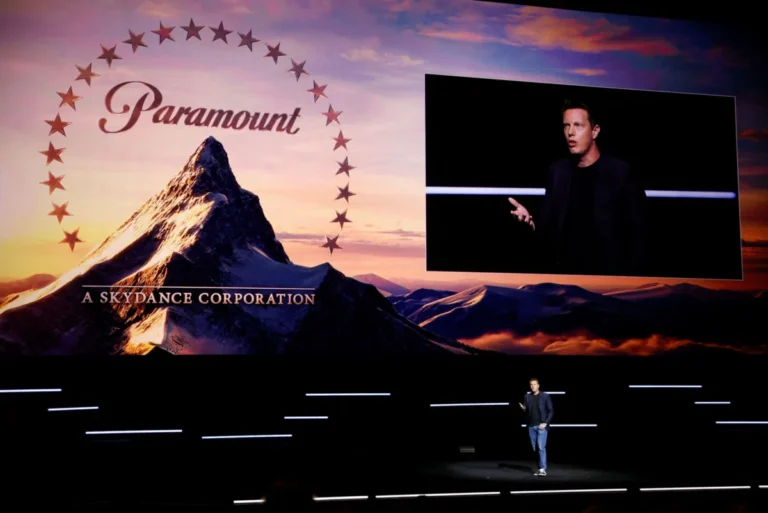



Warner Bros. Discovery (WBD) announced on Tuesday that it has received a significantly sweetened takeover proposal from Paramount Skydance, escalating a high-stakes bidding war for one of Hollywood’s most storied media empires. The revised offer, valued at $31 per share in an all-cash transaction, represents a direct challenge to WBD’s existing agreement to sell its core studio and streaming assets to Netflix. According to a statement released by the company, the WBD Board of Directors has acknowledged that the new proposal from Paramount Skydance—a consolidated entity referred to as PSKY—could "reasonably be expected" to lead to a "Company Superior Proposal" as defined under its current contractual obligations to Netflix.
The announcement marks a pivotal moment in a months-long consolidation saga that has captivated Wall Street and the entertainment industry. The $31 per share offer is an increase from Paramount Skydance’s previous hostile tender offer of $30 per share. More importantly, the revised bid includes a comprehensive suite of financial guarantees designed to alleviate concerns regarding regulatory hurdles and contractual penalties. Specifically, Paramount Skydance has committed to a $7 billion breakup fee if the merger fails to secure antitrust approval and has pledged to cover the $2.8 billion breakup fee WBD would owe Netflix should it choose to terminate their existing deal.
The Evolution of a Media Mega-Merger: A Chronology of Events
The current battle for Warner Bros. Discovery is the culmination of a complex series of negotiations that began in late 2025. In December of that year, WBD stunned the industry by announcing a definitive agreement to sell its studio and streaming businesses to Netflix for $27.75 per share. At the time, the deal was valued at approximately $72 billion for the assets alone, with a total enterprise value of roughly $82.7 billion. This transaction was seen as a strategic pivot for WBD, allowing it to shed its capital-intensive production arms and focus on its remaining linear television assets.
However, the Netflix deal immediately drew fire from rival Paramount Skydance. Shortly after the Netflix announcement, Paramount launched a hostile tender offer to WBD shareholders, arguing that the company should remain intact rather than being carved up. Paramount’s initial $30 per share offer was designed to appeal to shareholders who believed the "legacy" parts of WBD—including CNN, TBS, and HGTV—were being undervalued in the Netflix asset sale.
Last week, the dynamic shifted again when WBD entered into a seven-day limited waiver period with Netflix. This window allowed WBD leadership to reengage in formal talks with Paramount Skydance without immediately breaching its contract with Netflix. The $31 per share offer received on Tuesday is the direct result of those intense, week-long negotiations.
Financial Mechanics: Breakup Fees and "Ticking" Provisions
The revised Paramount Skydance offer is notable not just for its headline price, but for the aggressive financial protections it offers to WBD’s board and shareholders. The $7 billion regulatory breakup fee is among the largest in recent corporate history, signaling Paramount Skydance’s confidence—or perhaps its desperation—to see the deal through in a tightening antitrust environment.
In addition to the regulatory fee and the $2.8 billion Netflix reimbursement, Paramount Skydance has introduced a "ticking fee." In the world of mergers and acquisitions, a ticking fee is a per-diem or monthly payment made by the acquirer to the target company if the closing of the deal is delayed beyond a specific date, usually due to lengthy regulatory reviews. This provision is intended to compensate WBD for the opportunity cost and potential business degradation that occurs during the "limbo" period between signing and closing.

WBD’s board noted that while they are reviewing the PSKY proposal in consultation with financial and legal advisors, the Netflix merger agreement remains legally in effect. For the time being, the board continues to officially recommend the Netflix transaction to its shareholders, though that stance is widely expected to change if the PSKY bid is formally designated as "superior."
Strategic Implications: Two Divergent Visions for WBD
The competition between Netflix and Paramount Skydance represents two fundamentally different visions for the future of Warner Bros. Discovery and the broader media landscape.
The Netflix deal is a "carve-out" strategy. Under this arrangement, Netflix would acquire the Warner Bros. movie and television studios, as well as the HBO Max (now Max) streaming platform. This would provide Netflix with a massive influx of premium intellectual property, including the DC Universe, Harry Potter, and the HBO library, effectively ending the "streaming wars" by consolidating the two largest prestige content libraries under one roof. WBD would remain an independent, though much smaller, entity focused on linear cable networks and sports broadcasting through assets like TNT and Bleacher Report.
Conversely, the Paramount Skydance proposal is a "whole-company" acquisition. By merging the entirety of WBD with the Paramount Skydance entity, the deal would create a massive media conglomerate that rivals Disney in scale. This combination would merge two of the "Big Five" movie studios—Warner Bros. and Paramount Pictures. It would also unite two major news organizations, CNN and CBS News, under a single corporate umbrella, a prospect that has already raised significant concerns among media watchdogs and regulators.
Regulatory Scrutiny and Antitrust Concerns
Any deal involving Warner Bros. Discovery will face an uphill battle with regulators in both the United States and Europe. The Biden administration’s Department of Justice (DOJ) and the Federal Trade Commission (FTC) have shown a renewed appetite for blocking large-scale media mergers, citing concerns over reduced competition and the impact on consumer pricing.
A Paramount-WBD merger would consolidate a significant portion of the domestic box office and the television advertising market. Critics argue that placing CNN and CBS News under one owner could harm journalistic diversity, while combining Paramount+ and HBO Max would further reduce the number of major players in the streaming space.
The Netflix-WBD deal faces its own set of challenges. Regulators may be wary of Netflix—already the dominant player in global streaming—acquiring its most significant competitor’s production arm. This "vertical integration" could potentially lead to Netflix withholding content from other platforms, a move that could be viewed as anti-competitive.
Market Reaction and Shareholder Sentiment
The market’s reaction to the $31 offer has been cautiously optimistic. WBD shares saw a bump in pre-market trading following the announcement, as investors weighed the certainty of an all-cash $31 offer against the strategic long-term benefits of the Netflix deal.

For many WBD shareholders, the Paramount Skydance offer is increasingly attractive due to its "clean" exit strategy. An all-cash deal at $31 provides immediate liquidity at a premium, whereas the Netflix deal involves a more complex asset split that leaves shareholders holding stock in a "New WBD" consisting primarily of declining linear cable assets. However, some institutional investors remain concerned about the regulatory risk inherent in a Paramount merger, fearing that the deal could be tied up in court for years only to be eventually blocked.
The Path Forward: The Four-Day "Match" Window
The next steps are clearly defined by the existing merger agreement between WBD and Netflix. If the WBD board determines that the $31 Paramount Skydance offer constitutes a "Company Superior Proposal," they must formally notify Netflix. At that point, Netflix will have a four-day window to exercise its "matching rights."
During those four days, Netflix can choose to improve its bid—either by increasing the price per share or by offering better terms—to match or exceed the Paramount Skydance offer. If Netflix matches the offer, WBD is generally obligated to proceed with the Netflix deal. If Netflix declines to match, WBD can pay the $2.8 billion breakup fee (which would be funded by Paramount Skydance) and pivot to the new merger.
Industry analysts are divided on whether Netflix will enter a bidding war. While Netflix has a strong balance sheet, it has historically been disciplined about acquisitions, preferring to spend its capital on content production rather than corporate overhead. However, the prospect of losing the Warner Bros. library to a combined Paramount-Skydance competitor may be enough to force Netflix’s hand.
Conclusion: A Defining Moment for Hollywood
The battle for Warner Bros. Discovery is more than just a corporate transaction; it is a referendum on the future of the entertainment industry. As the lines between tech companies and traditional media companies continue to blur, the outcome of this bidding war will determine the gatekeepers of culture for the next decade.
Whether WBD eventually lands with Netflix or merges with Paramount Skydance, the landscape of Hollywood is about to be irrevocably changed. For now, the industry remains in a state of suspense, waiting to see if the world’s largest streaming service will blink in the face of a $31-per-share challenge from its oldest rivals. The WBD board’s upcoming decision will be the most consequential in the company’s history, balancing the immediate demands of shareholders against the long-term survival of its iconic brands.