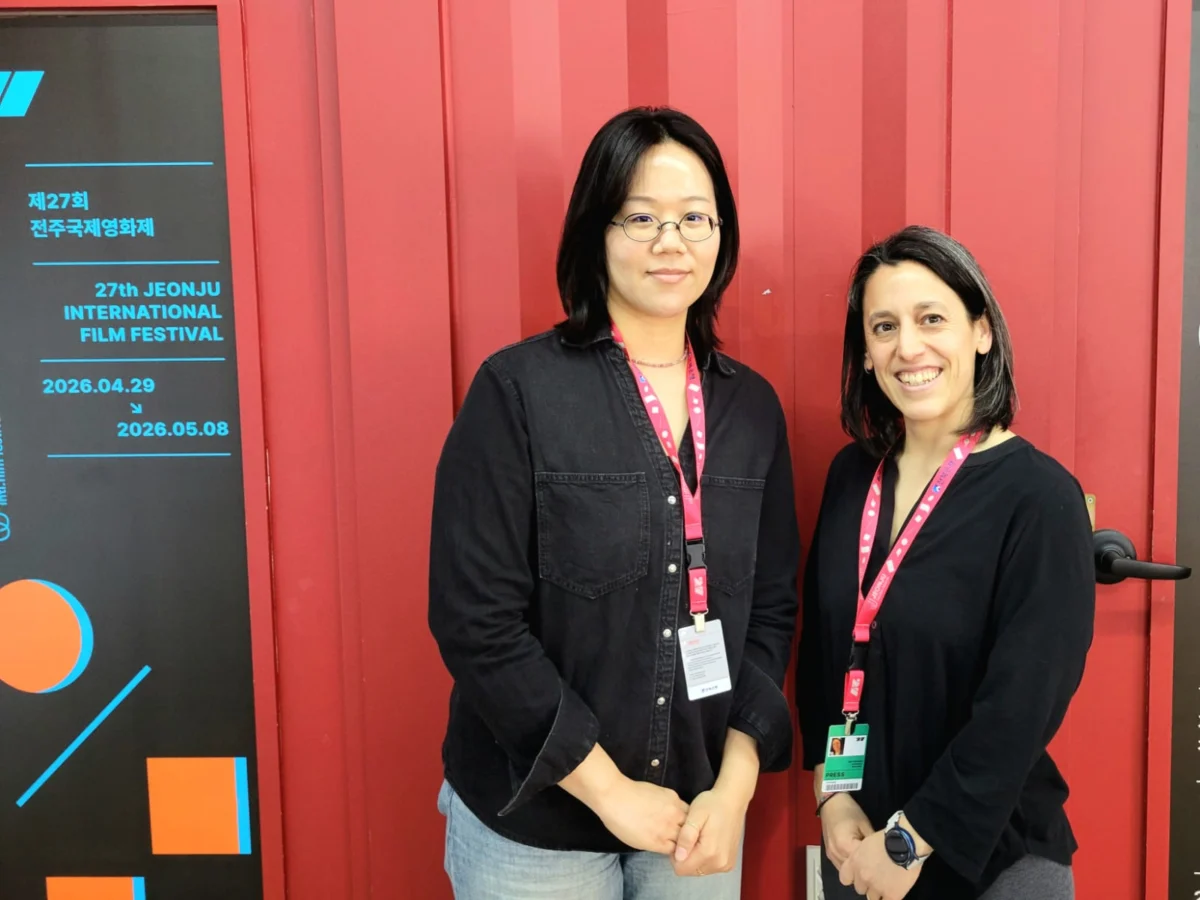
The Jeonju International Film Festival, a cornerstone of South Korean cinema, has unveiled a poignant debut feature that is already garnering significant attention. "SOAR" (Korean "현재를 위하여," romanized as "Hyeonjaeleul Wihayeo"), the first full-length film from emerging director Kim Da-som, offers a deeply personal and introspective exploration of family bonds, the profound impact of loss, and the quiet resilience of the human spirit. Discovered within the festival’s Korean Cinema section, the film’s genesis is as unexpected as its emotional resonance, stemming from a seemingly ordinary childhood experience that blossomed into a compelling narrative.
The impetus for "SOAR" arose during the COVID-19 pandemic, a period of enforced stillness that provided Kim Da-som with the time and space for introspection and creative development. "Because of Covid, I had a lot of time to watch films and write, so I started thinking about making one," Kim explained in an exclusive interview. Her creative spark was ignited by a familiar sight for many South Korean households: the back of Jolly Pong cereal boxes, which have long featured photographs of missing children. This practice, akin to the widely recognized milk carton campaigns in other parts of the world, serves as a quiet but persistent reminder of unresolved tragedies and the ongoing search for lost loved ones.
"I kept turning the box face-down, and that made me ask myself: why is it so difficult for me to look into the child’s eyes? That question is where the story began," Kim revealed. This simple yet profound question about avoidance and empathy became the bedrock of her screenplay. Initially, Kim envisioned centering the narrative around the mother of a missing child, but found the character too distant from her own lived experience. This realization led to a pivotal shift in her protagonist.
"So I decided to change the protagonist – I replaced her with a child named Hyun-jae, someone intimate and close to me. Once I did that, the story started to flow naturally," she stated. The narrative then coalesced around the encounter between Hyun-jae, a child yearning for escape from her home environment, and Hae-in, a woman consumed by the long, arduous wait for a child she lost. This dynamic offered Kim a powerful avenue to explore themes of longing, maternal instinct, and the multifaceted nature of parental grief. The screenplay was subsequently submitted as a practice piece to the Pitch & Catch program at the Seoul International Women’s Film Festival, a process that solidified Kim’s resolve to bring "SOAR" to the screen.
H2: Crafting a Visceral Opening: A Cinematic Statement
The opening sequence of "SOAR" has been widely lauded for its immediate impact and artistic sophistication. Kim Da-som drew inspiration from esteemed directors like Lee Chang-dong, known for his masterful opening and closing scenes. Her ambition was to create an opening that functioned as a self-contained short film, establishing the film’s thematic core and character dynamics without relying on conventional exposition.
"I decided I wanted the opening of my film to feel almost like a short film in itself: complete and self-contained from beginning to end," Kim elaborated. "My core idea was to reveal the child’s desires and her relationships with the other characters right away, without the everyday scenes that would normally ease the audience into intimacy with her." This deliberate choice aims to immediately immerse the viewer in the emotional landscape of the film.
A key element of this striking opening is the portrayal of the father. Kim consciously chose to depict him as a symbolic representation of violence and dysfunction rather than a fully developed character. "I wanted him to be a functional character rather than a meaningful presence in the film, a symbol of violence rather than a fully developed person," she explained. "I pondered how to reveal his violence and rudeness without showing his face in the first scene, and that is how this opening came about." While acknowledging feedback from her crew regarding the father’s underdeveloped nature, Kim stood firm in her artistic vision, prioritizing thematic impact over conventional character arcs.
The collaboration with cinematographer Kang Jeong-hoon, with whom Kim had previously worked on a music video and a short essay film, proved instrumental in translating her vision into striking visuals. "There are things I had not explicitly planned, things I was sensing unconsciously, that he found a way to express through light," Kim said. "Even when I describe a situation only briefly, he creates images as if he has entered my mind." Despite her confidence in Kang’s abilities, Kim remains her own harshest critic, admitting that "by my own personal standards, there are quite a few aspects of the opening that still leave much to be desired."
H2: A Dialogue of Motherhood: Two Paths to Healing
One of the most compelling strengths of "SOAR" lies in its nuanced portrayal of two distinct forms of parenthood, and more specifically, motherhood. The film centers on the interactions between Hyun-jae’s mother, Seok-yeong (played by Chae Jung-an), and Hae-in (played by Min Hyo-gyeong), a woman grappling with the loss of her own child. Kim Da-som deliberately eschewed conventional depictions of female conflict, instead opting for a portrayal that emphasizes empathy and mutual understanding.
"During the initial rehearsal process, I had a long conversation between the two actresses about how to portray a conflict without using violence," Kim revealed. She was particularly focused on a pivotal scene in a flower garden where Seok-yeong seeks out Hyun-jae. "Approached through pure dramatic logic, that scene demands a clash. But I kept asking myself: is that really how the women I know behave? My answer was: no. We have the heart and wisdom to look after each other’s circumstances."
This philosophical approach informed the development of the scene, transforming it into a moment of shared vulnerability. For Seok-yeong, it became an opportunity to confront her own pain and recognize Hae-in’s parallel struggle. For Hae-in, it was a chance to acknowledge Seok-yeong’s humanity and her own "bottom-level struggle." This collaborative process, a "three-way conversation" between Kim and the two actresses, shaped the scene into a testament to female solidarity.
Kim believes that both characters possess an inherent strength and intelligence, coupled with a deep love for life. She also addressed critical interpretations that suggested Seok-yeong, played by Min Hyo-gyeong, was too simplistic or solely defined by her caregiving role. "She is not an incapable woman," Kim asserted. "She is someone who has been placed in a situation where the structures around her have not protected her. Marriage became very hard for her because she had no financial independence. Her vulnerability comes from something structural, not personal. I wanted to show that." This framing highlights the socio-economic factors that can impact women’s lives, adding another layer of depth to the character.
H3: Casting Choices: Seeking Authenticity and Depth
The casting process for "SOAR" was guided by Kim Da-som’s desire for authenticity and a departure from conventional archetypes. For the role of Hae-in, Kim sought an actress who could embody an independent and strong-willed spirit, someone who might not immediately be perceived as a typical maternal figure. Chae Jung-an, a well-known figure in Korean entertainment primarily for her comedic and commercial work, fit this requirement perfectly.
"Chae Jung-an is quite well-known in Korea, but she mostly does comedy or commercial works, features or series," Kim noted. "But every now and then during breaks, she would like to tackle a little bit more challenging independent cinema. So, that was the angle that we went. I sent her the screenplay and she responded warmly." This desire for a performer with a strong independent streak, willing to explore new dramatic territory, proved to be a successful strategy.
For the role of Hyun-jae, Kim found Hwang Boun after seeing him in the film "Nobody’s Lover." She was struck by his palpable vitality. "When I saw the movie ‘Nobody’s Lover,’ I thought he was full of vitality," Kim recalled. "So, we had a meeting, it went well and we decided to work together." This approach to casting underscores Kim’s focus on finding actors who could bring a unique energy and authenticity to her characters.
H2: Art as Solace: Singing and Gardening as Healing Mechanisms
"SOAR" subtly weaves in two powerful metaphors for coping and connection: Hyun-jae’s singing and Hae-in’s dedication to nurturing plants. These artistic and horticultural pursuits are not mere decorative elements but serve as vital expressions of their inner lives and their journeys toward healing.
"Well, I believe that people with wounds from the past or the present inevitably choose art as a way of expressing themselves," Kim explained. "I wanted Hyun-jae to sing and the other to be seen and portrayed as someone who’s taking care of something, hence the plants." These activities provide a sanctuary, a means of channeling pain and finding solace.
The act of nurturing growth, whether through song or gardening, becomes a parallel to self-healing. "Through the act of nurturing growth in others, they also tend to heal their own wounds," Kim stated. Her hope was that audiences, particularly women facing similar challenges, would find inspiration to engage with their own emotional wounds constructively, integrating them into their daily lives.
The specific song Hyun-jae sings, "Whistle" by Jeong Mijo, carries a personal significance. It is a melody that Seok-yeong used to sing to her daughter in childhood. Kim viewed this as "a small legacy, something a mother can pass on," emphasizing the enduring power of maternal connection even in the face of separation and trauma. While Kim had initially envisioned visualizing Hae-in’s grief more concretely through the physical labor of gardening and its attendant exhaustion, she expressed a slight disappointment that this aspect did not fully translate onto the screen as intended.
H2: The Nuances of a "SOAR" and its Korean Significance
The Korean title of the film, "현재를 위하여" (Hyeonjaeleul Wihayeo), carries a layered meaning that is challenging to capture directly in English. Kim Da-som elaborated on its profound significance, revealing a dual interpretation that reflects the film’s central themes.
The literal pronunciation, "hyeonjaeleul wihayeo," translates to "For Hyun-jae." This directly references the young protagonist, whose spirit is described as perpetually focused on a hoped-for future rather than her present reality. "I chose the title ‘For the Present’ with the hope that she might learn to exist right here, right now," Kim explained, highlighting the film’s underlying message of embracing the present moment.
Adding another dimension, the Korean word "hyeonjae" itself means "now" or "the present moment." Therefore, the title also functions as "For Now" or "For the Present Time." This double entendre is intentional, serving as a dedication. "And in that sense, I thought of it as a dedication to women who actively seek and claim what they want," Kim concluded, connecting the film’s narrative to a broader statement about female agency and self-determination.
H2: Navigating the Challenges of First-Time Directing in South Korea
Kim Da-som candidly shared the significant hurdles faced by emerging filmmakers in South Korea, particularly first-time directors. While financial obstacles were initially paramount, the post-production phase presented its own unique set of challenges, most notably in securing distribution.
"Money was the biggest obstacle at first. But once the film was finished, I realised the hardest part was finding a way to share it, especially in Korea," Kim stated. "The film was completed three years ago. We submitted it to many festivals, but the festival landscape was shrinking. So after three years I went back to the editing room. What I kept thinking about was how to create more genuinely cinematic moments, sequences that festival audiences and general audiences can connect with." This period of recalibration highlights the iterative nature of filmmaking and the director’s dedication to refining her work.
Kim observed a surprising convergence between independent and commercial filmmaking in her experience, particularly concerning distribution strategies. "What strikes me is how similar this process ends up being to commercial filmmaking, despite everything," she remarked. She expressed a desire for a more robust ecosystem of independent cinemas, suggesting that increased support for art-house venues could foster alternative revenue streams for independent films. The scarcity of such distribution channels in Korea, despite a prolific output of independent cinema, presents a significant challenge.
The reliance on state funding, primarily through the Korean Film Council (KOFIC), is another critical aspect of the South Korean independent film landscape. "In Korea, KOFIC (Korean Film Council) is the main source of funding for independent films. Without it, independent filmmaking is almost impossible," Kim explained. She pointed out the limited options available to filmmakers after graduation, with university funds ceasing and regional commissions being restricted. This systemic dependence on state funding, while crucial, can also be perceived as limiting by some filmmakers.
H3: Distribution Plans: Bringing "SOAR" to Audiences
Despite the challenges, Kim Da-som’s production company has a strategic advantage in bringing "SOAR" to the public. "Our production company also owns a distribution company and a local indie cinema, LAIKA, a two-screen theatre," she confirmed. This integrated approach allows for greater control over the film’s release.
"We are planning to release the film on June 17th," Kim announced, providing a concrete timeline for audiences eager to experience her debut feature. This direct distribution channel through their own cinema and distribution arm offers a promising avenue for "SOAR" to find its audience and make its mark on the South Korean cinematic landscape.