

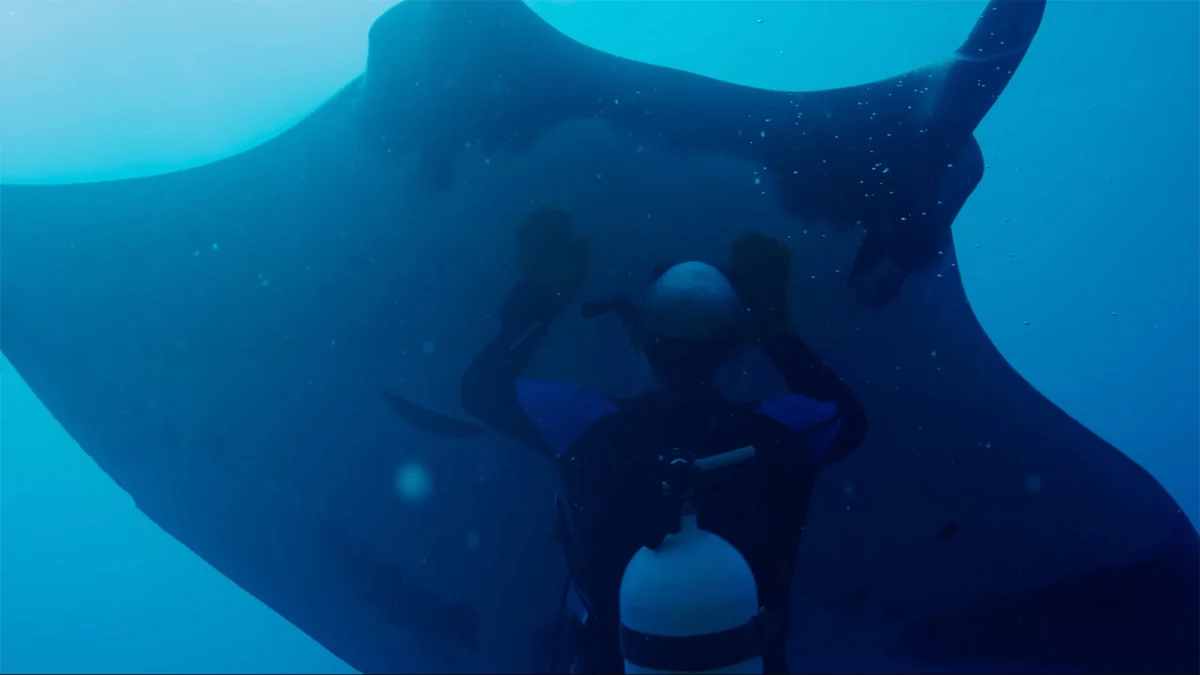
The global documentary landscape is set to welcome a profoundly moving addition this autumn with the release of The Last Dive, a feature-length film directed by award-winning documentarian Cody Sheehy. Distributed by Area 23A, the film chronicles the extraordinary two-decade relationship between Terry Kennedy, an American veteran and former Hell’s Angel living in Baja, Mexico, and Willy, a colossal 22-foot oceanic manta ray. Following its initial, highly praised festival premiere at the 2025 Tribeca Film Festival, the film is scheduled for a theatrical release beginning November 10, 2026.
Drawing inevitable yet distinct comparisons to breakout nature hits such as My Octopus Teacher, The Last Dive explores themes of redemption, cross-species communication, and the enduring tranquility found in the natural world. As Kennedy reaches his eighties, the documentary captures his emotional final voyage to a remote volcanic island, driven by the desire to reunite with his aquatic companion, secure personal closure, and bid a final farewell.
Main Facts and Narrative Overview
At its core, The Last Dive is a biographical nature documentary that examines the intersection of human trauma and marine majesty. Terry Kennedy, a fixture of the coastal waters of Baja, Mexico, spent decades navigating a life far removed from conventional society. Once carrying the heavy psychological burdens of an American veteran and a former member of the Hell’s Angel motorcycle club, Kennedy found unexpected solace beneath the waves.

His life took an improbable turn when he encountered Willy, a majestic oceanic manta ray spanning 22 feet. Over the course of twenty years, the animal developed a recognizable routine with Kennedy. Willy would famously signal the start of their underwater excursions by slapping his expansive fins against the hull of Kennedy’s sailboat. This rhythmic communication forged a bond that transcended human language, transforming Kennedy from a rugged expatriate into an ardent marine conservationist.
Now in his twilight years, Kennedy faces the physical limitations of aging. Determined to bridge the gap of time and distance, he organizes one final expedition to a remote volcanic habitat. The film documents this poignant endeavor, capturing not only the ecological wonders of the deep sea but also the deeply human quest for peace, reconciliation, and emotional resolution.
Chronology and Production History
The journey of The Last Dive from conceptualization to the silver screen spans several years of meticulous filmmaking and festival cultivation.
- Pre-2025: Principal photography and long-term documentation take place in the remote waters of Baja, Mexico, capturing the aging process of both Kennedy and his marine companion, alongside archival footage of their decades-long interactions.
- June 2025: The film makes its world premiere at the prestigious Tribeca Film Festival, drawing critical acclaim for its intimate portrayal of interspecies empathy and human vulnerability.
- Late 2025 to Mid-2026: Director Cody Sheehy and producers Rachel Cohen, Jana Edelbaum, Christopher Gebhardt, Randy Gebhardt, and Mark Monroe refine the cut and secure distribution deals, ultimately partnering with Area 23A for a widespread theatrical rollout.
- October 25, 2026: The official theatrical trailer and promotional posters debut to the public via major digital platforms, generating significant anticipation within the documentary community.
- November 10, 2026: The film is slated to open in select theaters worldwide, marking its official entry into the global commercial market.
Director and Production Pedigree
The film is helmed by Cody Sheehy, a documentary filmmaker recognized for tackling complex, globally resonant subjects. Sheehy’s previous directorial credits include Voices of Mongolia, Beyond the Mirage: The Future of Water in the West, and Make People Better. His visual style frequently emphasizes environmental stewardship, human resilience, and the intricate relationship between modern society and natural ecosystems.

Behind the camera, The Last Dive benefits from a seasoned production team. Producers Rachel Cohen, Jana Edelbaum, Christopher Gebhardt, Randy Gebhardt, and Mark Monroe bring extensive industry experience to the project. Mark Monroe, in particular, is well-regarded for his work on critically acclaimed documentaries, bringing a narrative sharpness that elevates the film beyond a standard wildlife profile into the realm of profound character study.
Contextualizing Interspecies Documentaries
In recent years, the documentary market has experienced a significant surge in demand for intimate, character-driven nature films that challenge the traditional, detached David Attenborough-style narration. Films like My Octopus Teacher demonstrated that audiences are deeply receptive to narratives emphasizing emotional reciprocity between humans and wild animals.
However, marine biologists and animal behaviorists point out that oceanic manta rays (Mobula birostris) are uniquely suited for such interactions due to their high brain-to-body mass ratio, complex social structures, and documented curiosity toward divers. While scientific literature often cautions against habituating wild marine life, long-term observational accounts like Kennedy’s provide rare qualitative data on the capacity of pelagic species to form enduring, non-aggressive associations with specific humans over decades.
Furthermore, Kennedy’s background introduces a distinct sociological element to the film. The trope of the hardened, traumatized outsider finding redemption through nature is a time-tested narrative arc, but the documentary grounds this archetype in the gritty, unpolished reality of life on the Baja coast. By contrasting the aggressive, mechanized brotherhood of Kennedy’s past with the silent, fluid grace of his aquatic present, the film constructs a multi-layered exploration of healing.

Broader Impact and Industry Implications
As The Last Dive prepares for its November 2026 theatrical rollout under the banner of distributor Area 23A, industry analysts are closely watching its box office and streaming potential. While traditional wildlife documentaries frequently struggle for theatrical space against tentpole blockbusters, character-focused environmental films have increasingly carved out profitable niches via specialized theatrical runs and subsequent digital acquisition by major streaming platforms.
Beyond commercial metrics, the film carries notable implications for marine conservation awareness in the Baja California region. Oceanic manta rays face significant global threats, including targeted fisheries, entanglement in fishing gear, and habitat degradation. By placing a charismatic individual specimen at the center of the narrative, the filmmakers hope to foster a visceral connection with audiences that abstract conservation statistics often fail to achieve.
Ultimately, The Last Dive stands as a testament to the unexpected bridges built across the natural world. Through the lens of Cody Sheehy and the lived experience of Terry Kennedy, the documentary invites viewers to reconsider the boundaries of empathy, offering a solemn yet uplifting meditation on companionship, aging, and the finality of the ocean deep.