

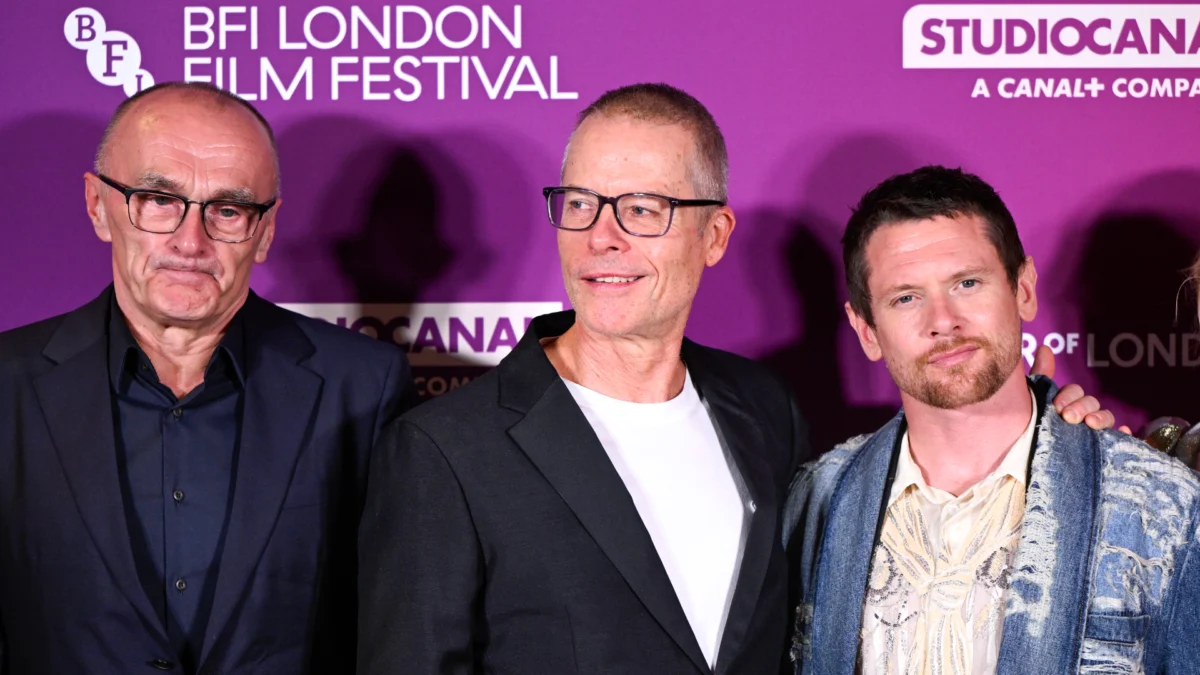
For Jack O’Connell, who portrays the ambitious editor Larry Lamb, the London premiere carries a weight distinct from the international reception the film received in Italy. Addressing the press on the red carpet, O’Connell noted that the film’s authenticity hinges on its reception by those who lived through or were shaped by the era of Fleet Street’s dominance. "I expect the difference to be palpable," O’Connell remarked. "It is a London film. If it doesn’t work here, it’s not going to work anywhere."
The Genesis of a Media Empire
The narrative of Ink centers on the pivotal year of 1969, a period that defined the trajectory of global journalism. The film chronicles the acquisition of the then-failing tabloid The Sun by Australian media tycoon Rupert Murdoch, portrayed by Guy Pearce. The partnership between the calculating, expansionist Murdoch and his chosen editor, Larry Lamb, proved to be the catalyst for a radical shift in British journalism. By blending right-leaning political agendas with a populist, sensation-driven editorial style, the duo transformed a stagnant publication into a dominant, albeit controversial, force in the media market.
Historical records confirm that the tactics deployed at The Sun during this period were not merely isolated business strategies; they served as the blueprint for Murdoch’s subsequent global expansion. The methodology—characterized by aggressive headlines, a focus on celebrity and scandal, and a direct appeal to the working-class reader—would later be imported to the United States to shape the editorial policies of the New York Post and, eventually, the creation of Fox News. The film posits that this era in London was the laboratory for what is now a ubiquitous global media strategy.
Character Motivations and Ethical Gray Areas
The portrayal of Larry Lamb has generated considerable discussion regarding the ethics of the period. O’Connell, who has earned critical praise for his nuanced performance, argues against labeling the historical figure as a conventional villain. Instead, he views Lamb as a manifestation of extreme, singular ambition. "I don’t think he was an out-and-out bad guy," O’Connell observed. "I think he was just perhaps overly ambitious. His obsession was newspapers, and he broke a few rules along the way. It wasn’t a victimless pursuit, certainly, but his actions were driven by a professional fervor that defined that era."
Guy Pearce’s portrayal of Rupert Murdoch has also been a point of intrigue, particularly given the mogul’s enduring influence on global politics. When asked about the potential reaction from the subject of his performance, Pearce adopted a pragmatic, if slightly cautious, tone. He revealed that he had been in contact with members of the Murdoch family, noting that Liz Murdoch had suggested her father was aware of the production and not necessarily opposed to the casting. However, Pearce remained realistic about the reception. "He might watch the film and go, ‘Eugh! Jesus Christ, what were they thinking?’" Pearce mused. Regardless of the mogul’s personal opinion, Pearce believes the film’s examination of the power of the press will inevitably strike a chord with contemporary British audiences.
Danny Boyle on the Attention Economy
Director Danny Boyle, whose previous works such as Trainspotting and 28 Days Later have often explored the fringes of society and the consequences of rapid cultural shifts, views Ink as a vital origin story for the current digital age. Boyle suggests that the aggressive tactics employed by the 1969 iteration of The Sun were the precursors to the modern attention economy.
"You can argue about whether they introduced this entirely or whether they nurtured something that was latent within us," Boyle told reporters. "But it is the beginnings of the attention economy—the clickbait economy, the ‘what’s next, swipe, move on’ culture. It was the beginning of the fire, and now it’s a bushfire that’s all around us. If you want to understand how we got here, there is a very good case for this being the place where it began."
The Cultural Significance of Fleet Street
Playwright James Graham, who adapted his own stage work for the screen, emphasized that the film is a deeply rooted British product, even as its themes possess universal application. The "Fleet Street" era, characterized by a concentration of print media giants in a single, distinct neighborhood, created a unique environment of intense competition and collaborative scandal-mongering.
"No other country in the world had its newspapers on one street with all the associated restaurants, bars, and culture," Graham noted. "The richness and the seduction of that environment, combined with its inherent ugliness, is what makes this story so specific and yet so globally appealing."
Graham draws a direct parallel between the 1960s newspaper industry and the current climate in Silicon Valley. He points out that the disruption caused by Murdoch and Lamb—taking the worst-selling paper and turning it into the world’s largest—mirrors the "move fast and break things" ethos that defines modern tech giants. Boyle added a touch of hyperbole to illustrate the magnitude of the feat, likening the duo’s rise to a "local pub team beating Real Madrid."
Broader Implications and Industry Context
The 70th BFI London Film Festival, which runs from October 7 to October 18, has served as a significant platform for Ink to cement its place in the 2026 awards conversation. The festival has already showcased several high-profile projects, including the European premiere of Andrew Scott’s Elsinore, and other notable entries such as Wild Horse Nine, Artificial, and Paper Tiger.
The implications of Ink extend beyond mere historical recreation. By focusing on the transition from traditional journalism to the "attention economy," the film invites a critical analysis of current media consumption habits. The decline of the print era, contrasted with the rise of the digital, creates a narrative arc that is particularly poignant in 2026. Experts suggest that as audiences become increasingly skeptical of institutional media, films that demystify the origins of these organizations gain significant cultural currency.
Furthermore, the collaboration between Boyle and O’Connell remains a topic of industry interest. Following their work on the 28 Years Later franchise, the two have established a creative rapport that suggests future projects are likely. While O’Connell remained coy regarding specific upcoming collaborations, his admission that the two are "inseparable" indicates that their partnership is a cornerstone of current British cinematic output.
Conclusion: A Mirror to the Present
As Ink concludes its festival circuit and looks toward its wider theatrical release, its impact is clear. It provides a historical lens through which to view the contemporary volatility of news cycles, social media algorithms, and the erosion of privacy. By revisiting the smoke-filled offices of 1969 Fleet Street, Danny Boyle has provided more than just a biopic; he has constructed a diagnostic tool for understanding the modern, fragmented information landscape. Whether the film succeeds in shifting the public discourse on media accountability remains to be seen, but its arrival in London has undoubtedly reignited the debate over how we consume the news and who is responsible for the narratives that define our age. As the festival concludes, the film stands as a testament to the enduring power of the written word—and the dangerous, transformative influence of those who wield it.