The intersection of familial intimacy and historical filmmaking has yielded a remarkable cinematic artifact with the release of Making Marie Antoinette. Premiering at the Telluride Film Festival and the New York Film Festival, the 86-minute documentary captures the chaotic, highly anticipated, and unprecedented production of Sofia Coppola’s 2006 historical drama, Marie Antoinette. Drawn from 80 hours of archival footage shot in 2005 by the late documentarian and family matriarch Eleanor Coppola, the film offers an unobstructed view of a massive studio production operating under the singular, gentle vision of a pioneering female auteur. Narrated by Academy Award-nominated actor Diane Lane through readings from Eleanor’s personal journals, the documentary has been brought to fruition by Sofia Coppola following her mother’s passing in 2024. Mubi is scheduled to release the feature in theaters this fall, setting the stage for renewed appreciation of one of the 2000s’ most polarizing and enduring cinematic experiments.
Chronology of a Monumental Production: From Versailles to the Editing Suite
In 2005, the production of Marie Antoinette marked a watershed moment in the history of French cinema and international co-productions. For the first time in history, the French government granted a film production full, unrestricted access to film inside the Palace of Versailles, a UNESCO World Heritage site and the historic epicenter of French royal power. Securing this access required extensive diplomatic negotiations between American producers and French cultural authorities, given the sensitivity of protecting 18th-century architecture, priceless furnishings, and manicured gardens.
When principal photography commenced, Sofia Coppola was already an established voice in independent cinema. Her debut feature, The Virgin Suicides (1999), garnered critical acclaim, while her sophomore effort, Lost in Translation (2003), grossed over $119 million worldwide against a modest $4 million budget. For Lost in Translation, Coppola earned the Academy Award for Best Original Screenplay and made history as only the third woman ever nominated for the Academy Award for Best Director.
Transitioning from contemporary, low-budget, character-driven dramas to a $40 million historical epic represented a massive professional leap. While the scale of the production was staggering—requiring hundreds of period-accurate costumes, elaborate hair and makeup departments, and an army of extras—Coppola’s directorial methodology remained fiercely independent. Eleanor Coppola’s camera was there to document every hurdle, recording the daily trials of translating an internal, modern psychological portrait of an Austrian teenager into a lavish cinematic spectacle.
The Coppola Family Enterprise and Production Dynamics
Behind the scenes, Making Marie Antoinette highlights the unique operational ecosystem of the Coppola family. The production functioned as a multi-generational creative collective, blending Hollywood royalty with hands-on crew collaboration. Francis Ford Coppola served as executive producer, frequently offering counsel and presence on the Versailles set. Roman Coppola contributed significantly as the second unit director, managing complex sequences and crowd logistics, while Gia Coppola appeared on screen as an extra. Additionally, actor Jason Schwartzman, Sofia’s cousin, took on the leading role of King Louis XVI, starring opposite Kirsten Dunst’s titular queen.
Eleanor Coppola’s presence as both documentarian and mother created an environment of radical transparency. Her audio diaries, voiced by Diane Lane, reflect a complex emotional landscape: profound maternal pride mixed with a poignant, reflective envy. Eleanor frequently ponders what her own artistic trajectory might have achieved had she been afforded the uninterrupted decades of creative focus that her daughter’s generation of female filmmakers began to command.

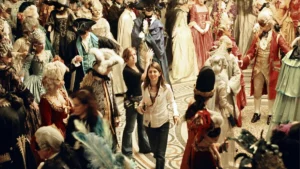
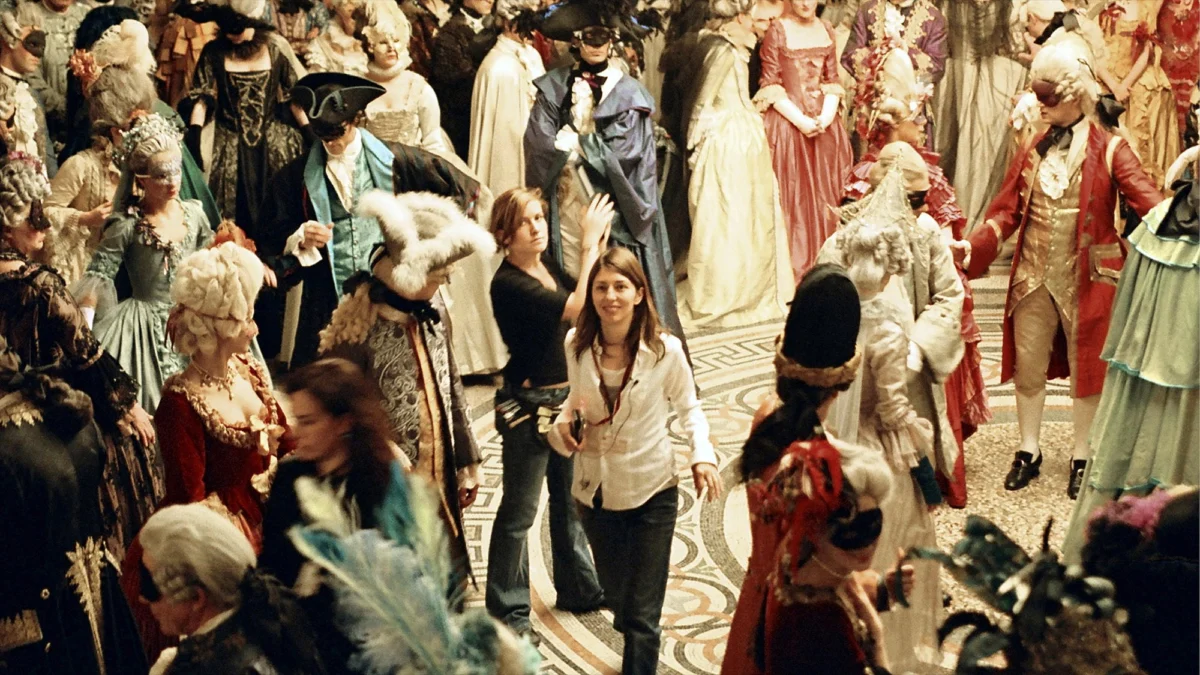
Despite the heavy presence of family, the documentary’s core focus remains on Sofia Coppola’s distinctive directorial style. Eschewing the traditional Hollywood reliance on exhaustive storyboards, Coppola chose to stage scenes organically, working in real-time alongside cinematographer Lance Acord. Given the vastness of the Versailles interiors and the immense logistical challenges posed by period wardrobe, this improvisational blocking approach operated as a high-stakes gamble. The footage reveals a director who commands authority not through intimidation or raised voices, but through an unwavering, quiet clarity of purpose—standing as a solitary female leader navigating the historically male-dominated machinery of major studio filmmaking.
Artisanal Craftsmanship and Historical Reinterpretation
The scale of Marie Antoinette relied heavily on the meticulous work of master artisans, a process that Making Marie Antoinette examines in exhaustive detail. Academy Award-winning costume designer Milena Canonero led a massive team responsible for constructing hundreds of intricate gowns, court suits, and millinery pieces. Footwear was custom-built by legendary designer Manolo Blahnik and L.C.P. di Pompei, while the hair department—spearheaded by Rocchetti & Rocchetti—managed hundreds of elaborate, towering powdered wigs. Eschewing digital shortcuts, the production insisted on authenticity: every flower on set, every banquet dish, and every interior prop was physically realized.
When Columbia Pictures released Marie Antoinette in October 2006, the film faced a complex critical and commercial reception. Operating on a $40 million budget, the film grossed approximately $60.9 million worldwide. More notably, contemporary audiences and mainstream critics were deeply polarized by Coppola’s deliberate stylistic anachronisms. By pairing 18th-century court life with a post-punk and new-wave soundtrack (featuring artists like The Cure, New Order, and Siouxsie and the Banshees), incorporating contemporary Converse sneakers into costume shots, and framing the French Revolution through the lens of a suffocated, modern adolescent girl, Coppola defied traditional conventions of the historical bio-pic genre.
Implications and Legacy of a Modern Classic
Two decades after its theatrical release, Marie Antoinette is widely reevaluated as a foundational text in modern cinematic fashion and visual culture, having heavily influenced contemporary television, high-fashion advertising, and indie filmmaking aesthetics. The release of Making Marie Antoinette arrives at an ideal moment to cement this legacy, providing film historians, scholars, and fans with empirical evidence of how a controversial artistic vision was executed under intense pressure.
Industry analysts note that documentaries focusing on the mechanics of auteur-driven filmmaking hold significant educational and cultural value, offering future generations of filmmakers a rare masterclass in resilience, collaboration, and uncompromising artistic integrity. By honoring Eleanor Coppola’s final wishes, Sofia Coppola has ensured that her mother’s observational diligence is preserved, transforming a collection of raw archival tapes into an essential companion piece for one of the 21st century’s most defining cinematic achievements.
As Mubi prepares to bring Making Marie Antoinette to theaters this fall, audiences will be invited to look past the velvet ropes of Versailles and witness the human cost, creative friction, and familial devotion required to rewrite the rules of historical cinema.