
Twenty-five years after its initial theatrical release was abruptly derailed by global tragedy, Richard Kelly’s psychological science-fiction thriller Donnie Darko remains a monumental touchstone in modern independent cinema. To commemorate the milestone, Fathom Entertainment, in collaboration with rights holders and repertory institutions, is launching a nationwide limited theatrical rerelease of the film in a pristine new 4K digital presentation. The screenings, bolstered by an exclusive recorded introduction from the writer-director, are slated to begin on October 2—the exact calendar date that propels the film’s troubled protagonist, suburban teenager Donnie Darko, into a surreal, apocalyptic countdown.
The revival arrives at a fascinating intersection of nostalgia and expansion for the franchise. Kelly, now 51, is actively preparing for the December 15 publication of The Philosophy of Time Travel, an 800-page companion novel that picks up directly where the 2001 film concluded. Designed to lay the narrative groundwork for a long-anticipated cinematic sequel, the literary endeavor represents Kelly’s ongoing effort to reclaim and expand his creative universe on his own terms. Sitting down for a retrospective interview at Santa Monica’s historic Aero Theatre—a venue inextricably linked to the film’s production lore—Kelly reflected on a quarter-century of cultural persistence, industry near-misses, and the shifting paradigms of distribution and audience reception.
The Rocky Genesis and Tragic Box Office Launch
To understand the cultural footprint of Donnie Darko is to examine one of the most improbable trajectories in modern film history. Written by Kelly while he was a student at the University of Southern California, the screenplay languished in Hollywood development purgatory for over a year. Industry executives repeatedly dismissed the property, arguing that the narrative was overly ambitious for a first-time filmmaker, that the surrealist elements defied commercial categorization, and that Kelly’s insistence on directing his own script was a non-starter.
The project’s fortunes reversed only when actor Jason Schwartzman became initially attached to play the titular role, breathing new life into the circulating script and attracting the attention of Nancy Juvonen and Drew Barrymore at Flower Films. Barrymore struck a deal with Kelly to co-produce the project through her banner and take on the supporting role of English teacher Mrs. Pomeroy, working within a hyper-compressed shooting window in August 2000 just before committing to Penny Marshall’s Riding in Cars with Boys.
When Schwartzman subsequently exited the production due to scheduling conflicts, a then-unknown Jake Gyllenhaal stepped into the lead role, anchoring the film alongside his real-life sister, Maggie Gyllenhaal, who portrayed Donnie’s sister Elizabeth. Bolstered by a fortuitous Los Angeles actors’ strike that coincided with a commercial advertising blackout—giving the production access to a deep pool of young local talent, including a 19-year-old Seth Rogen in his feature film debut—the independent production was captured on a modest budget over 28 days.
However, the film’s commercial prospects were effectively paralyzed by macro-historical events. Released in October 2001, just weeks after the September 11 terrorist attacks, the theatrical run faced an insurmountable marketing hurdle: the film’s central narrative hinge involves a jet engine inexplicably detaching from a commercial airliner and crashing into a suburban home. With audiences acutely sensitive to aviation disasters, the studio quietly abandoned promotional efforts, and the film unceremoniously faded from mainstream theaters, grossing a negligible fraction of its budget domestically.
The Midnight Movie Phenomenon and Home Video Renaissance
Donnie Darko’s transition from a commercial casualty to a canonical pop-culture artifact is a textbook case study in the power of the home video market and grassroots exhibition. Throughout late 2001 and early 2002, the film found a second life on DVD and VHS, propelled by word-of-mouth recommendations and its labyrinthine puzzle-box narrative.
The turning point for Kelly occurred in March 2002 during a visit to New York City’s East Village. Noticing his own theatrical poster displayed in the window of a local pizzeria, Two Boots, Kelly discovered that the venue’s adjoining independent cinema, the Pioneer Theater, had been screening the film every Saturday night at midnight to sold-out audiences. Arriving for a subsequent screening, Kelly was greeted by throngs of enthusiastic fans, documenting the phenomenon with camcorders alongside cultural critics like Michael Musto of the Village Voice.
This unexpected grassroots mobilization transformed the film into an enduring midnight movie staple, running for months in major metropolitan markets and solidifying its status as a defining cinematic exploration of adolescent alienation, existential dread, and temporal mechanics.
Artistic Choices and Miraculous Production Pivots
The enduring appeal of Donnie Darko is frequently attributed to its distinctive aesthetic and auditory landscape, elements that Kelly assembled under immense logistical pressure. The meticulous recreation of 1988 suburban America—achieved by costume designer April Ferry, who utilized subtle period cues rather than overt pop-culture pastiche—relied heavily on a deliberate visual grammar.
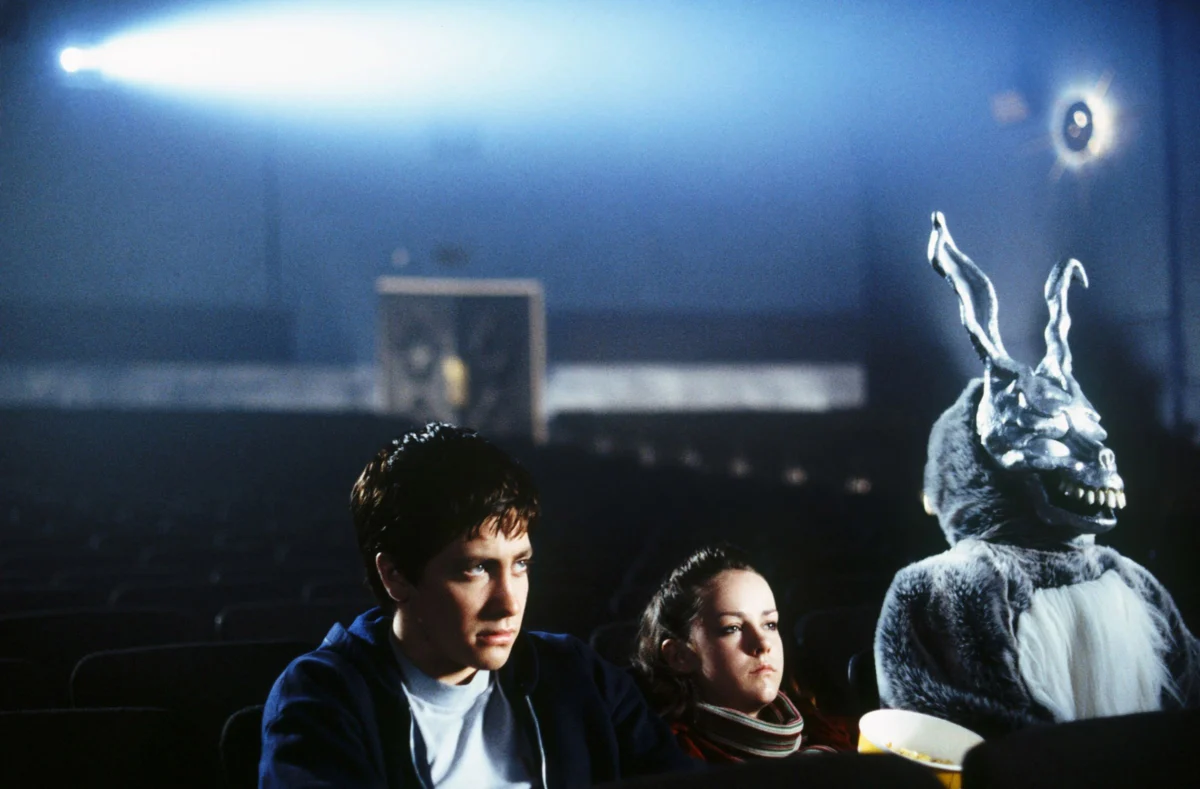
Similarly, the film’s iconic soundtrack nearly underwent a drastic alteration due to licensing bottlenecks. In the original script, Donnie and his love interest Gretchen (Jena Malone) were slated to attend a screening of the 1984 horror film C.H.U.D. However, three days before filming at the Aero Theatre, studio executives managing the licensing rights demanded exorbitant fees and ultimately denied permission.
In a classic industry eleventh-hour save, Flower Films executive Linda McDonough leveraged personal relationships with producers at Renaissance Pictures. Through the intervention of filmmaker Sam Raimi, the production secured the rights to use promotional materials, imagery, and audio clips from The Evil Dead for virtually no cost. This fortuitous pivot resulted in one of the film’s most memorable theatrical sequences, seamlessly pairing Raimi’s low-budget horror masterwork with the marquee billing of Martin Scorsese’s The Last Temptation of Christ.
Musically, the film’s integration of post-punk and new wave staples—most notably Tears for Fears’ "Head Over Heels," Joy Division, and Echo and the Bunnymen—was driven largely by Kelly’s instinctual editorial rhythm. Collaborating with music supervisors Manish Raval and Tom Wolfe, Kelly structured narrative sequences directly around musical cues, though budgetary constraints occasionally forced last-minute alterations, such as substituting the Pet Shop Boys with Duran Duran for the infamous "Sparkle Motion" dance sequence.
Implications of the 25th Anniversary and Literary Expansion
As Hollywood increasingly relies on intellectual property reboots and algorithmic predictability, the 25th-anniversary rerelease of Donnie Darko serves as a reminder of the vital role independent cinema plays in cultivating enduring artistic legacies. Fathom Entertainment’s decision to distribute a restored 4K version underscores the commercial viability of repertory cinema when paired with modern digital presentation standards.
Furthermore, Kelly’s transition into long-form fiction with The Philosophy of Time Travel highlights an emerging strategy for auteurs navigating the modern financing landscape. Faced with the persistent difficulties of securing studio backing for ambitious, high-budget fantasy and science-fiction features—such as his long-gestating Rod Serling biographical drama, conceived through a speculative lens influenced by Albert Brooks’ Defending Your Life and Bob Fosse’s All That Jazz—Kelly is leveraging literature to build an expansive narrative engine independently.
Reflecting on the digital landscape and contemporary film discourse, Kelly remains wary of the hyper-connected, reactive nature of modern online fandom, preferring a traditionalist approach to artistic curation. For an auteur whose debut feature was nearly lost to the currents of history, the upcoming novel and theatrical revival represent a definitive reclamation of authorship—proving that visionary art, once planted in the cultural consciousness, possesses a timeline entirely its own.