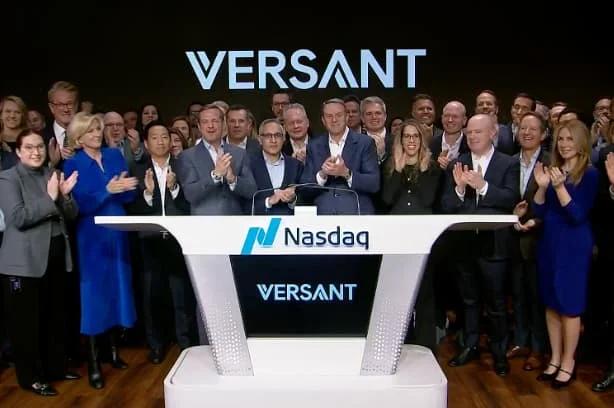
Versant Media Group (NASDAQ: VSNT) on Thursday unveiled its financial results for the first quarter of 2026, marking a pivotal milestone as the media entity’s first performance report as an independent, publicly traded company. Following its high-profile separation from Comcast’s NBCUniversal division and its subsequent January debut on the Nasdaq, the company’s inaugural quarterly report offered a complex snapshot of a legacy media giant in transition. While the report highlighted the persistent headwinds facing traditional cable television, it also showcased a robust expansion in content licensing and digital platform revenue, a combination that sent Versant shares climbing nearly 10% in Thursday’s trading session.
The company reported overall revenue of $1.69 billion for the period ending March 31, representing a modest 1% decline compared to the same quarter in the previous year. Despite the slight dip, the figure comfortably outperformed Wall Street’s expectations; analysts polled by LSEG had projected revenue closer to $1.62 billion. This beat was largely attributed to a massive surge in licensing deals and the resilience of Versant’s "platforms" segment, which includes transactional and niche digital businesses. However, the transition to independence came with significant costs, as net income attributable to Versant fell 22% to $286 million, or $1.99 per share. The company cited the inherent expenses of operating as a standalone public entity, alongside interest expenses stemming from the spin-off, as the primary drivers of the bottom-line contraction.
The Evolution of Versant: From Corporate Division to Independent Player
The journey to Versant’s independence began in late 2024, when Comcast announced its intention to spin off a portfolio of cable networks that were once considered the bedrock of NBCUniversal. The strategic move was designed to allow Comcast to focus on its high-growth areas—broadband, wireless, and the Peacock streaming service—while giving the cable networks the autonomy to pursue their own consolidation or digital transformation strategies.
The spin-off, which reached its fruition in early January 2026, bundled together a diverse array of assets. These include news powerhouses CNBC and MS NOW (the rebranded digital-first iteration of MSNBC), the Golf Channel, and a suite of entertainment networks including USA, E!, Syfy, and Oxygen. By becoming a standalone entity, Versant assumed control of a portfolio that, while profitable, faces the industry-wide challenge of "cord-cutting," where consumers migrate from expensive cable bundles to a-la-carte streaming services.
Industry analysts view Versant’s first-quarter performance as a "proof of concept" for the spin-off. By exceeding revenue expectations and demonstrating double-digit growth in non-linear sectors, the company is attempting to prove that its "legacy" assets still possess significant monetization potential outside the traditional cable ecosystem.
Navigating the Decline of Linear Distribution and Advertising
The most significant pressure point in Versant’s Q1 report remained its linear distribution business. Revenue from pay TV networks fell approximately 7% to $1.01 billion. This decline was driven by a shrinking subscriber base as households continue to cancel traditional cable subscriptions. While Versant managed to partially offset these losses by negotiating higher carriage rates with remaining distributors, the underlying trend remains a primary concern for long-term stability.
The advertising sector provided a more nuanced picture. Ad revenue for the first quarter fell 5% to $368 million. While a decline is rarely viewed positively, the figure represented a significant stabilization compared to the previous year’s first quarter, which saw a much steeper 12% drop. Management pointed to a tightening of the ad market and a renewed interest in live news and sports as factors that helped stem the tide.
Versant’s reliance on the traditional pay TV model remains high, with more than 80% of its current revenue derived from this segment. However, CEO Mark Lazarus has been transparent about the company’s mandate to rebalance this mix. The stated long-term goal is a 50/50 split between linear revenue and a combination of digital, subscription, and transactional revenue.
Licensing Surges and Platform Growth: The Digital Pivot
The standout performer in the Q1 report was Versant’s content licensing division, which saw revenue skyrocket by 113.5% to $121 million. This exponential growth was primarily fueled by a landmark deal with Disney’s Hulu, which acquired the rights to the extensive library of "Keeping Up With the Kardashians" and its associated spin-offs. This move signals a strategic shift for Versant; rather than hoarding content for a proprietary general-entertainment streaming service, the company is aggressively monetizing its library through third-party platforms to maximize immediate cash flow.

Simultaneously, the "platforms" business—comprising GolfNow, Fandango, and several nascent direct-to-consumer (DTC) units—showed promising momentum. Revenue in this segment grew 9.5% to $192 million. Executives characterized this as "pure organic growth," noting that Fandango benefited from a stabilizing theatrical release calendar and GolfNow continued to dominate the digital tee-time booking market.
During an earnings call with investors, CEO Mark Lazarus emphasized the importance of scaling these digital audiences. "We hope that comes with a large base of subscribers, and we’ll gauge ourselves as to how revenues look across all of our various forms of distributing content," Lazarus stated. He further noted that the company is focused on "revenue diversification within each of our verticals" to ensure that the decline of any single distribution method does not destabilize the overall enterprise.
Financial Resilience and Shareholder Returns
Despite the 22% drop in net income, Versant’s underlying operational health appeared stable when viewed through the lens of Adjusted EBITDA (earnings before interest, taxes, depreciation, and amortization). While adjusted EBITDA fell 7% to $704 million on a year-over-year basis, the company introduced a "stand-alone adjusted EBITDA" metric to provide a more accurate comparison of its current performance against its pre-spin-off status. Under this metric, adjusted EBITDA actually rose by approximately 5%.
This operational improvement was credited to aggressive cost-cutting measures. Versant has successfully reduced entertainment programming expenses and lowered selling, general, and administrative (SG&A) costs, effectively streamlining its operations to match its new scale as an independent company.
Versant’s relatively light debt load—a byproduct of the spin-off structure—has allowed it to prioritize shareholder returns. The company declared a quarterly cash dividend of 37.5 cents per share, payable on July 22. Furthermore, the board announced a $100 million accelerated share repurchase agreement, set to begin immediately. This follows the repurchase of 2.7 million shares during the first quarter, leaving the company with a remaining authorization of roughly $900 million.
Future Outlook: M&A Strategy and the Sports/News Moat
Looking ahead, Versant’s strategy is centered on two pillars: defending its "moat" in live news and sports, and exploring inorganic growth through mergers and acquisitions (M&A). The company highlighted viewership gains for CNBC and MS NOW, reinforcing the idea that live, "appointment" television remains the most resilient part of the linear bundle.
On the M&A front, Lazarus confirmed that Versant is actively scanning the market for opportunities that could build scale. "We’ve been looking in a variety of areas," he said, though he cautioned that the threshold for any deal remains high. CFO and COO Anand Kini echoed this sentiment, stressing that while M&A is part of the strategy, the company remains committed to maintaining a healthy balance sheet and prioritizing organic growth.
The broader implications of Versant’s first quarter are significant for the media industry at large. As other conglomerates consider spinning off their own legacy cable assets, Versant’s ability to beat revenue targets and successfully pivot toward licensing and niche digital platforms provides a potential roadmap. The market’s positive reaction to the report suggests that investors are willing to reward legacy media companies that can demonstrate a clear, disciplined path toward revenue diversification, even in the face of a declining traditional television market.
As Versant moves into the second half of 2026, the focus will likely remain on its ability to sustain the growth of its platform businesses and whether it can secure more high-value licensing deals to offset the inevitable, albeit managed, decline of its linear networks. For now, the company has successfully navigated its first major test as a standalone entity, providing a glimmer of optimism for the future of the "mid-tier" media landscape.