


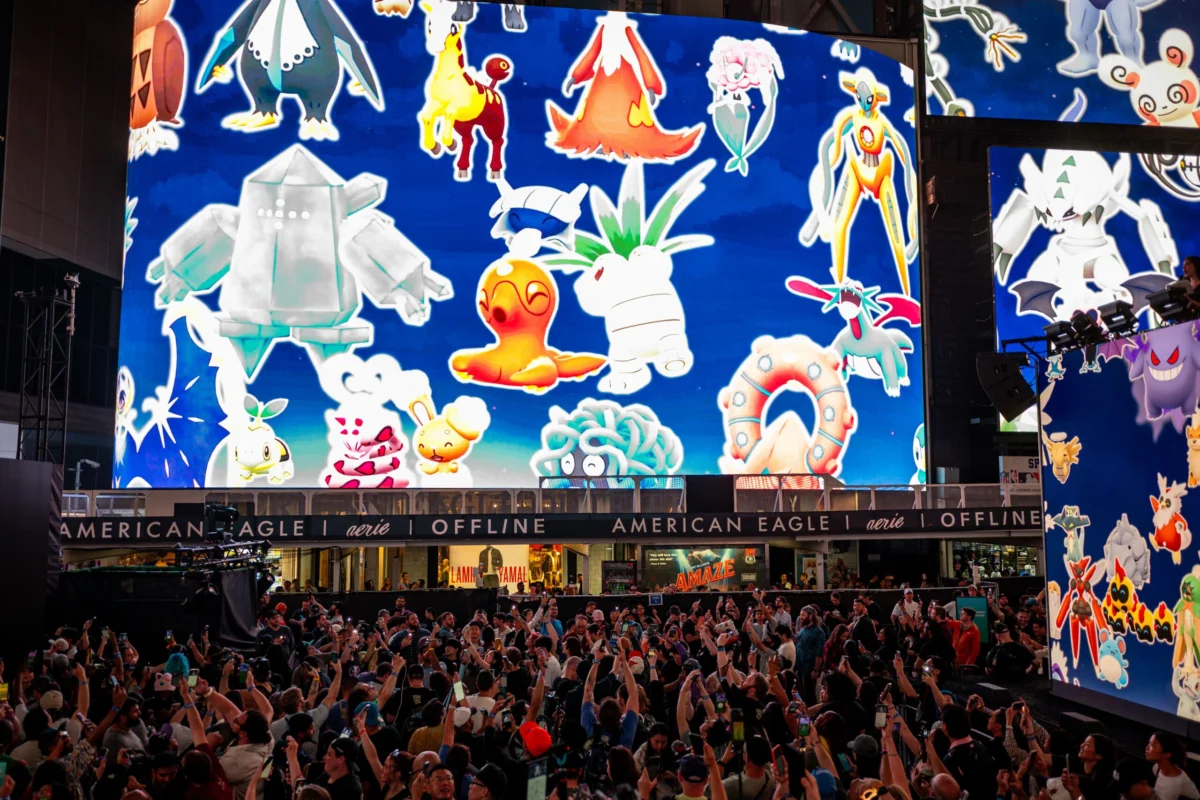
The air in Times Square on Thursday evening was electric, charged by a unique convergence of meteorological phenomena and digital spectacle. Under a steady rain, thousands of virtual Pokémon unleashed a barrage of attacks, including Thunderbolt and Hyper Beam, against the legendary Mega Mewtwo Y. Below the towering digital billboards, more than 1,500 real-world trainers gathered for what has been described as one of the largest concentrated in-person Pokémon battles in the history of mobile gaming. This gathering was not merely a casual meet-up but a high-stakes coordinated raid, marking the 10th anniversary of Pokémon Go, the mixed-reality title that redefined the intersection of physical space and digital entertainment.
Launched by Niantic in 2016, Pokémon Go became an overnight cultural phenomenon, bringing augmented reality (AR) to the mainstream. In its debut month, the game recorded more than 130 million downloads, reaching a staggering peak of 232 million active players within its first year. The game’s financial trajectory was equally historic, generating nearly $1 billion in revenue in 2016 alone. Over the subsequent decade, the title has transitioned from a viral trend into a "forever game," a term used in the industry to describe live-service titles with sustained, multi-year engagement. As of 2024, data from Statista indicates that Pokémon Go has surpassed $6 billion in lifetime player spending, a milestone that cemented its value during its $3.5 billion acquisition by Scopely, one of the world’s largest mobile publishers, in 2023.
A Promise Fulfilled: From Trailer to Reality
For long-time players, the scene in Times Square was the realization of a decade-old promise. In the game’s original 2016 reveal trailer, Niantic depicted a swarm of trainers rushing toward the iconic New York City intersection. In that cinematic vision, every billboard was synchronized to display a countdown for a massive battle against Mewtwo. While the game launched with many of those features absent—such as trainer-to-trainer trading and real-time competitive battling—the developers have spent the last ten years incrementally closing the gap between the marketing vision and the user experience.

Michael Steranka, Vice President of Product at Scopely, who has been with the Pokémon Go team since 2017, noted the significance of the event. "We sort of made promises to players on the type of game that this was going to be," Steranka stated. "Now, 10 years later, when we look back at that trailer, we feel like we’ve actually delivered on a lot of the promises made there." The Times Square raid represented the first time the company successfully recreated the trailer’s centerpiece on such a massive, synchronized scale, utilizing the very screens that define the Manhattan skyline.
The Logistics of a Digital Siege
Managing a crowd of thousands in one of the world’s most congested urban environments required surgical precision. To prevent the event from devolving into a public safety hazard, Scopely and Niantic utilized an invitation-only system. Roughly 2,000 tickets were distributed to players across New York City’s five boroughs through "community ambassadors"—vetted volunteers who act as liaisons between the developers and local player bases.
The event was shrouded in a degree of mystery. According to Mark Van Lommel, Scopely’s Director of Marketing Communications, invited players were initially only informed of thematic raids occurring in the general vicinity of Times Square. As the evening progressed, mobile notifications directed ticketed participants to the center of the square. The experience was augmented by a live EDM performance from the duo Loud Luxury, which served as a prelude to the main event. At the climax, Mega Mewtwo Y "took over" the surrounding digital displays, signaling the start of a unified raid. Despite the formidable strength of the digital boss, the collective efforts of the 1,500 trainers led to its eventual defeat.
For those unable to attend the Manhattan event, the experience was livestreamed across Pokémon’s official social and web channels. Furthermore, the company announced that the Mega Mewtwo Y gameplay experience would be rolled out globally as part of a virtual Pokémon Go Fest weekend, allowing millions of trainers worldwide to participate in the raid from their own local environments for free.

A Decade of Data: The Scale of Global Engagement
The statistics surrounding Pokémon Go’s first decade highlight the sheer scale of the platform’s reach. Since 2016, more than 800 million individuals have played the game globally. The collective activity of this user base is staggering: players have caught more than 1 trillion Pokémon and walked a combined distance of more than 62 billion miles.
In 2024, despite the aging of the platform, the game maintained more than 100 million active players and generated $1 billion in annual revenue. Engagement metrics remain robust, with active players spending an average of 45 minutes per day within the app. Perhaps most importantly for the developers, the game has seen a resurgence in growth following the Scopely acquisition. Since last year, daily playtime has increased by 10 percent, while real-world exploration—measured by the physical distance players travel—has risen by 29 percent.
The Evolution of Community and Technical Infrastructure
The success of the Times Square event stands in stark contrast to the game’s early technical struggles. In 2017, the inaugural Pokémon Go Fest in Chicago was widely criticized as a "disaster" due to overloaded cellular networks and server crashes that rendered the game unplayable for thousands of attendees. Howie Ragunton, a US Federal Aviation Administration worker and a player since 2016, recalled the frustration of those early days. "They’ve learned throughout the years," Ragunton said, noting that the infrastructure has become significantly more resilient.
Ragunton’s personal story mirrors the social impact the game has had on its most dedicated users. He met his wife through the game and proposed to her at a Pokémon Go event in June. "The game helped me socialize; it made me go out, and that’s kind of what I love about it," he explained. Beyond the social aspect, Ragunton is a contributor to the Niantic Wayfarer program, a platform where players nominate local landmarks to become "PokéStops" or "Gyms." This crowd-sourced data not only populates the world of Pokémon Go but also provides valuable geospatial mapping data that Scopely uses to refine its other titles.

Kim Adams, Vice President of Game Development for Pokémon Go, emphasized that the player community is the game’s most vital asset. In the last two years, the company has expanded its community ambassador program from 50 volunteers to more than 3,000 worldwide. "We are nothing without all of those people who contributed to the game in that way; we are in service of them," Adams said.
Strategic Outlook and the Road to 2036
As Pokémon Go enters its second decade, the strategic focus has shifted toward ensuring the game remains a multi-generational staple. The "Pokémon" brand itself provides a powerful foundation, but the developers believe the in-person social structures are what will sustain the game until its 20th anniversary in 2036.
Steranka highlighted the game’s unique ability to bridge age gaps. "I will go out to a park with my mom, who’s turning 70 next week, my wife, and my two kids… and all of us can enjoy Pokémon Go together," he said. This multi-generational appeal is a core pillar of the development roadmap. While the company remains tight-lipped about future hardware integrations—such as dedicated AR glasses or new wearables—Steranka confirmed that the engineering team is constantly evaluating new technologies. However, he stressed that technology would only be adopted if it genuinely enhanced the immersion of the player experience rather than for the sake of novelty.
The acquisition by Scopely appears to have provided the resources necessary for this long-term vision. Adams described the company as being "supercharged" for the future, with plans to double down on community-centric features. "People right now need more joy in their lives," Adams remarked. "Life can get particularly hard, and if I’m standing in the grocery store line and some Pokémon can brighten my day, I’m not the only one. To them and to us, it’s not just a game."

Analysis of Implications for the AR Industry
The longevity of Pokémon Go serves as a critical case study for the broader augmented reality and gaming industries. While many other high-profile AR titles—including those based on the Harry Potter and Marvel franchises—have struggled to maintain a player base and were eventually shuttered, Pokémon Go has thrived. Analysts attribute this success to a combination of a perfectly suited intellectual property, a first-mover advantage, and a pivot toward community-led events rather than purely digital ones.
By transforming physical landmarks into digital hubs, the game has created a new form of "digital tourism." Major live events like those in Times Square or the annual Go Fests in cities like London, Osaka, and Chicago generate significant economic activity, with the game selling nearly 1 million event tickets in 2024 alone. As the boundary between the physical and digital worlds continues to blur, the lessons learned from Pokémon Go’s first ten years will likely inform the next generation of spatial computing and social entertainment. For now, the victory in Times Square stands as a testament to the enduring power of a digital world mapped onto our own.