
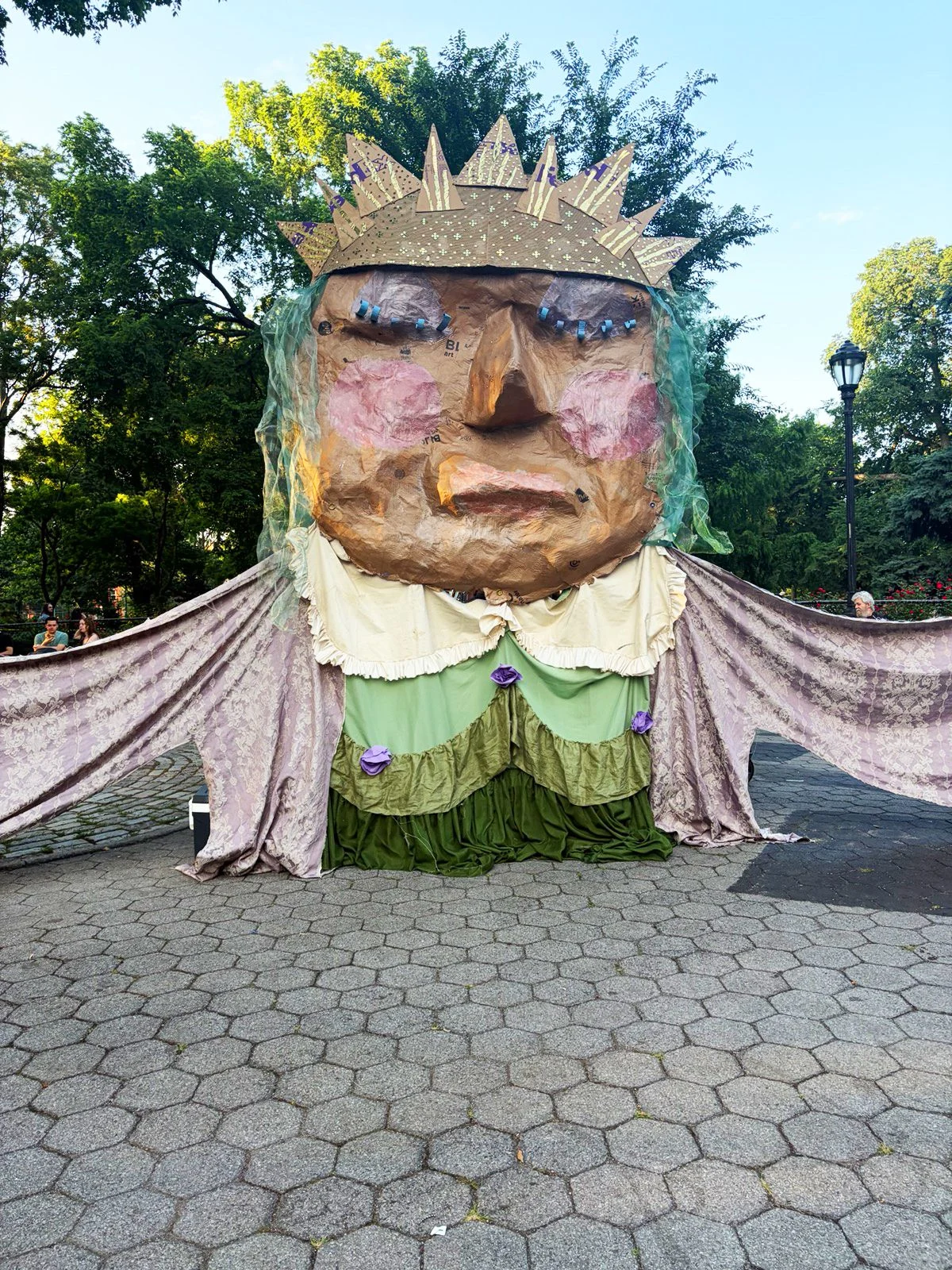
On a humid Sunday evening in New York City’s Tompkins Square Park, a crowd of several hundred gathered not for a digital spectacle, but for a performance rooted in the physical and the historical. Against the backdrop of a towering papier-mâché face of a crowned woman—a stage piece doubling as a curtain for actors—the "Summer of Ludd" officially commenced. This week-long series of events, centered in the heart of the East Village, represents a burgeoning counter-cultural movement aimed at challenging the hegemony of modern technology and reclaiming human connection from the digital sphere.
The inaugural performance, titled "Luddite Recreations," served as a dramatic retelling of the 19th-century Luddite movement. Historically, the Luddites were a clandestine group of English textile workers and artisans who, between 1811 and 1816, protested the introduction of machinery that threatened their livelihoods and the quality of their craft. Far from being "anti-technology" in a primitive sense, the original Luddites were skilled laborers resisting the "fraudulent and deceitful" use of machines to bypass standard labor practices. In 2024, this sentiment has found a new resonance among a generation of New Yorkers disillusioned by social media, generative artificial intelligence (AI), and the pervasive surveillance of the modern internet.

The Philosophical Framework of the Summer of Ludd
The Summer of Ludd is structured as a series of workshops, talks, and community activities designed to facilitate "off-tech" alternatives to daily life. The curriculum includes sessions on offline dating and flirting, textile mending, and strategies for resisting the expansion of data centers—the physical infrastructure of the cloud that consumes vast amounts of energy and water. The movement is characterized by a deliberate rejection of digital promotion; the organizers eschewed social media advertising in favor of hand-distributed booklets and wheat-pasted posters throughout the neighborhood bearing the slogan "only in real life!"
Central to the movement’s philosophy is the concept of "attention fracking," a term utilized by the School of Radical Attention, a participant organization. This concept posits that tech companies extract value from human attention in a manner similar to the extraction of fossil fuels, leaving individuals cognitively depleted and socially alienated. By organizing events that prohibit filming, recording, or the use of smartphones, the Summer of Ludd seeks to create a "sacred" space for human interaction that is shielded from the data-harvesting mechanisms of Silicon Valley.
A Chronology of Resistance and Community Engagement
The planning for the Summer of Ludd reportedly began in January, orchestrated by a decentralized collective of organizers who have opted for anonymity to avoid the scrutiny of digital platforms. The group’s public face is a puppet named "Gowanus," a blue cloth figure with soda-cap eyes, which conducted a press conference to announce the festival’s goals. According to the organizers, the choice of a puppet spokesperson allows the movement to communicate its message without creating individual "influencers" or digital footprints for its leaders.

The schedule of events reflects a diverse array of interests:
- July 1–3: Workshops on shortwave radio and walkie-talkie communication, providing technical skills for long-distance interaction without reliance on cellular networks or internet service providers.
- July 2: A "Google in Real Life" session where participants shared expertise on topics ranging from tarot reading to technical repair, emphasizing the value of human-to-human knowledge transfer over algorithmic search results.
- July 4: A community beach cookout, designed as a tech-free alternative to traditional holiday gatherings.
- July 5: Closing ceremonies and a final push for "platformless" political engagement.
The movement also intersects with academic and political spheres. Parallel to the park events, a Luddite-themed conference was held at The New School, where speakers addressed the "kill chain" of AI in military applications and the broader ethical implications of automated systems. Furthermore, the festival saw the announcement of a "platformless" run for the presidency by Dan Fox, an advocate for "dumbphones" and phone-free social gatherings.
Supporting Data: The Gen Z Shift and Digital Fatigue
The Summer of Ludd arrives at a time when public sentiment toward technology is shifting significantly, particularly among younger demographics. While Generation Z is often characterized as "digital natives," data suggests a growing trend of tech-skepticism within this cohort. According to a 2025 Pew Research Center study, 48 percent of teenagers reported that social media has a negative impact on people their age, a sharp increase from 32 percent in 2022.

This skepticism is mirrored in consumer behavior. The market for "dumbphones"—basic devices with limited or no internet connectivity—has seen a resurgence. Companies like Light Phone, which produce devices designed specifically to be used as little as possible, have reported increased interest from users looking to escape the "attention economy."
Furthermore, the broader cultural landscape shows signs of "app fatigue." Reports from health and lifestyle analysts indicate a decline in the satisfaction levels of dating app users, leading to a rise in in-person social clubs, such as run clubs and hobby-based meetups, which prioritize physical presence over digital matching.
Labor Implications and the Critique of Generative AI
A significant portion of the movement’s energy is directed toward the critique of generative AI. At the Tompkins Square Park events, zines with titles like "Why GenAI Sucks" were distributed alongside literature on how to exit proprietary platforms like Spotify. The concerns raised by attendees often center on the displacement of human creativity and the degradation of professional standards.

One attendee, a former security engineer at a major tech firm who requested anonymity, noted that he resigned after his leadership began encouraging non-technical staff to produce code using AI-assisted tools. "From a security perspective, pushing AI-generated code to production without rigorous human oversight is deeply concerning," he stated. His perspective highlights a core Luddite tenet: the resistance is not against the tool itself, but against how the tool is used to devalue expertise and compromise safety for the sake of corporate efficiency.
Damian Thomas, a web developer and founder of Unplatform, echoed these sentiments. He argued that the modern tech landscape mirrors the industrial era where workers were forced to rent the "big machines" of infrastructure. "With SaaS (Software as a Service) and AI models, we are seeing a return to that dependency. It’s about building infrastructure that doesn’t push people into these proprietary silos," Thomas explained.
Professional Analysis: Implications and Long-term Viability
Despite the enthusiasm of the Summer of Ludd participants, some experts remain skeptical about the movement’s ability to effect systemic change. Andrew Maynard, a professor of advanced technology transitions at Arizona State University, notes that while the questions raised by the movement are "critically important," individual lifestyle changes rarely disrupt the momentum of global technological shifts.

"Even when people agree that these technologies are harmful, it rarely impacts the way they live their lives on a large scale. They are still tethered to their phones for work, education, and essential services," Maynard observed. However, he acknowledged that the movement serves as a vital "pushback" that asserts human autonomy in an increasingly automated world.
The Summer of Ludd’s primary success may lie in its ability to foster "real-life" community in an era of digital isolation. By providing a physical space for dissent, the organizers have tapped into a latent desire for a "slow" culture—one where the speed of interaction is governed by human capacity rather than algorithmic optimization.
Conclusion: A Growing Counter-Culture
As the Summer of Ludd concludes, the movement leaves behind a neighborhood revitalized by analog interaction and a series of lingering questions about the future of the digital age. The event was not merely a nostalgic exercise but a pointed political statement against the "fracking" of human attention and the monopolization of social life by a handful of Silicon Valley corporations.

Whether the "Luddite Renaissance" can transition from a week of park performances to a sustained political and social force remains to be seen. However, the presence of 300 people in a park, voluntarily tucking their phones away to watch a play about 19th-century rebels, suggests that the appetite for a life "unplugged" is more than just a passing trend. It is a reflection of a society beginning to grapple with the true cost of its digital conveniences and seeking, however tentatively, a way back to the "sacred human interactions" that define the human experience.