

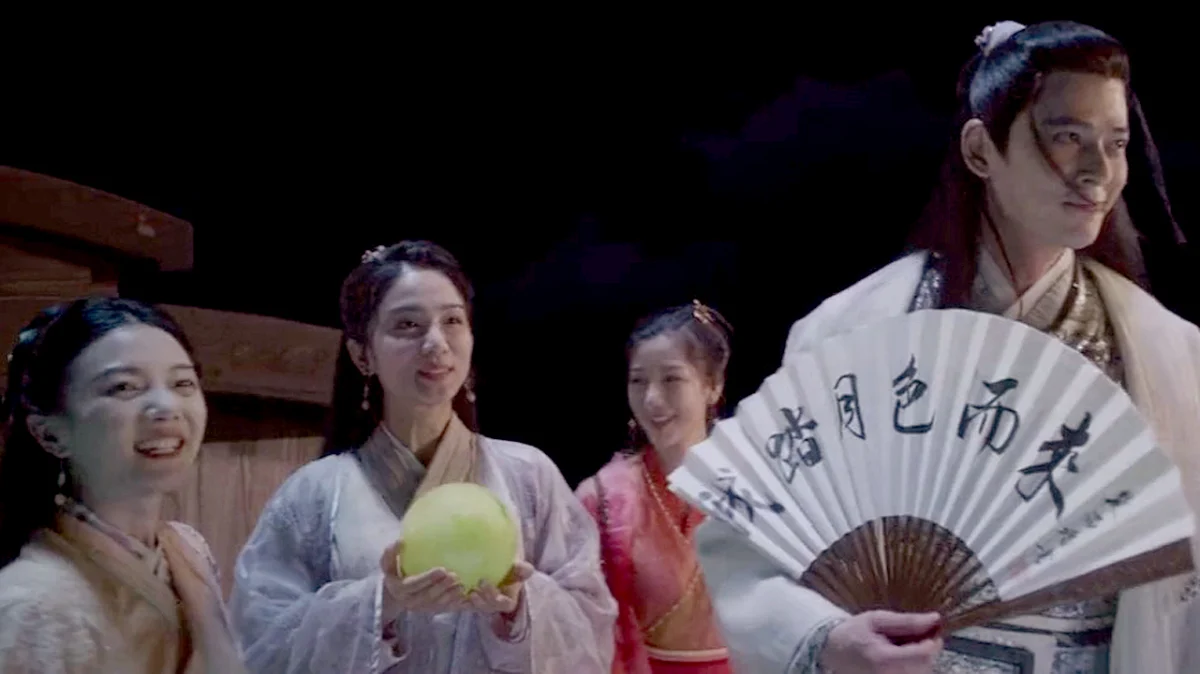
The year 2021 saw the release of "Chief of Thieves: Chu Liu Xiang," a Chinese online production that attempts to bring the legendary wuxia character created by Gu Long to a new generation of viewers. Adapted from "Xuehai Piaoxiang" (Fragrance of the Sea of Blood), the inaugural novel in Gu Long’s celebrated series, the film plunges into the martial arts underworld, following the titular hero, Chu Liu Xiang, a figure renowned for his chivalrous thievery and mastery of unparalleled martial arts. The narrative introduces Chu’s fateful encounter with Mu Qianyu and charts his journey towards embracing his destiny as the "Chief of Thieves," a moniker translating to "Daoshuai." This adaptation, while visually ambitious in parts, presents a complex tapestry of heroism, intrigue, and fantastical elements that invites critical examination of its fidelity to the source material and its effectiveness as a modern wuxia adaptation.
The genesis of Chu Liu Xiang lies within the prolific imagination of Gu Long, a literary titan of the wuxia genre. Gu Long, born Xiong Yaohua, revolutionized martial arts fiction with his distinctive prose, focusing on character psychology, philosophical undertones, and intricate plot twists, often deviating from the more traditional narrative structures of his contemporaries. Chu Liu Xiang, whose given name "Liu Xiang" signifies "lingering fragrance," emerged as one of Gu Long’s most enduring creations. He is not merely a martial artist but a complex anti-hero, a gentleman thief who embodies a unique moral compass. His exploits are characterized by a commitment to justice within the often-unforgiving Jianghu (martial arts world), a domain populated by sects, masters, and rivalries. Chu Liu Xiang’s modus operandi involves redistributing wealth from the opulent to the impoverished, a Robin Hood-esque persona that has resonated deeply with readers. His martial prowess is equally legendary, marked by his exceptional Qinggong, the art of weightless movement, and his signature weapon, a metal hand fan, wielded with lethal precision yet never to end a life. This commitment to non-lethality is a defining characteristic, setting him apart from more brutal figures in the genre.
The 2021 adaptation, "Chief of Thieves: Chu Liu Xiang," endeavors to capture the essence of this iconic character, beginning with a pivotal scene that sets the stage for the film’s tone and narrative trajectory. The opening sequence, set against the vast expanse of the ocean, depicts Chu Liu Xiang executing a daring heist. He successfully pilfers a magnificent Night Pearl from the opulent vessel belonging to the formidable Lord Wu. This initial act of thievery, executed with extensive wirework to emphasize Chu’s Qinggong abilities, and a subsequent fistfight, immediately establishes the film’s reliance on visually dynamic, albeit heavily assisted, action sequences. This stylistic choice, while intended to convey the character’s superhuman agility, also foreshadows a narrative that leans heavily on fantastical elements and heightened reality, a hallmark of many wuxia productions.
Central to the film’s plot is the introduction of Mu Qianyu, the newly appointed leader of the Shenshui Palace, a powerful all-female sect. In a strategic maneuver, Mu Qianyu orchestrates a deception, sending a disciple in her stead to a town parade while she herself ventures into a local establishment. It is here that she encounters Chu Liu Xiang. Their meeting is serendipitous, marked by Mu’s display of prowess as she deftly foils a pickpocket using her unique Shenshui Palm technique. This interaction, culminating in a shared drink, appears to serve as a catalyst for Chu Liu Xiang’s decision to fully embrace his role as a "grand thief." The narrative suggests that Mu Qianyu’s confidence, skill, and perhaps her unconventional approach to leadership, inspire Chu, solidifying his commitment to his chosen path.
The Shenshui Palace, a significant power broker in the Central Plains, derives its authority and influence from a mysterious substance known as "Heavenly Divine Water." This potent elixir is the nexus of a brewing conflict, attracting the attention of a group of ambitious Japanese invaders. Their leader, the ronin Tianfeng Shisilang, harbors designs to weaponize the Heavenly Divine Water, aiming to subjugate the land under his dominion. The plot thickens with the infiltration of the palace by a female ninja, who assumes the guise of Mu Qianyu. This infiltrator commits a heinous act, poisoning and assassinating the supreme leader of the Shenshui Palace. The ensuing power vacuum and the ensuing struggle for control of the Heavenly Divine Water subsequently ensnare Chu Liu Xiang and the genuine Mu Qianyu, placing them squarely in the crosshairs of both the invaders and internal factions vying for power.
The casting of Dylan Kuo (Guo Pinchao) as the young Chu Liu Xiang has been a point of contention and discussion among fans and critics. At approximately forty years of age during the production, Kuo’s portrayal of the youthful protagonist has been perceived by some as an incongruity. While the actor reportedly gives his best effort, his performance has been described as somewhat stiff and lacking the inherent charisma and effortless grace often associated with the character. Critics have drawn comparisons to Ti Lung’s iconic portrayal of Chu Liu Xiang in the classic Shaw Brothers production "Clans of Intrigue," suggesting that Kuo’s rendition falls short of capturing the carefree spirit and philosophical depth envisioned by Gu Long. This perceived disconnect has led to observations that Kuo’s Chu Liu Xiang, at times, resembles archetypal characters found in numerous fantasy melodramas rather than the distinctive hero of Gu Long’s novels. The implication is that the adaptation struggles to imbue the character with the essential element of his carefree, almost detached, yet profoundly principled existence.
However, the challenges in portraying Chu Liu Xiang’s core essence are not solely attributable to the actor’s performance. The film’s narrative structure and internal logic have also been cited as contributing factors. The screenplay has been criticized for being heavily contrived and, at times, bordering on the illogical. The central conflict, revolving around the power struggle between the Japanese invaders and the Shenshui Palace, is presented as somewhat untenable, lacking the grounded plausibility that can anchor even fantastical narratives. Furthermore, the screenwriter’s apparent liberty in allowing the protagonists’ fighting skills to fluctuate significantly from scene to scene has been noted. This inconsistency undermines the established martial arts hierarchy and character development. An intriguing, albeit peculiar, revelation within the film is the nature of the "Heavenly Divine Water." It is eventually unveiled to be a form of Chi Kung, or inner energy cultivation, that grants the practitioner the ability to extract bodily fluids and utilize them as formidable projectiles. This unique interpretation of a magical substance adds a layer of surrealism to the martial arts lore presented.
In contrast to the perceived shortcomings in the portrayal of the male lead, Chinese actress Kang Ning has garnered significant praise for her performance as Mu Qianyu. Her depiction of the new leader of the formidable Shenshui Palace, and Chu Liu Xiang’s love interest, has been described as memorable and impressive, imbued with a fiery spirit. The narrative, while ostensibly focused on Chu Liu Xiang, grants Mu Qianyu a role of comparable significance and depth, suggesting that her character development is a strong suit of the production. However, a notable disparity in their apparent ages – Kang Ning being nearly twenty years younger than Dylan Kuo – has contributed to a visual incongruity, making them appear as an unlikely or illogical pairing on screen. The supporting cast also features Zhou Xiaofei in a brief appearance as Shuimu Taiji, the matriarch of the Shenshui Palace. Yue Dongfeng portrays Su Bufan, an elder master, while Joyin Cai plays his daughter, Su Rongrong, who is depicted as having a romantic infatuation with Chu Liu Xiang, adding a romantic subplot to the unfolding events.
The film’s visual presentation, particularly its costume design, has been lauded. Chen Yunzhu, the designer, has been credited with creating visually striking and detailed outfits, especially those worn by the leaders of the Shenshui Palace, which are noted for their vibrant colors and intricate embellishments. Certain visual sequences within the movie have been highlighted as particular strengths, including the depiction of the town parade and Chu Liu Xiang’s serene mountain retreat. The ending theme song has also been singled out for its catchiness and memorability, contributing positively to the overall sensory experience of the film. However, the action choreography, overseen by Chao Wei, has been assessed as merely average. While acknowledging the extensive use of wirework to showcase Chu Liu Xiang’s gravity-defying Qinggong, the choreography itself is said to lack standout moments or innovative sequences that would elevate the fight scenes beyond the conventional.
Ultimately, "Chief of Thieves: Chu Liu Xiang," directed by Dong Wei, can be broadly categorized as a fantasy melodrama with a martial arts component. The film offers decent performances from its cast, but it struggles to fully capture the inherent charm and multifaceted personality of its central character, Chu Liu Xiang, as envisioned by Gu Long. With a runtime of approximately eighty minutes, the production functions as a somewhat loose adaptation of the source material, providing a fairly light and entertaining viewing experience for audiences seeking a modern interpretation of classic wuxia tropes. The film’s exploration of themes such as justice, destiny, and the complexities of power within a fantastical setting, while ambitious, ultimately falls short of delivering a wholly cohesive or deeply resonant narrative. The broader implications of such adaptations lie in their potential to introduce Gu Long’s rich literary universe to new audiences, even if the fidelity and execution of individual projects may vary. The success of such endeavors hinges on balancing faithfulness to the spirit of the original works with the demands and sensibilities of contemporary filmmaking. The reception of "Chief of Thieves: Chu Liu Xiang" suggests that while the foundation of Gu Long’s storytelling remains compelling, translating its nuances to the screen continues to present a significant challenge for filmmakers.