

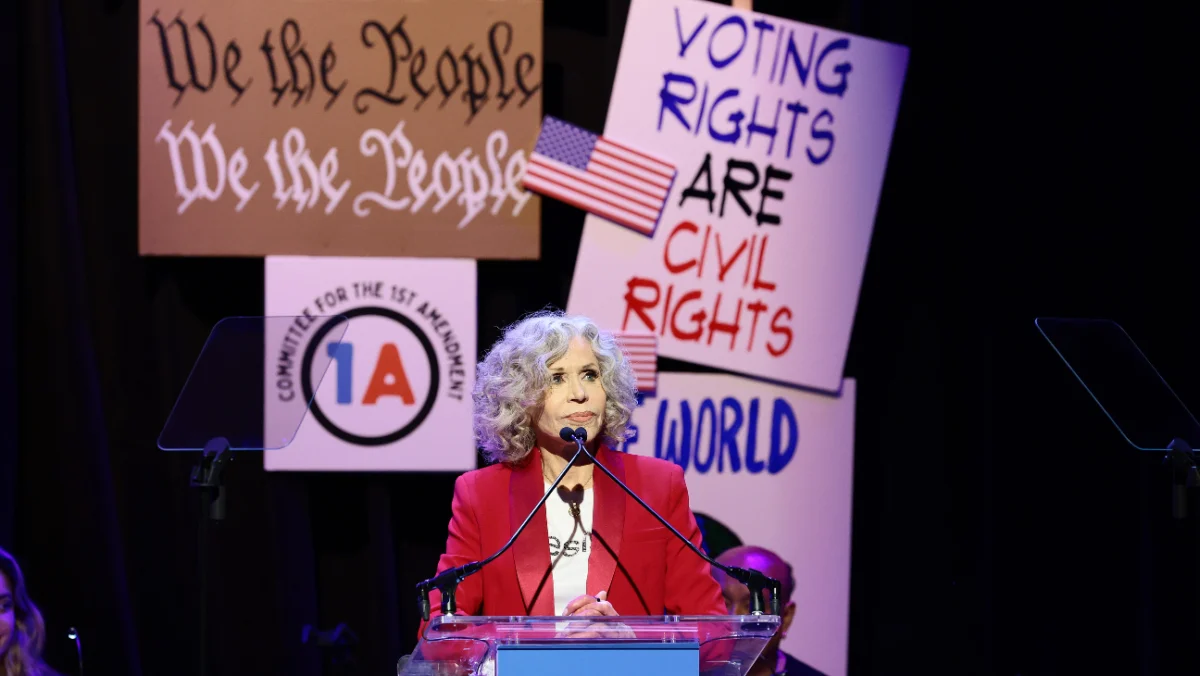
Veteran actress and activist Jane Fonda delivered a fervent address Sunday night, advocating for the foundational principles of the First Amendment at the "Rise Up, Sing Out: A Concert for the First Amendment." The high-profile event, held at The Town Hall in New York City, marked the public re-emergence of the Committee for the First Amendment, an organization initially formed during the tumultuous McCarthy era of 1947 and recently reactivated under Fonda’s stewardship. Her speech underscored growing concerns over what she described as systemic infringements on free expression, particularly targeting artists and cultural institutions.
Fonda’s Urgent Call to Action and Core Accusations
From the stage, Fonda articulated a stark assessment of the current landscape, asserting that "the government and its cronies [are] routinely violating its First Amendment to silence artists." She cited several specific examples to illustrate her point, including the alleged shuttering of institutions like the Kennedy Center, the defunding of museums and the National Endowment for the Arts (NEA), the widespread banning of books, and the cancellation of television hosts who voice dissenting opinions. These actions, she contended, are being enabled by "cowardly corporations" that she chose not to name directly but implicitly criticized for their complicity. Fonda’s remarks painted a picture of a shrinking space for artistic freedom and critical discourse, highlighting a perceived assault on the very mechanisms that allow for open societal debate.
The actress then transitioned to introduce a roster of artists and activists, stating her honor "to pass the mic to artists and activists who continue to speak up and sing out so that we might be inspired to rise up." This handover emphasized the concert’s dual purpose: to illuminate the challenges facing free expression and to galvanize collective action through the power of artistic performance. The event itself served as a powerful demonstration of the very freedoms it sought to protect, bringing together a diverse array of voices to publicly challenge perceived threats to civil liberties.
Reviving a Legacy: The Committee for the First Amendment’s History and Modern Mandate
A significant aspect of the evening was the revival of the Committee for the First Amendment, an organization steeped in Hollywood history. Fonda explained her motivation for reactivating the group, which had originally been a bulwark against the anti-communist hysteria of the late 1940s. The original committee was established in 1947 in response to the House Un-American Activities Committee (HUAC) hearings, which targeted alleged communist influence in the American film industry. This period, known as the McCarthy era, saw many artists, writers, and directors blacklisted, effectively ending their careers. Luminaries like Fonda’s father, Henry Fonda, alongside Humphrey Bogart, Lauren Bacall, and Danny Kaye, were among the original members who bravely stood against the political intimidation tactics of the time. Their collective action aimed to protect the right to free thought and expression against government overreach and the chilling effect of fear.
Fonda stated that the committee was "relaunched last October to bring together the entertainment industry" at a time when "our democracy is in peril." She stressed the imperative for unity within the industry, urging it to be "unified, activated and unwilling to engage in anticipatory obedience." The concept of "anticipatory obedience" refers to the act of self-censorship or conforming to perceived official pressure before any explicit directive is issued, a phenomenon that critics argue can be just as damaging to free expression as overt suppression. By invoking this term, Fonda challenged the industry to resist internalizing fear and to actively champion its collective rights. Her powerful declaration, "They come for one of us, by God, they come for all of us," echoed the historical solidarity that defined the committee’s initial formation and served as a rallying cry for contemporary artists.
The Broader Context of Free Expression Concerns: Data and Trends
Fonda’s speech resonated against a backdrop of increasing national debate surrounding free speech, censorship, and the role of artistic and cultural institutions. The issues she highlighted – book bans, defunding of cultural programs, and silencing dissenting voices – are not isolated incidents but reflect broader trends tracked by various civil liberties and arts advocacy organizations.
For instance, reports from the American Library Association (ALA) consistently show a surge in challenges to library books, particularly those by or about people of color or LGBTQ+ individuals. In 2023, the ALA documented an unprecedented number of attempts to ban or restrict books, with 4,240 unique titles targeted, a 65% increase over 2022 figures. These challenges often originate from organized groups and local political figures, leading to removals from school and public library shelves across numerous states. This trend directly aligns with Fonda’s concern about the suppression of diverse narratives and perspectives.
Similarly, the funding of federal arts and humanities agencies like the National Endowment for the Arts (NEA) and the National Endowment for the Humanities (NEH) has frequently been a political battleground. While the Kennedy Center, a living memorial to John F. Kennedy, receives federal appropriations, debates around the scope and nature of government support for the arts often include calls for cuts from conservative factions who question the value or appropriateness of certain artistic expressions. While direct "shuttering" of institutions due to federal action is rare, significant defunding can severely curtail programs, limit accessibility, and effectively silence certain artistic voices by removing their platforms. Advocacy groups regularly campaign for stable and increased funding for these institutions, arguing their crucial role in fostering cultural enrichment and educational opportunities.
Fonda also touched upon the "canceling of TV hosts who speak out." This phenomenon, often occurring in the highly polarized media landscape, involves public pressure campaigns, advertiser boycotts, or network decisions leading to the removal of personalities whose views are deemed controversial or unacceptable by certain segments of the audience or political spectrum. While media companies, as private entities, generally have the right to make editorial decisions, the cumulative effect can contribute to a climate where hosts and commentators feel pressure to self-censor, fearing professional repercussions for expressing certain opinions.
A Non-Partisan Appeal for Universal Rights
Throughout her speech, Fonda emphasized the non-partisan nature of the First Amendment, asserting that its defense transcends political divides. "Those rights are for everyone, everyone. And we must defend them for everyone. Even if we don’t agree with them," she declared. This statement directly addressed the increasing polarization in American society, where free speech debates often become entangled in partisan loyalties. Fonda deliberately reframed the issue as one of fundamental principles: "It’s not about Democrat or Republican, or left or right. It’s about right or wrong."
She specifically decried the practice of attacking individuals and labeling them "terrorists" for exercising their rights and freedoms, a tactic that she argued is inherently "wrong." This sentiment reflects a growing concern among civil liberties advocates that the weaponization of language and the erosion of civil discourse undermine the very spirit of free expression. Fonda’s call for Americans "all across the country, all across the political spectrum, who care about these freedoms, to stand up, creatively, nonviolently, to defend these rights, while we can" was a powerful appeal for broad-based civic engagement. Her warning was stark: "Because if we don’t, we’re not gonna have any rights to descend." This underlined the urgency of the moment, suggesting that inaction could lead to irreversible losses of fundamental liberties.
The Star-Studded Lineup and the Power of Collective Voice
The "Rise Up, Sing Out" concert itself was a testament to the entertainment industry’s capacity for collective action. The event featured a constellation of stars, including Julia Roberts, Robert De Niro, Tessa Thompson, Ayo Edebiri, Bette Midler, Ms. Rachel, Joy Reid, Lily Gladstone, and Patti Smith, among others. Such a lineup not only drew significant public attention but also underscored the broad concern within the artistic community regarding the state of free expression.
The presence of these high-profile individuals lent considerable weight to the committee’s mission. Their participation symbolized a unified stance against perceived threats to artistic freedom and civil liberties. For many attendees, seeing beloved figures actively engaging in advocacy provided both inspiration and a sense of solidarity. The concert format, combining impassioned speeches with musical performances, served as an effective medium for conveying complex messages and galvanizing an audience, demonstrating how artistic expression can itself be a powerful form of protest and advocacy.
Implications and Future Outlook
The revival of the Committee for the First Amendment and the success of the "Rise Up, Sing Out" concert carry significant implications. Firstly, it signals a renewed commitment from a segment of the entertainment industry to engage directly in political advocacy, particularly on issues related to fundamental rights. The historical precedent of the original committee demonstrates the potential for such groups to influence public discourse and offer a collective defense against perceived government overreach.
Secondly, the emphasis on a non-partisan defense of the First Amendment, as articulated by Fonda, attempts to carve out a space for dialogue that transcends the current political polarization. Whether this approach can effectively unite diverse segments of the population remains to be seen, but it represents a deliberate effort to focus on shared constitutional values rather than partisan divides.
Finally, the concert and Fonda’s speech serve as a prominent reminder of the ongoing vigilance required to protect civil liberties. In an era marked by rapid technological change, evolving media landscapes, and persistent cultural battles, the boundaries of free expression are constantly being tested. The Committee for the First Amendment, now reactivated, aims to be a consistent voice in these debates, advocating for the rights of artists and all citizens to speak, create, and express themselves without fear of repression or reprisal. The challenge for the revived committee will be to translate the energy and star power of Sunday night’s event into sustained advocacy and tangible action that resonates beyond the confines of New York City and the entertainment industry.