

The unsettling nature of auditory anomalies, particularly those that pierce the silence of the night, has long been a fertile ground for narrative exploration. Director Henry Chaisson’s debut feature, "Recluse," attempts to tap into this primal fear, presenting a story rooted in the uncanny power of sound and the dark undercurrents of familial history. The film centers on Joan, a movie audio engineer whose professional acumen for discerning subtle sonic details becomes her unwilling guide into a labyrinth of ancestral secrets and a palpable, unseen malevolence that permeates her childhood home.
The premise of "Recluse" echoes the thematic territory explored in Ian Tuason’s earlier directorial effort, "Undertone." Tuason’s film, released earlier this year, masterfully employed unsettling, distorted audio recordings to unearth hidden familial traumas, demonstrating the potent impact of sound design in generating an atmosphere of dread even in the absence of overt visual scares. Chaisson’s venture, on its surface, appears to follow a similar sonic-driven mystery, promising an immersive dive into the psychological and supernatural implications of what we hear, or perhaps, what we think we hear. However, the execution of "Recluse" struggles to translate its compelling theoretical framework into a cohesive and impactful cinematic experience, ultimately succumbing to an inconsistent directorial vision and a screenplay that, at times, feels more like a series of disconnected observations than a fully realized narrative.
The Narrative Unravels: A Return to the Familial Estate
At the heart of "Recluse" is Joan, portrayed by Sasha Frolova, a skilled audio engineer whose life is defined by her acute sensitivity to sound. Her world is upended when a cryptic and disquieting voicemail from her estranged father, a once-prominent artist now confined to his bed following a devastating studio fire, compels her to return to her decaying ancestral mansion. The fire, which not only left her father physically incapacitated but also seemingly consumed much of his creative output and personal effects, serves as a catalytic event, forcing Joan back into a landscape fraught with unresolved grief and unspoken histories.
The film positions Joan’s return not merely as a familial obligation but as an investigation, driven by her professional curiosity and a deep-seated need to understand the fragmented whispers emanating from her father’s voicemail. This initial setup suggests a narrative that will intricately weave together the technical expertise of its protagonist with the supernatural phenomena she encounters. The mansion, a character in itself, is depicted as a repository of the past, its decaying grandeur hinting at a once-vibrant existence now overshadowed by a pervasive gloom.
Upon arrival, Joan encounters the household staff, notably the housekeeper Lydia, played by Toby Poser, and the nurse Emily, portrayed by Mia Vallet. These characters are imbued with an "intriguingly off-kilter energy," a deliberate choice by Chaisson to introduce an element of ambiguity and potential menace. Their presence within the isolated estate immediately raises questions about their roles, loyalties, and any potential involvement in the unfolding events. Their interactions with Joan are often stilted, laden with subtext that, while intended to build suspense, often feels more like expositional placeholders.
As Joan navigates the oppressive atmosphere of the mansion, she is inexorably drawn into the unresolved mystery surrounding her mother’s cold-case disappearance. This personal tragedy, long buried beneath layers of family silence, becomes intertwined with the present-day manifestations of the house’s dark energy. The narrative threads of her father’s decline, her mother’s vanishing, and the spectral activity within the mansion are presented as intrinsically linked, suggesting a profound and perhaps sinister connection.
A Muddled Tapestry of Unfulfilled Potential
Despite the promising premise, "Recluse" falters in its execution, struggling to coalesce its various narrative strands into a coherent and compelling whole. The screenplay, penned by Chaisson himself, introduces a multitude of thematic and plot elements that feel underdeveloped, resembling "rough drafts" rather than fully integrated components of a cohesive story. The film grapples with questions of artistic creation and its potential connection to suffering, hinted at by the father’s status as a controversial artist and the presence of his works within the mansion. However, this thematic exploration remains superficial, lacking the depth required to resonate beyond a surface-level observation.
The characterizations in "Recluse" are notably thin, leaving their individual motivations and their interrelationships shrouded in a fog of ambiguity that often borders on nonsensical. This lack of clear character development makes it difficult for the audience to invest emotionally in their plights or to understand the stakes of their involvement in the unfolding supernatural drama. For instance, the motivations of Lydia and Emily, the household staff, remain opaque throughout much of the film, their actions and dialogue often serving as narrative devices rather than revealing glimpses into their inner lives.
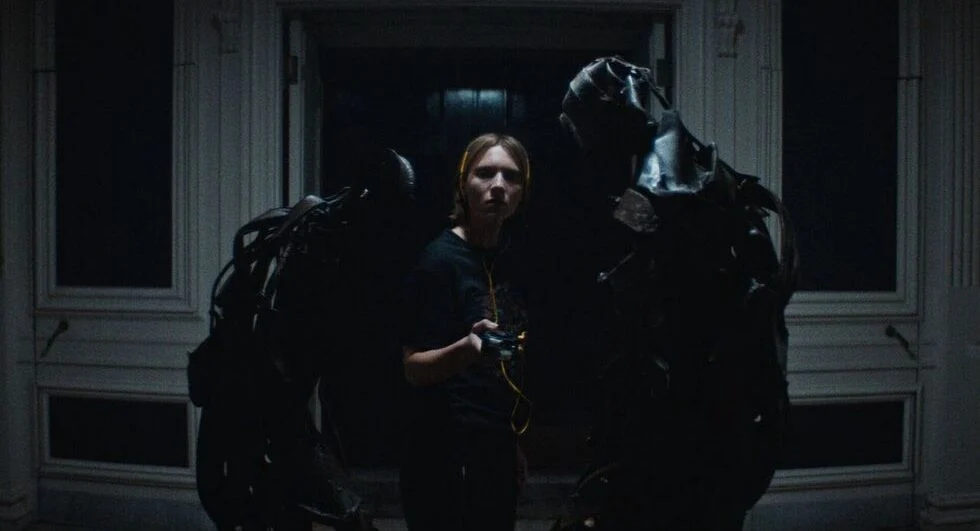
A particularly jarring example of the film’s unfocused storytelling is a scene featuring an "eerie mask reveal" late in the narrative. This moment, intended to be a significant turning point or revelation, feels abruptly inserted, lacking any discernible buildup or cohesive integration into the overarching plot. It exemplifies a pattern where plot developments feel disconnected from any established reality within the film, often appearing derivative of established horror tropes without adding a fresh perspective or contributing to a unique narrative arc. The film’s reliance on a "show-and-tell" approach, where intended scares and mysteries are overtly presented rather than subtly implied, significantly diminishes the potential for genuine suspense and allows very little room for audience interpretation or imagination.
Sonic Ambitions Undermined by Execution
"Recluse" shines brightest in moments where the camera deliberately focuses on Joan’s isolation and her meticulous process of capturing and analyzing ambient sounds. These instances, where her professional skills intersect with the unsettling occurrences, offer glimpses of the film’s intended impact. A standout scene involves Joan positioned outside her father’s recovery room, eavesdropping on a muffled conversation between him and his nurse, Emily. This moment effectively utilizes sound design to build an atmosphere of intrigue and foreboding, hinting at the potential for a deeply immersive auditory horror experience.
However, such potent moments are regrettably few and far between. The film frequently cuts short promising buildups of tension, thereby squandering opportunities to delve deeper into Joan’s fascination with auditory phenomena and its connection to her psychological state. While Joan’s profession as a movie audio engineer presents a rich vein of character exploration, the film fails to adequately explore her interior world or develop her personality beyond her professional role. Her reactions to the escalating paranormal events, despite Sasha Frolova’s committed performance, often lack the emotional resonance necessary to support the film’s otherwise serious and somber tone. The stilted dialogue and limited characterization create a distance between Joan and the audience, leaving a sense of frustrating emptiness, particularly given her centrality to the narrative. The film’s tendency to sideline Joan’s perspective in favor of what are perceived as more "tedious" supporting characters, who themselves often embody genre clichés, further detracts from the core narrative and Joan’s potential for emotional engagement.
A Contradictory Approach to Horror
"Recluse" operates under a dualistic approach to horror, oscillating between a "less is more" philosophy and a more overt, literal depiction of malevolent forces. This inconsistency prevents the film from establishing a clear and effective tone. For every moment of subtle dread, characterized by shadowy figures or ominous architectural details, there is an immediate counterpoint of explicit scares. The recurring presence of Joan’s bandaged father, intended to be a source of threat, is often reduced to generic jump scares, accompanied by music that signals impending danger in a predictable fashion. These attempts at generating fear feel forced and repetitive, lacking the originality or psychological depth that could have elevated the film.
While there are instances where Chaisson attempts to craft slow-burning tension through sound work, these sequences often drag, causing the narrative momentum to dissipate before any significant impact can be achieved. The mansion, with its collection of paintings and sculptures, provides a visually rich backdrop, allowing for some atmospheric shots, such as the striking "wood man" art piece situated on the estate grounds. This artwork, attributed to one of the mansion’s staff, serves as a visual anchor for Chaisson’s recurring theme that "creation and suffering are inextricably linked." Yet, this thematic exploration, like many others in the film, remains on the surface, failing to be compellingly explored or integrated into the emotional core of the narrative.
Implications and Concluding Thoughts
"Recluse" ultimately struggles to penetrate the surface of its intriguing premise. While Director Henry Chaisson demonstrates a visual aptitude for establishing an atmospheric tone, the film’s narrative development lacks precision, and its horror elements fail to generate genuine tension or lasting impact. The inherent potential of the plot—a sound engineer confronting familial demons through auditory clues—is hampered by a lack of deep character introspection. Had the characters been afforded more internal dialogue and psychological exploration, the ominous recordings that haunt them might have resonated more profoundly. Instead, their journeys become a chore to follow, and the increasing intertwining of their fates only serves to further diminish the storytelling’s coherence.
The film’s reliance on vaguely defined characters and sporadically placed sound effects contributes to an ending that is, unfortunately, instantly forgettable. The promising foundation of a sonically driven mystery collapses under the weight of inconsistent direction, a muddled screenplay, and underdeveloped characters. The film’s running time of 102 minutes feels protracted due to the narrative’s inability to maintain engagement, leaving the audience with a sense of missed opportunity. The cast, which includes Sasha Frolova, Xander Berkeley, Toby Poser, Mia Vallet, Kimball Farley, and Frankie Seratch, performs competently within the confines of the material, but even their efforts cannot salvage a film that fails to deliver on its own ambitious promises. The implications of "Recluse" are that even the most innovative conceptual frameworks require robust execution to translate into compelling cinema, and in this instance, the echoes of what could have been are far more resonant than the film itself.