
The arrival of Silent Friend in North American theaters marks a significant milestone in the storied career of Tony Leung Chiu-wai, a performer widely regarded as one of the most influential actors in the history of global cinema. Directed by the Academy Award-nominated Hungarian filmmaker Ildikó Enyedi, the film serves as a meditative exploration of connection, consciousness, and the passage of time. The release, which occurred on May 8 via the distributor 1-2 Special, coincided with a comprehensive retrospective of Leung’s work at Film at Lincoln Center, signaling his first major promotional appearance in New York City in nearly a quarter of a century.
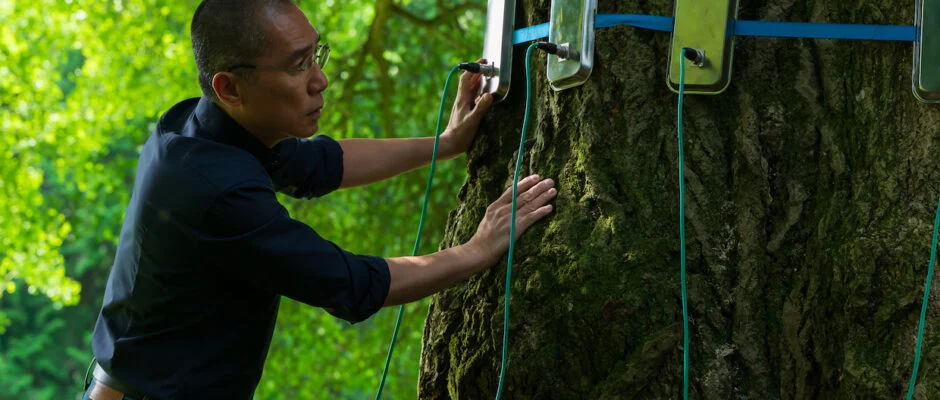
Silent Friend is structured as a triptych narrative, centering on a single ginkgo tree located in the botanical garden of Marburg, Germany. The film traces the interactions between various human characters and this ancient tree across three distinct eras: 1908, 1972, and 2020. Leung anchors the final segment of the film, portraying a renowned neuroscientist whose life and research are abruptly interrupted by the onset of the COVID-19 pandemic. As his professional world contracts due to lockdowns and social distancing, his character develops a profound, almost spiritual preoccupation with the 200-year-old ginkgo, attempting to bridge the gap between human neurological activity and the biological rhythms of the plant.
The Narrative Structure and Conceptual Origins of Silent Friend
The collaboration between Enyedi and Leung represents a unique fusion of European art-house sensibilities and the disciplined craft of Hong Kong’s most celebrated leading man. Enyedi, known for her Berlinale Golden Bear-winning film On Body and Soul, conceived Silent Friend as an investigation into the "silent" connections that bind sentient life. The choice of a ginkgo tree—a species often referred to as a "living fossil" due to its lack of close living relatives—serves as a metaphor for endurance and the persistence of memory.
In the 2020 segment, Leung’s character is a scientist specializing in the brain activity of newborns. When the pandemic halts his laboratory work, the narrative shifts toward the philosophical. The character begins to apply his rigorous scientific methodology to the ginkgo tree, questioning the traditional boundaries of consciousness. This role required Leung to balance the cold objectivity of a researcher with the internal vulnerability of a man isolated by a global crisis.
During the production process, Leung immersed himself in the study of neuroscience and plant intelligence for over six months. His preparation involved consulting with academic researchers and exploring the philosophy of consciousness to ensure that his portrayal of a high-level academic was grounded in intellectual authenticity. This dedication included working with a British language coach to adopt a subtle accent reflective of a character who likely studied at elite institutions like Oxford or Cambridge.
A Chronology of a Cinematic Icon: From TVB to Marvel
Tony Leung’s career trajectory is inseparable from the evolution of Hong Kong cinema over the last four decades. He first entered the public eye in 1982 as a co-host of the children’s television program Space Shuttle 035, before transitioning into acting through the TVB training program. Alongside contemporaries such as Andy Lau, he became part of the "Five Tiger Generals of TVB," a group of young actors who dominated the small screen in the early 1980s.
Leung’s transition to film was marked by a series of collaborations with the world’s most visionary directors. His work with Wong Kar-wai is particularly foundational, spanning masterpieces such as Chungking Express (1994), Happy Together (1997), and In the Mood for Love (2000). The latter earned him the Best Actor award at the Cannes Film Festival, making him the first Hong Kong actor to receive the honor.
His filmography is characterized by an extraordinary range of genres:

- Historical Drama: A City of Sadness (1989), directed by Hou Hsiao-hsien, which won the Golden Lion at the Venice Film Festival.
- Action and Crime: Hard Boiled (1992), directed by John Woo, and the critically acclaimed Infernal Affairs (2002), which served as the basis for Martin Scorsese’s The Departed.
- Espionage and Romance: Lust, Caution (2007), directed by Ang Lee.
- Wuxia and Martial Arts: Hero (2002), directed by Zhang Yimou, and The Grandmaster (2013).
- International Blockbusters: His Hollywood debut as Xu Wenwu in Marvel Studios’ Shang-Chi and the Legend of the Ten Rings (2021).
Analysis of Performance Style: The Power of the Gaze
Central to Leung’s acclaim is a performance style often described as "internalized" or "minimalist." Directors frequently cite his eyes as his most potent tool. Ildikó Enyedi observed that Leung possesses a "monk-like" attention to the world, characterized by a gentle but piercing curiosity. Leung has attributed this quality to a difficult childhood, during which he learned to isolate himself and hide his emotions, eventually channeling that suppressed energy into his acting.
In Silent Friend, this trait is utilized to convey the character’s transition from scientific skepticism to a state of wonder. The "Leung gaze" allows the audience to witness the character’s internal transformation without the need for expository dialogue. This ability to communicate complex psychological states through subtle facial shifts has made him a favorite of directors who prioritize visual storytelling over verbal scripts.
Expanding the Range: The Shift Toward Antagonists
In recent years, Leung has deliberately sought out roles that diverge from his established persona as a romantic or heroic lead. This shift toward "villainous" or morally ambiguous characters is evident in his recent output. In The Goldfinger (2023), he reunited with Infernal Affairs co-star Andy Lau to play Henry Ching Yat-yin, a character inspired by the real-life George Tan, the mastermind behind the Carrian Group scandal that rocked Hong Kong’s financial sector in the 1980s.
His portrayal of Xu Wenwu in Shang-Chi was also praised for adding emotional depth and tragic nuance to a traditional antagonist role. By exploring the mindsets of corrupt officials, mysterious tycoons, and power-hungry leaders, Leung continues to challenge his own artistic boundaries. He has noted that playing "bad guys" offers a form of experiential exploration that is absent from his real life, allowing him to inhabit the darker corners of the human psyche.
Industry Context and the Impact of Global Events
The production of Silent Friend was significantly shaped by the real-world events it depicts. The COVID-19 pandemic necessitated strict filming protocols and mirrored the isolation experienced by the characters. Leung noted that his own experience of the pandemic—spent largely in Tokyo during a period of eerie urban stillness—informed his performance.
The film also highlights the increasing trend of cross-cultural collaborations in the independent film sector. By casting a global superstar like Leung in a European production, Enyedi bridges the gap between Eastern and Western cinematic traditions. This synergy is reflective of a broader globalization within the industry, where prestige projects are increasingly drawing from a worldwide talent pool.
Future Projects and Sustained Legacy
As Leung reflects on his career through the Lincoln Center retrospective, his eyes remain on the future. He has confirmed that he is currently collaborating on a new script with legendary Hong Kong director Johnnie To, with production tentatively slated for late 2027. This partnership is highly anticipated by cinephiles, as their previous work on films like The Longest Nite (1998) showcased a grittier, more cynical side of Leung’s talent.
With a career spanning over 40 years, Tony Leung Chiu-wai remains a vital force in contemporary cinema. His involvement in Silent Friend underscores his commitment to projects that prioritize thematic depth and artistic experimentation over commercial formula. As the film reaches global audiences, it serves as a testament to Leung’s enduring ability to captivate viewers through a blend of profound empathy, intellectual rigor, and the unparalleled power of his presence on screen.
The ginkgo tree at the heart of Silent Friend—an organism that survives across centuries—acts as a fitting symbol for Leung’s own career: a steady, silent, and deeply rooted presence in an ever-changing cultural landscape. Through his portrayal of a scientist seeking consciousness in nature, Leung invites the audience to reconsider their own relationship with the world, proving once again that his most impactful performances are those that speak the loudest in their silence.