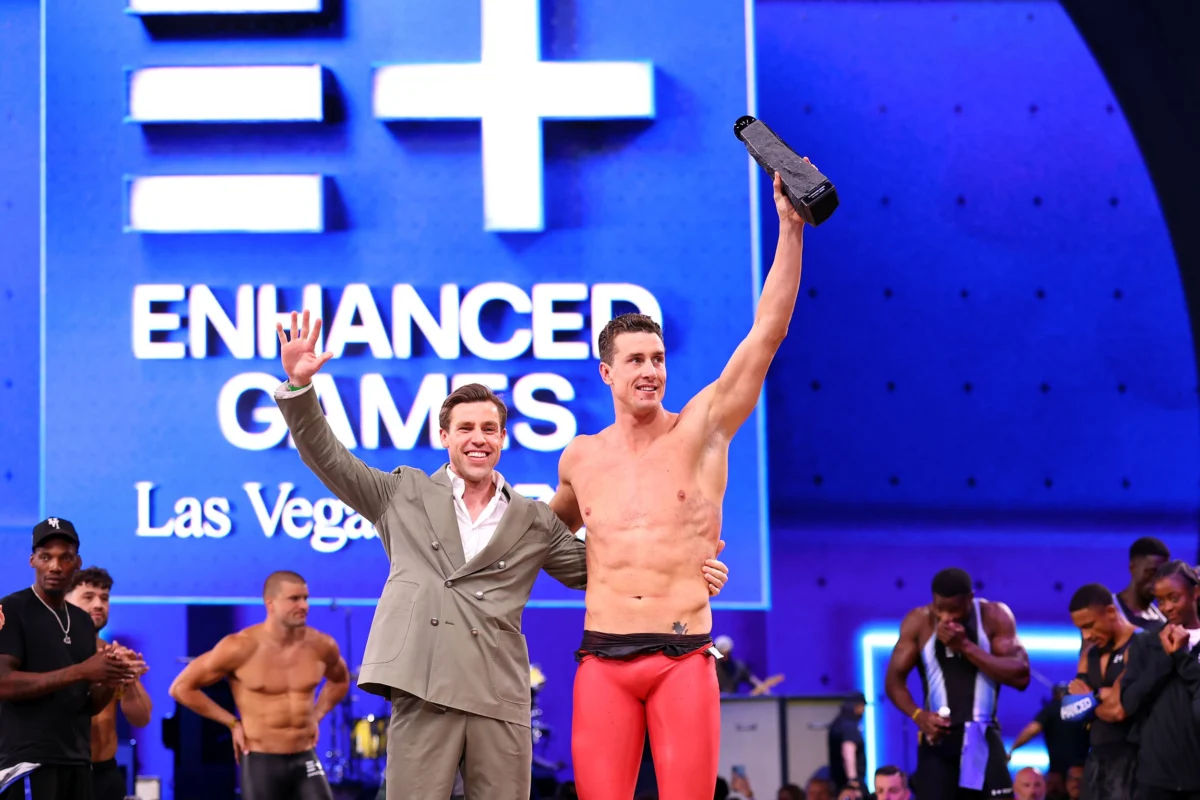
The Las Vegas Strip provided a neon-soaked backdrop for a sporting experiment that has polarized the international athletic community, as the inaugural Enhanced Games concluded with a mixture of technical triumphs and lingering questions regarding the future of human performance. In a purpose-built, $50 million temporary facility, 42 athletes from across the globe gathered not to prove their natural limits, but to showcase what the human body can achieve when augmented by modern pharmacology and advanced technology. The event, which explicitly encourages the use of performance-enhancing drugs (PEDs), represents the most significant challenge to the Olympic "clean sport" paradigm in decades.
The pinnacle of the competition arrived during the final event: the 50-meter freestyle swim. Kristian Gkolomeev, a 32-year-old Greek swimmer and four-time Olympian who had never reached a podium in traditional competition, touched the wall at 20.81 seconds. This time technically eclipsed the official world record of 20.88 seconds, set by Australian Cameron McEvoy at the China Open earlier this year. However, Gkolomeev’s feat was achieved under conditions that would result in a lifetime ban in any other sanctioned arena. Not only was the swimmer utilizing a personalized regimen of PEDs, but he also competed in a "supersuit"—a polyurethane-based garment banned by World Aquatics in 2010 for providing an artificial buoyancy and speed advantage. While the time stands as a "world record" within the internal books of the Enhanced Games, it remains unrecognized by the global sporting establishment.

The Genesis and Framework of the Enhanced Games
The Enhanced Games were conceived by Australian entrepreneur Aron D’Souza and backed by high-profile Silicon Valley investors, including Peter Thiel and Christian Angermayer. The organization’s premise is built on two primary pillars: financial liberation for athletes and a "pro-science" approach to human enhancement. Unlike the Olympic Games, where athletes often struggle for financial stability despite their elite status, the Enhanced Games offered massive incentives, including $250,000 for first-place finishes and a $1 million bonus for breaking a world record.
The event organizers position the competition as a safer alternative to the "shadow doping" they claim is rampant in traditional sports. By bringing PED use out of the darkness and under the supervision of clinical professionals, they argue that they are practicing a form of harm reduction. However, this philosophy has been met with fierce resistance from the World Anti-Doping Agency (WADA) and the International Olympic Committee (IOC), who view the event as a dangerous glorification of substance abuse that undermines the integrity of fair play.
Chronology of the Competition and Athlete Performance
The lead-up to the Games was marked by grand promises of "shattering" long-standing records. American sprinter Fred Kerley, a prominent name in track and field, had publicly vowed to destroy Usain Bolt’s legendary 9.58-second 100-meter dash record. However, the reality on the track told a different story. Kerley clocked in at 9.97 seconds, a respectable time but one that would have placed him last in the final of the 2024 Paris Olympics.

The discrepancy between the hype and the results highlighted a recurring theme throughout the weekend: pharmacology is not a substitute for peak condition, and the transition from "clean" to "enhanced" training does not yield instantaneous, superhuman results. Despite the presence of high-profile figures like Hafthor "Thor" Björnsson—the strongman and actor known for his role in Game of Thrones—the stands remained partially empty, with attendance figures falling short of the organizers’ more optimistic projections. Björnsson, who has been open about his PED use since the age of 19, noted that the Games actually required him to scale back his regimen, as the event restricted athletes to FDA-approved substances, excluding some of the more experimental compounds used in professional strongman circuits.
Clinical Data and Substance Regulation
Central to the Enhanced Games’ marketing is their ongoing clinical trial. Of the 42 participants, 36 were enrolled in a study designed to monitor the effects of supervised PED use. The data released by the organization paints a stark picture of the lengths to which these athletes went to achieve a competitive edge:
- 91% of participants utilized testosterone or testosterone esters.
- 79% of participants used human growth hormone (HGH).
- 62% of participants utilized stimulants, including Adderall and other metabolic modulators.
- Anabolic agents and peptides were common across almost all disciplines, including weightlifting and sprinting.
The organization maintains that because these substances are FDA-approved and administered under medical oversight, the risks are mitigated. However, medical experts and researchers, writing in journals such as Performance Enhancement & Health, warn that the long-term effects of androgenic-anabolic steroids remain severe. These include permanent damage to cardiovascular health, increased risk of stroke, liver dysfunction, and significant psychological volatility. Critics argue that "medical supervision" in this context is a misnomer, as there are no established "safe" levels for using these drugs for non-medical athletic enhancement.

Institutional Backlash and Regulatory Responses
The response from the global sporting community has been one of near-unanimous condemnation. WADA issued a statement describing the event as "dangerous and irresponsible," emphasizing that the pursuit of profit should never supersede the health of athletes. World Aquatics, the governing body for swimming, took a more direct approach by promising to ban any athlete who participated in the Enhanced Games from future sanctioned international competitions, including the Olympics.
This creates a significant crossroad for athletes like Shane Ryan, a three-time Olympic swimmer for Ireland. At 32, Ryan admitted that the financial allure was the primary driver for his participation. He criticized the traditional model where aging athletes are often left without support, leading some to seek unregulated and risky substances on the black market. Ryan argued that the Enhanced Games offer a transparent alternative, though he acknowledged that the event is more "show business" than traditional sport.
The Business of Enhancement: Silicon Valley and Politics
Beyond the pool and the track, the Enhanced Games function as a flagship for a broader commercial ecosystem. The organization’s website features a "Live Enhanced" products page, operating as a telehealth platform for PEDs, growth hormones, and metabolic modulators like GLP-1s. CEO Max Martin has been transparent about the goal: to normalize and monetize human enhancement for the general public, moving these substances from the fringes of bodybuilding into the mainstream of "biohacking" and "longevity" culture.

The event also carries a distinct political undertone, aligned with the "Make America Healthy Again" (MAHA) movement and the libertarian ideologies of its primary investors. Founders have cited figures like Robert F. Kennedy Jr. as being "pro-human enhancement," framing the right to dope as a matter of personal bodily autonomy and technological progress. This intersection of Silicon Valley venture capital, dissident political health movements, and professional sports suggests that the Enhanced Games are intended to be a permanent fixture in the cultural landscape, rather than a one-off spectacle.
Implications for the Future of Sport
The inaugural Enhanced Games leave behind a complex legacy. On one hand, they have successfully created a platform where athletes can earn life-changing sums of money while being honest about their training methods. On the other hand, the event has raised profound ethical questions about the message being sent to younger generations and the potential for a "pharmacological arms race" that could render natural athletic achievement obsolete.
As the organization looks toward next year, with plans for expanded events and deeper integration with its telehealth wing, the divide between "natural" and "enhanced" sport is likely to widen. If Kristian Gkolomeev’s 20.81-second swim is any indication, the technical records will continue to fall, but the debate over the soul of athletics—and what constitutes a "fair" achievement—is only beginning. Whether the public will embrace a future where the chemist is as important as the coach remains the $50 million question.