

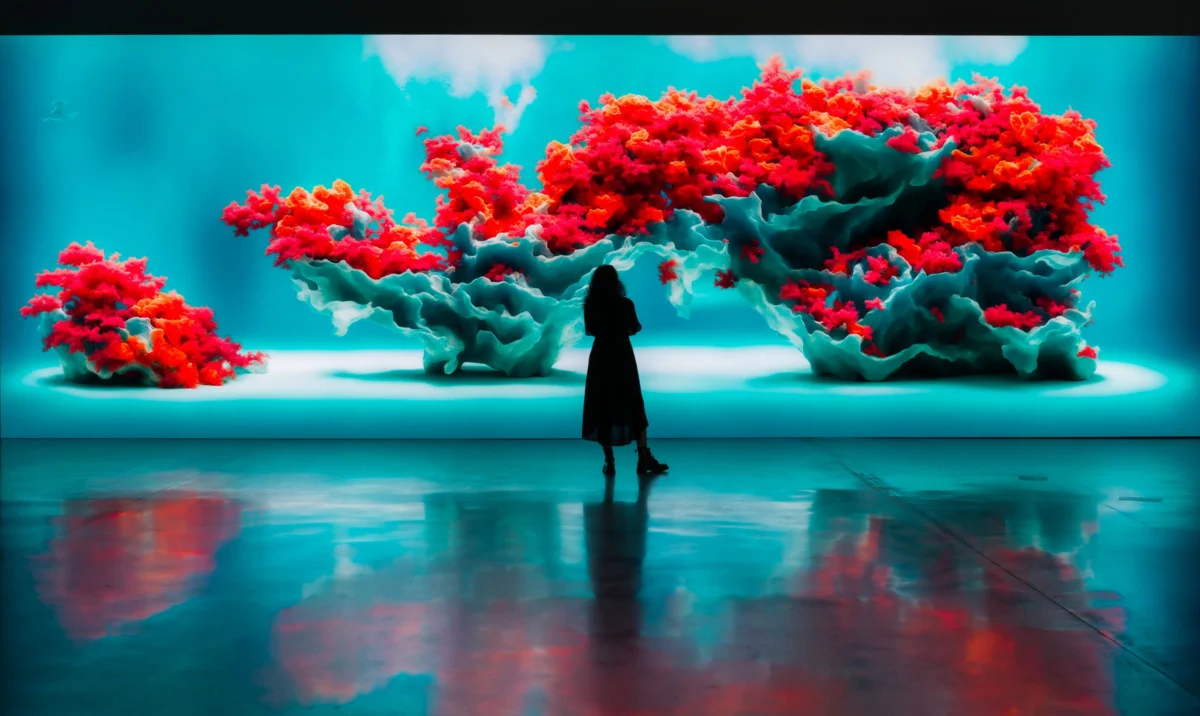
The intersection of generative technology and fine art has reached a significant milestone with the official opening of Dataland, a pioneering institution situated in the heart of downtown Los Angeles. Founded by the internationally acclaimed media artist Refik Anadol and his studio partner Efsun Erkilic, Dataland has been positioned as the world’s first "museum of AI arts." Since its doors opened to the public on June 20, the venue has seen an unprecedented influx of visitors, welcoming more than 10,000 guests in its first two weeks of operation. This surge in public interest comes at a critical juncture for the art world, as critics and creators alike grapple with the ethical, environmental, and aesthetic implications of artificial intelligence.
Refik Anadol, whose career has been defined by a deep exploration of the relationship between human consciousness and machine logic, views this era as a "renaissance" for the arts. This perspective serves as the foundational philosophy for Dataland, which aims to move beyond the controversial "prompt-based" generation often associated with AI. Instead, the museum presents a multi-sensory environment that utilizes vast proprietary datasets, biometric feedback, and sustainable computing to create what Anadol describes as "living, breathing ecosystems."

The Genesis of Dataland and the Machine Dreams Exhibit
The centerpiece of Dataland’s inaugural season is "Machine Dreams: Rainforest," an immersive architectural installation that represents the culmination of three years of intensive research and field data collection. Unlike many contemporary AI projects that rely on scraped internet data, Anadol’s team traveled to the Amazon and other global rainforests to capture raw sensory material. This effort resulted in a massive repository of five petabytes of data, which fuels the "Large Nature Model," a specialized AI system developed by Anadol’s studio.
The experience of "Machine Dreams: Rainforest" is designed to be deeply personal and interactive. Upon entry, visitors undergo a calibration process involving a specialized application and the distribution of wearable devices. These include a smartwatch and a U-shaped plastic collar worn over the shoulders. These biosensors track biometric data, including heart rate and skin temperature, allowing the artwork to respond in real-time to the physiological states of the audience. The installation further distinguishes itself by incorporating olfactory elements; as visitors move through the space, the shoulder harness emits scents—such as the smell of trees or the crisp air of a summer storm—synced to the visual and auditory displays.
Technological Infrastructure and Sustainable Computing
A significant challenge for large-scale AI installations is the immense energy consumption required for real-time data processing. To address this, Dataland has partnered with Google DeepMind and Google Cloud to utilize "experimental low-energy" resources. This collaboration allows the museum to maintain "sustainable compute" practices, a move intended to distance the institution from the environmental criticisms often leveled at the tech industry.

The technical backbone of the exhibition, the Large Nature Model, was built using natural science archives from prestigious institutions, including the Smithsonian. Specifically, the Smithsonian’s Encyclopedia of Life provided data on more than two million species. This high-fidelity data allows the AI to generate what Anadol calls "machine hallucinations"—surreal but scientifically grounded interpretations of nature. By training their own models from scratch rather than relying on pre-existing commercial tools, Anadol’s studio maintains a level of creative and ethical control that is rare in the field of generative art.
The Latent Gallery and the Demystification of AI
One of the most critical components of Dataland is the "Latent Gallery," a space dedicated to transparency and education. In this wing, visitors can interact with consoles that allow them to peer behind the curtain of the AI’s decision-making process. By scrolling through categories such as "Frogs" or "Tropical Plants," guests can view the actual training data—thousands of photographs and scientific records—that the machine uses to construct its "dreams."
This focus on demystification is a deliberate response to the "black box" nature of most AI systems. Anadol argues that by showing the audience the reason for a specific machine hallucination, the museum can foster a deeper understanding of the technology. This transparency also serves an ethical purpose, highlighting that the data was sourced with the consent and participation of researchers and indigenous communities, contrasting with the "extractive" practices that have led to numerous lawsuits against major Silicon Valley firms like OpenAI and Stability AI.

Chronology of Development and Global Context
The opening of Dataland is the latest chapter in a timeline of AI art evolution that has accelerated over the past decade. Refik Anadol’s journey toward this museum began in earnest in 2016, when he became the first person awarded the Google Artists and Machine Intelligence Artist Residency. Since then, his work has appeared in some of the world’s most prominent venues, including the Museum of Modern Art (MoMA) in New York and the Sphere in Las Vegas.
The global art market has seen a rapid shift in its reception of AI. In 2018, the auction house Christie’s sold its first AI-generated portrait for $432,500, signaling institutional interest. However, the subsequent years were marked by a backlash from traditional artists who feared displacement and copyright infringement. Dataland enters this landscape not as a replacement for human creativity, but as a "laboratory of imagination" that seeks to define a new medium. The museum’s success in its opening weeks suggests that there is a significant public appetite for AI art when it is presented with high production values and a clear ethical framework.
Biometric Interaction: The Sanctuary and the Infinity Room
The physical layout of Dataland guides visitors through several distinct "chapters" of machine consciousness. Following the main hall, the "Infinity Room" offers a narrative-driven experience, where a glittery hummingbird leads the audience through a neon-lit, aerial forest. The perspective shifts dynamically, mimicking the sensation of flight and often challenging the visitor’s sense of balance.

The experience concludes in "The Sanctuary," a concept Anadol has developed over several years. In this final room, the biometric information collected from the group is compiled into a collective representation of the room’s energy. This swirling, abstract 3D visualization is unique to each group of visitors and is never repeated. Anadol notes that the artwork can "feel" the audience, picking up on physiological responses such as goosebumps or increased heart rates. This creates a feedback loop where the human emotional state becomes an input for the digital output, blurring the line between the observer and the observed.
Ethical Standards and Data Privacy
In an era of invasive surveillance, Dataland has implemented strict data privacy protocols. Anadol emphasizes that the museum "forgets" a visitor’s biometric data the moment they leave the premises. While visitors receive a personal token at the exit that allows them to access their own data privately, the museum does not retain this information for secondary use. This approach is intended to model a respectful relationship with data, treating it as a "form of memory" rather than a commodity.
This commitment to ethics extends to the sourcing of training data. While Silicon Valley firms face ongoing litigation over the unlicensed use of copyrighted content, Dataland’s reliance on partnerships with scientific institutions and original field recordings provides a legal and moral blueprint for the future of the industry. By obtaining consent from the researchers and communities whose environments are being digitized, Anadol’s studio seeks to establish a more equitable "data economy" within the arts.

Broader Impact and the Future of the Medium
The establishment of Dataland is expected to have a lasting impact on the cultural landscape of Los Angeles and the broader international art community. As a permanent fixture in downtown LA, the museum contributes to the city’s growing reputation as a hub for "Tech-Art" and experiential entertainment. Industry analysts suggest that the success of Dataland could inspire similar institutions in other global cities, potentially creating a new category of "AI Tourism."
Furthermore, the museum’s focus on the "human" aspect of technology addresses a common fear: that AI will dehumanize the creative process. Anadol’s assertion that "this is all about being human at the end" serves as a rebuttal to critics who dismiss AI art as mere "slop" or "prompt engineering." By emphasizing the craftsmanship involved in data collection, model training, and sensory design, Dataland argues that AI is a tool of immense complexity that requires a human hand to guide it toward meaning.
As Dataland continues its inaugural run, the conversation it has sparked remains a focal point for the future of visual media. Whether the "renaissance" Anadol describes will fundamentally alter the course of art history remains to be seen, but the 10,000 visitors who walked through its doors in late June suggest that the public is ready to explore the machine’s dream. In the heart of Los Angeles, the world’s first AI museum is not just displaying art; it is attempting to prove that technology, when handled with ethical rigor and creative vision, can enhance the very essence of human experience.