


Historical Context and the Displacement of the Emberá
The narrative of the film is deeply rooted in the historical reality of the Emberá people, an indigenous group whose presence in the Chocó rainforest has been significantly disrupted by decades of armed conflict in Colombia. According to data from the Internal Displacement Monitoring Centre (IDMC) and the Colombian government’s own records, indigenous communities are disproportionately affected by the country’s internal strife. The Emberá, in particular, have faced repeated instances of forced migration, often fleeing their ancestral lands to escape the crossfire between paramilitary groups, guerrilla factions, and state military forces.
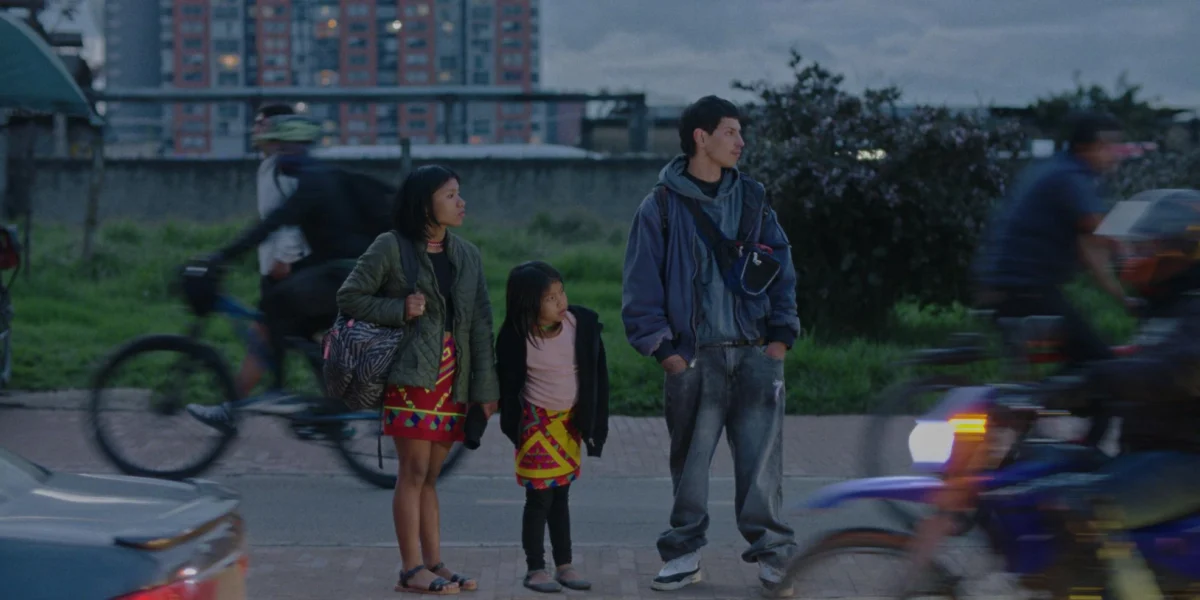
In the film, Arango captures the visceral experience of this displacement by opening with a haunting scene of a village reduced to ash. This imagery mirrors the lived experience of thousands who have seen their territories encroached upon by illicit industries, including illegal mining and coca cultivation. The transition from the dense, vibrant greenery of the Chocó to the gray, claustrophobic urban landscape of Bogotá highlights the sociological disconnect experienced by displaced populations—a phenomenon described by sociologists as "urban exile."
Narrative Arc and Character Dynamics
The story centers on Yajaira, portrayed by Girleza Duave Cerezo, a resilient woman struggling to sustain herself and her young daughter, Maria, through the informal sale of artisanal jewelry in the capital. Her existence is defined by the tension between her desire for cultural preservation and the daily necessity of survival in a hostile urban environment.
The introduction of Jhon, played by Juan David Junca Linares, serves as a catalyst for the film’s central journey. Jhon is depicted as a charismatic but troubled youth entangled in Bogotá’s gang culture, a reality for many young people in marginalized neighborhoods where the lack of state presence creates a power vacuum filled by criminal organizations. Their collective decision to return to the Andágueda River—a journey fraught with physical and psychological danger—is framed as an attempt to reclaim a sense of agency lost to the violence of the state and the gangs.
The relationship between the characters, particularly the tentative trust formed between Yajaira and Jhon, acts as a microcosm for the broader societal challenge of reconciliation. Both characters are victims of a cycle of violence that has stripped them of their pasts and rendered their futures uncertain.
Technical Execution and Cinematographic Vision
Director Juan Andrés Arango, known for his commitment to naturalism, employs a technical approach that prioritizes visual immersion over traditional narrative pacing. Cinematographer Nicolas Canniccioni utilizes long, labyrinthine takes that simulate the disorientation and confinement of the protagonists. These shots are deliberately contrasted with static, observational sequences that force the audience to sit with the protagonists in moments of mundane, often grueling, inactivity—such as commuting on public transit or attempting to sell goods on a street corner.
The editing, overseen by Xi Feng, maintains a tight focus on these observational beats, yet the resulting pace is intentionally languid. This stylistic choice reflects Arango’s objective: to mirror the slow, often agonizing process of rebuilding a life in the shadow of trauma. While the film has received praise for its aesthetic depth, critics have noted that the reliance on non-professional actors creates a distinct emotional barrier. The performances, while authentic in their lack of artifice, often struggle to convey the profound interiority of the characters, resulting in a film that functions more effectively as a visual mood piece than as a traditional, high-stakes drama.
Supporting Data and Demographic Realities
The challenges depicted in the film are supported by demographic shifts within Bogotá. Over the past twenty years, the city has become one of the primary destinations for internally displaced persons (IDPs). Estimates from the Unit for the Victims (Unidad para las Víctimas) indicate that hundreds of thousands of indigenous people have been registered as victims of the conflict. The Emberá community has frequently held public demonstrations in Bogotá, protesting the lack of housing, sanitation, and safety in temporary shelters—scenes that are echoed in the film’s depiction of communal living spaces.
The struggle to maintain cultural identity while navigating a city that views these communities as a transient, problematic demographic is a central, albeit subtle, theme of the film. The jewelry-making scenes, for instance, serve as a bridge between the traditional skills of the Emberá and the commodified reality of their urban existence.
Critical Analysis and Implications
The primary implication of Arango’s work is the questioning of what "home" signifies for a generation raised in exile. For Yajaira, the return to the Chocó is not merely a geographical trip; it is an attempt to recover the cultural, spiritual, and familial connections severed by violence.
However, the film’s restrained approach poses a challenge to the viewer. By avoiding the tropes of conventional thriller cinema—despite the involvement of gang members and the inherent dangers of the trek—Arango demands a level of patience that may alienate some audiences. The film’s greatest strength lies in its refusal to offer easy resolutions or a romanticized view of indigenous life. Instead, it posits that for those caught in the gears of the Colombian conflict, "home" is often an ephemeral, shifting concept that remains just out of reach.
The decision to cast non-actors is a significant artistic gamble. While it reinforces the film’s authenticity and provides a platform for voices from the region, it also exposes the limitations of the screenplay. When the emotional stakes are highest, particularly during the film’s climax, the inability of the cast to fully articulate the internal shift in their characters risks undercutting the narrative momentum. Nevertheless, the film remains a significant document of the modern Colombian experience, capturing the intersection of environmental beauty and human suffering.
Conclusion: The Legacy of the Journey
Where the River Begins ultimately serves as an important entry in the canon of contemporary Latin American cinema. By centering the Emberá experience, Arango brings attention to the long-term, structural consequences of displacement that often fade from the headlines once the initial reports of violence cease.
The film does not seek to provide a definitive answer to the issues it raises; instead, it presents a tableau of endurance. As Yajaira, Jhon, and Maria move toward the Andágueda River, the audience is left to contemplate the fragility of the peace they seek and the permanence of the scars left by the conflict. Despite the criticisms leveled at its pacing and emotional restraint, the film stands as a testament to the persistence of the human spirit in the face of near-total systemic collapse. It is a work that captures the intersection of the personal and the political, grounding the abstract statistics of the Colombian conflict in the faces and movements of those who have lost the most.
As the film concludes, the lasting image is one of quiet transition—a reminder that for thousands of people across the globe, the journey home is a path that is rarely direct, often dangerous, and always, in the end, a testament to the necessity of belonging. Through his lens, Arango ensures that the plight of the Emberá is not merely seen, but felt as a persistent, rhythmic pulse, much like the river that gives the film its name.