

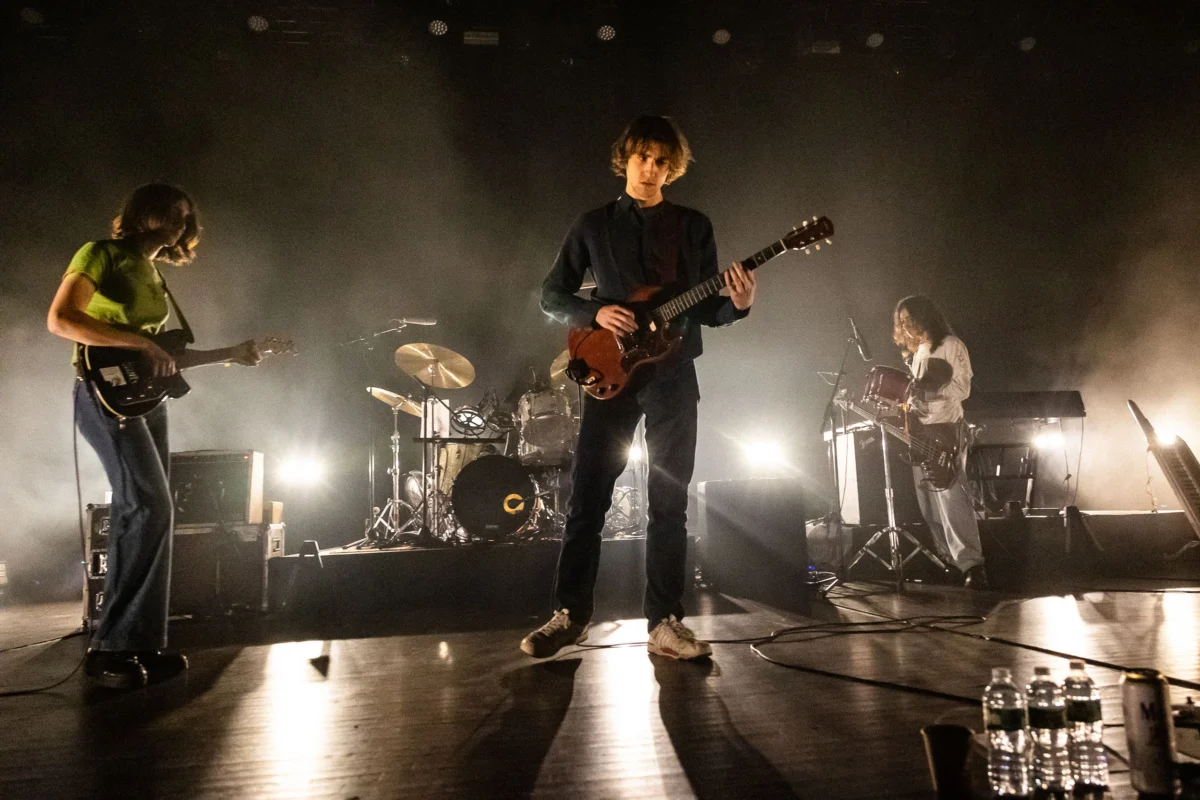
By the close of 2025, the Brooklyn-based indie rock outfit Geese had achieved a level of cultural saturation rarely seen in the contemporary alternative landscape. Their fourth studio album, Getting Killed, released in late September, did more than just garner critical acclaim; it effectively monopolized the year-end critical discourse, appearing at the top of nearly every major publication’s “Best of 2025” list. This critical momentum translated into a commercial juggernaut, with the band’s subsequent fall tour reporting sell-outs at almost every venue across North America and Europe. The culmination of this rise saw the group, led by frontman Cameron Winter, securing high-profile appearances on Saturday Night Live and prime slots at the Coachella Valley Music and Arts Festival. For a band specializing in polyrhythmic art rock—a genre usually relegated to the fringes of the mainstream—Geese had become a household name, with The Guardian notably crowning them the “new saviors of rock ’n’ roll.”
However, the speed and uniformity of their ascent triggered a secondary wave of skepticism. In the digital age, where audiences are increasingly attuned to the mechanics of viral marketing, the "industry plant" narrative began to take hold. Critics on social media platforms like X and TikTok began to question the authenticity of the band’s explosion, with some labeling the phenomenon a “psyop” or a product of sophisticated back-room machinations rather than organic grassroots growth. These suspicions were recently validated, albeit with nuance, through the public disclosures of a digital marketing firm and the investigative efforts of fellow artists within the industry.
The Architecture of Trend Simulation
The mystery surrounding Geese’s meteoric rise began to unravel in late March 2026 during a live recording of Billboard’s On The Record podcast at the South by Southwest (SXSW) festival. Andrew Spelman and Jesse Coren, cofounders of the digital marketing agency Chaotic Good Projects, provided a rare glimpse into the strategies used to propel artists into the cultural zeitgeist. Spelman introduced a concept he termed “trend simulation,” a process designed to trick social media algorithms into perceiving a groundswell of organic interest.
The mechanics of trend simulation involve the deployment of thousands of social media accounts, primarily on TikTok and YouTube, to drive a specific narrative. Chaotic Good Projects creates entire ecosystems of digital interaction—sharing live clips, dropping songs into the background of seemingly unrelated videos, and fabricating comment sections filled with discourse. By manufacturing a high volume of interactions, the firm ensures that an artist’s content is pushed higher in the algorithmic rankings of major platforms. This, in turn, leads to discovery by actual fans, who then contribute to a legitimate, organic following.
“We can drive impressions on anything at this point,” Spelman told the Billboard audience. “We know how to go viral. We have thousands of pages.” These efforts are categorized by the firm as “narrative” or “User-Generated Content” (UGC) campaigns, designed to create the illusion of a spontaneous cultural moment.
Chronology of a Managed Breakthrough
The timeline of Geese’s rise suggests a calculated long-term strategy rather than an overnight success. While the controversy centers on their 2025 achievements, the band’s foundation was laid years earlier:
- 2021: Geese releases their debut project, Projector, establishing a baseline of critical interest and a small, dedicated fan base.
- 2024: Frontman Cameron Winter releases his solo debut, Heavy Metal, supported by early iterations of digital PR consulting.
- Late September 2025: Getting Killed is released to immediate, widespread acclaim.
- Fall 2025: A near-universal sell-out of their international tour, bolstered by heavy social media presence.
- March 2026: Chaotic Good Projects founders discuss their "trend simulation" methods at SXSW.
- Early April 2026: Singer-songwriter Eliza McLamb publishes “Fake Fans” on Substack, tracing the specific links between Geese and Chaotic Good Projects.
- Mid-April 2026: Chaotic Good Projects scrubs mentions of Geese and Cameron Winter from its website to mitigate “industry plant” accusations.
Adam Tarsia, a cofounder of Chaotic Good Projects, confirmed to WIRED that the firm had indeed engineered campaigns for both Geese and Winter. Tarsia clarified that while the firm distributed clips and interviews to stoke the algorithm, they had been fans of the band since 2021. He argued that the marketing was a necessary tool to help a talented act “cut through the noise” of a saturated digital market.
Supporting Data: The Algorithmic Gatekeepers
The necessity of such tactics is underscored by current data regarding music discovery. According to a 2025 Music Impact Report by Luminate and TikTok, over 65% of Gen Z and Millennial listeners discover new music through short-form video platforms. The report highlights that a song’s inclusion in the background of a viral trend is now a more significant predictor of Billboard Chart success than traditional radio airplay or editorial playlisting on streaming services.
Furthermore, a study by MIDiA Research found that "algorithmic discovery" now accounts for nearly 40% of all streams on platforms like Spotify. This shift has created a vacuum where labels and marketing firms are incentivized to manipulate the "input" of the algorithm. If a firm can simulate the initial 100,000 interactions required to trigger a platform’s recommendation engine, the subsequent millions of impressions are often delivered for free by the platform itself.
This environment has led to a rise in "streaming farms" and bot accounts. While Chaotic Good Projects denies the use of bots—insisting their team consists of "genuine music fans" manually operating accounts—the line between manual simulation and automated inflation remains thin in the eyes of many industry observers.
Official Responses and Reputational Management
The fallout from these revelations has prompted a defensive posture from the parties involved. Following the viral success of Eliza McLamb’s Substack post, which argued that “if 100 people think your song sucks, Chaotic Good will create 200 people who think your song is awesome,” the marketing firm took steps to distance its clients from the controversy.
“We took things down from the site so our artist partners don’t get wrapped up in false accusations or misconceptions about how their music was discovered,” Adam Tarsia stated. He further claimed that the term “narrative campaign” had been misunderstood by the public, framing it instead as a form of digital PR strategy rather than deceptive manipulation.
Partisan Records, the independent label representing Geese and Cameron Winter, has notably declined to comment on the matter. This silence reflects a broader industry hesitation to discuss the "dark arts" of digital marketing, particularly for artists whose brand is built on "indie" credibility and countercultural appeal.
Eliza McLamb, while critical of the lack of transparency, acknowledged the reality of the modern industry. “I do think people have a needless purity about artists who aren’t on major labels,” she noted, adding that she herself would likely participate in a UGC campaign to ensure her music reached an audience in an era of algorithmic dominance.
Broader Impact and Industry Implications
The Geese controversy serves as a microcosm of a larger crisis of authenticity within the arts. For decades, the music industry operated on a system of "payola," where labels provided incentives to radio DJs for airtime. Modern trend simulation is effectively the digital evolution of this practice, moved from the airwaves to the smartphone screen.
The implications for "indie" music are particularly profound. As Darren Hemmings of the marketing agency Motive Unknown observed, reputational damage is the hardest thing to recover from in the art world. When a band is labeled an “industry plant,” it risks alienating the core audience that values perceived authenticity. However, the success of Getting Killed suggests that for many listeners, the quality of the music ultimately outweighs the methods used to bring it to their attention.
The legal landscape is also shifting in response to these tactics. In 2025, a landmark lawsuit was filed in California against Spotify, alleging that the platform failed to police artificially inflated streams, citing "sprawling networks of bot accounts" associated with major artists. As platforms face increasing pressure to provide "clean" data to advertisers and artists, the use of "trend simulation" may eventually face regulatory or platform-level crackdowns.
For now, the case of Geese illustrates a new reality: in the 2020s, a "grassroots" movement can be meticulously engineered from a smartphone in a marketing office. As the founding partners of Chaotic Good Projects noted, in a landscape where discovery is governed by opaque code, the distinction between what is real and what is manufactured is increasingly irrelevant to the bottom line. The music may be real, the talent may be genuine, but the "buzz" is increasingly a product of a synthetic symphony.