



A Portrait of Moral Complexity
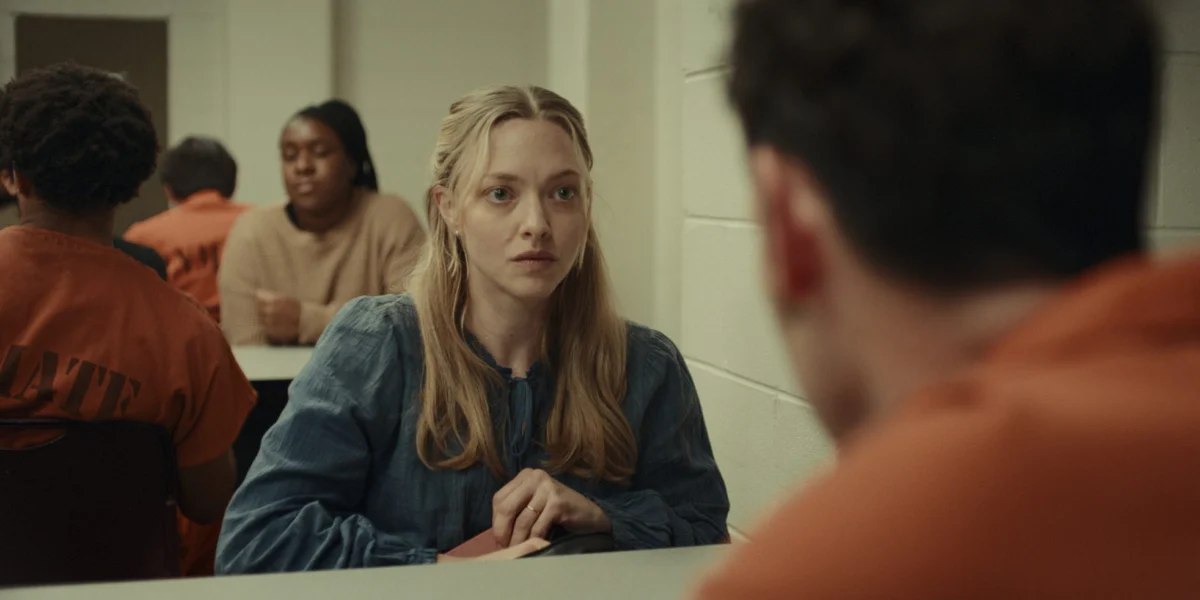
Tim Blake Nelson, a filmmaker noted for his work on The Ballad of Buster Scruggs and O Brother, Where Art Thou, spent over a decade developing this project. His directorial approach centers on the concept of the "outsider"—individuals who exist outside the traditional social contract due to poverty, criminal history, or systemic abuse. In this narrative, the protagonist, Karen (Seyfried), is presented as a woman already confined by the dynamics of an abusive domestic environment. Her transition into the high-security prison system serves as the catalyst for the film’s primary conflict: the development of an intense, intellectual, and ultimately dangerous bond with Wilson Shedd (McNairy).
The narrative structure of the film is tripartite, fragmented into the inception of the relationship, the details of Shedd’s violent prison escape, and the final administrative procedures leading to his state-sanctioned execution. This non-linear approach forces the viewer to reconcile the humanity of a convicted killer with the reality of his crimes.
Societal Context and the True Crime Phenomenon
The release of The Life and Deaths of Wilson Shedd arrives during a period of intense public scrutiny regarding the "true crime" genre. Data from media analysis firms suggests that audiences have increasingly gravitated toward narratives involving capital offenders, a trend that sociologists often categorize as a mix of cautionary curiosity and a desensitization to real-world trauma.
The film serves as a meta-commentary on this phenomenon. By framing Karen’s infatuation with Shedd through the lens of her own domestic misery, Nelson posits that the fascination with violent criminals is often a displacement activity—a way for individuals to process their own feelings of helplessness by engaging with the extreme, albeit vicarious, experiences of others. This raises significant ethical questions regarding how the media and entertainment industries commodify the suffering of victims. When an audience consumes a film about a real-life double murderer, the boundary between witnessing a tragedy and consuming it as entertainment becomes perilously thin.
Chronological Analysis of the Narrative
The film operates on three distinct timelines, each serving a different thematic purpose:
- The Formative Phase: This segment explores the prison classroom setting. Here, the power dynamic is initially intellectual. Shedd’s literacy and articulateness are contrasted against the rigid, dehumanizing environment of the correctional facility. The exchange of writing assignments acts as a bridge, allowing both characters to escape their immediate environments.
- The Breach: This segment details the logistical and violent reality of Shedd’s escape. It functions as a rupture in the narrative, forcing the audience to confront the physical consequences of the choices made by both the criminal and the system that holds him.
- The Terminal Phase: The final act focuses on the legal finality of the death penalty. It is here that the film is at its most clinical, documenting the bureaucratic nature of death. This portion of the film has been noted for its adherence to a cold, procedural reality, stripping away the romanticization that may have existed in the earlier, more intimate segments of the relationship.
Institutional Implications and Ethical Discourse
The film’s focus on the death penalty is not merely atmospheric; it is an interrogation of the morality of state-sanctioned retribution. By highlighting the relationship between a teacher and a death row inmate, the film asks whether compassion can ever be "unearned." Critics and legal scholars have long debated whether empathy for a perpetrator undermines the justice owed to victims. The film does not provide a definitive answer, instead opting to present the audience with the discomfort of witnessing that very dilemma play out in real time.
In institutional settings, such as maximum-security facilities, the maintenance of professional boundaries is a primary concern for correctional authorities. The narrative of the film illustrates how easily these boundaries can be eroded when two individuals—both isolated by their circumstances—find a common language. From an administrative standpoint, the story serves as a cautionary case study on the importance of maintaining systemic distance, even in environments intended for rehabilitation.
Performance and Technical Execution
Despite the film’s challenging structure, performances by Amanda Seyfried and Scoot McNairy are widely cited as the production’s anchor. Seyfried’s portrayal of Karen avoids the common tropes associated with "the damsel in distress" or the "enabler," instead opting for a nuanced performance that highlights the psychological erosion caused by long-term abuse. McNairy, tasked with playing a man simultaneously capable of profound intelligence and extreme violence, delivers a performance that challenges the audience’s capacity for empathy.
Technical elements, including cinematography and sound design, contribute to the film’s atmosphere of claustrophobia. The prison is depicted not as a place of correction, but as a liminal space where time functions differently. The decision to use a non-linear narrative, while criticized by some as potentially manipulative, is clearly intended to mirror the fractured psychological states of the protagonists. It is an exercise in forcing the viewer to piece together the truth behind a tragedy, much as a legal investigator would.
Broader Impact and Conclusion
The Life and Deaths of Wilson Shedd is a dense, often unrelenting study of the human condition in its most degraded forms. By refusing to provide easy resolutions, Tim Blake Nelson forces the audience to engage with the uncomfortable reality of violence. The film’s contribution to the conversation surrounding criminal justice and the ethics of empathy is significant, though it remains a difficult watch due to its unflinching depiction of trauma.
As the film continues to reach broader audiences, it is expected to spark debate regarding the representation of violent offenders in media. The central tension remains: how do we balance the requirement for justice with the inherent human desire to understand the motivations behind evil? While the film’s structure may pose challenges for viewers accustomed to more traditional narrative arcs, its success in stimulating these difficult questions is undeniable. It stands as a testament to the fact that, even in the darkest of corners, there is a narrative to be told—and that in the act of telling, we are forced to confront our own moral boundaries. The film is not merely a story of a teacher and a prisoner; it is a reflection on how we, as a society, choose to define the limits of forgiveness and the nature of the "unforgivable."