German cinematic icon Werner Herzog once famously observed that every man should pull a boat over a mountain at least once in his life. At the 2026 Venice Film Festival, the 84-year-old auteur proved he remains committed to his own arduous artistic climbs, presenting his 21st narrative feature film, Bucking Fastard. Following a prestigious Lifetime Achievement Golden Lion honor at the same festival just a year prior, Herzog returned to the Lido with a peculiar, transcendent tragicomedy dedicated to the late David Lynch. Star-studded, deeply unconventional, and steadfastly analog, the new picture represents yet another idiosyncratic chapter in a legendary filmmaking career that spans more than six decades.
Main Facts of the Production and Premiere
Bucking Fastard made its high-profile world premiere in the Main Competition at the 83rd Venice International Film Festival in September 2026, quickly generating substantial critical buzz before embarking on the autumn festival circuit, including stops at Telluride, Toronto, Zurich, San Sebastian, and the New York Film Festival.
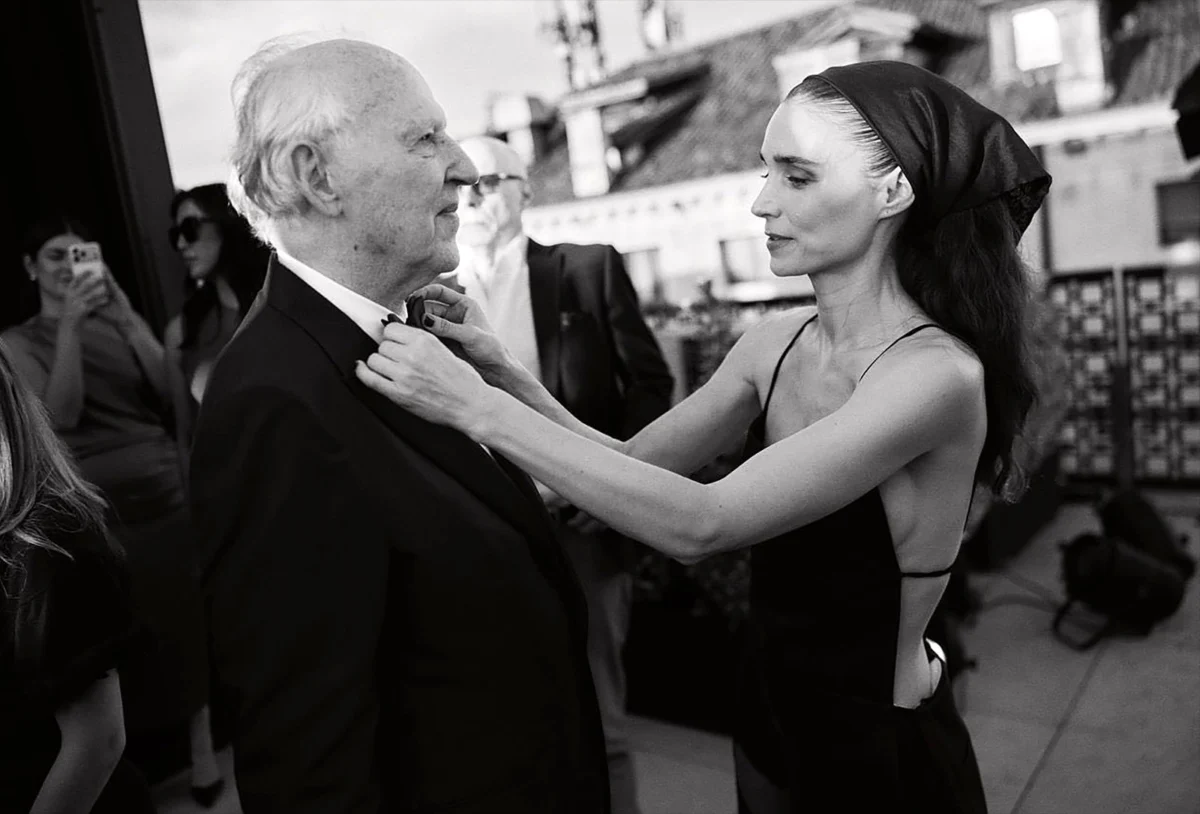
The narrative feature is inspired by the real-life British identical twin sisters Freda and Greta Chaplin. In Herzog’s cinematic translation, real-life sisters and actors Kate Mara and Rooney Mara star as Jean and Joan Holbrooke, a pair of inseparable twins who speak in absolute unison. The film follows the sisters as they embark on a quest for a better life and unconditional love, a journey that eventually introduces them to a charismatic scoundrel played by Orlando Bloom, and—in typical Herzogian fashion—a mystical live-action fox that wanders through the second half of the picture.

Despite industry-wide pressures to embrace fully digital workflows, Herzog steadfastly utilized a real, live fox for the production rather than relying on computer-generated imagery. Accompanied on set by two young farm boys who cared for the animal as a pet, the fox became an unscripted yet integral presence alongside the human cast.
Chronology and Festival Trajectory
Werner Herzog’s relationship with the Venice Film Festival spans decades of artistic triumphs. In September 2025, the festival management awarded him the prestigious Lifetime Achievement Golden Lion, recognizing his foundational contributions to the German New Wave and global cinema. Just twelve months later, Herzog returned to the red carpet not merely to accept accolades, but to debut fresh creative work.
Following its Lido debut, Bucking Fastard anchored an aggressive festival run throughout September and October 2026. While the film has secured major festival distribution buzz, industry insiders note that distributors have yet to lock down a definitive commercial theatrical release date, though expectations point toward a wider rollout in mid-2027. This narrative rollout runs parallel to Herzog’s documentary output; earlier in 2026, the director released his Angola-set documentary feature Ghost Elephants, proving his concurrent dedication to both non-fiction illumination and fictional storytelling.
Supporting Data and Historical Context

To contextualize Bucking Fastard within Herzog’s expansive filmography, analysts often look to his recurring thematic obsessions: singular dreamers, untamed landscapes, and the pursuit of transcendence against insurmountable odds. From 1982’s Fitzcarraldo—where a rubber baron literalizes Herzog’s boat-over-mountain philosophy by hauling a 320-ton steamship over a steep hill in the Amazon rainforest—to his 2005 documentary masterpiece Grizzly Man (which recently joined the esteemed Criterion Collection), Herzog has continually probed the psychological extremes of human desire.
Throughout his career, Herzog has directed more than 60 films, effortlessly straddling the boundary between documentary realism and narrative abstraction. His distinct methodological approach involves applying fictional techniques—such as dramatic scripting, intentional casting, and emotional pacing—to real-life subjects in documentaries, while simultaneously anchoring his fiction films in psychological "inner landscapes."
Critical Analysis of Industry Implications
In interviews accompanying the Venice premiere, Herzog offered sharp commentary regarding the contemporary state of cinema, drawing a stark contrast between modern blockbuster spectacles and traditional cinematic storytelling. While acknowledging the technical prowess behind computer-generated special effects in contemporary franchise filmmaking, Herzog asserted that the industry suffers from a noticeable narrative deficit compared to mid-century cinema.
His choice to cast Orlando Bloom alongside Domhnall Gleeson and the Mara sisters has likewise drawn praise from cultural critics, who note Herzog’s exceptional talent for revitalizing major Hollywood actors by placing them within unconventional, European-inflected arthouse frameworks. Historical precedent supports this observation; actors such as Nicolas Cage (who delivered a career-best performance in Herzog’s 2009 film Bad Lieutenant: Port of Call New Orleans) and the famously volatile Klaus Kinski frequently produced their most celebrated work under Herzog’s rigorous direction.

Broader Impact and Artistic Philosophy
Addressing journalists and festival attendees in Venice, Herzog weighed in on the broader cultural responsibilities of artists, explicitly rejecting the notion that cinema should function as a direct tool for social engineering or political activism. Aligning himself with sentiments expressed by animation master Hayao Miyazaki regarding the limits of art to alter human behavior, Herzog emphasized that a filmmaker’s primary obligation is to act as a storyteller rather than a moral crusader.
"When somebody says, ‘I’m here to make the world a better place,’ that makes me cringe," Herzog remarked, arguing instead that true cultural impact stems from tangible, localized acts of kindness and community engagement rather than grand artistic proclamations.
As Bucking Fastard prepares for its eventual commercial distribution in 2027, the film stands as a testament to Herzog’s enduring vitality. At 84 years old, the director continues to map the outermost boundaries of human obsession, proving that whether he is tracking ghostly elephants in Angola or casting A-list actors alongside a farm-raised fox, his singular cinematic vision remains entirely uncompromised.