

Skydance Animation’s latest offering, “Swapped,” arrives on Netflix with a premise as peculiar as its fantastical creatures: a tiny woodland dweller and a majestic bird find themselves in each other’s bodies, igniting a perilous journey of survival and unexpected alliance. Directed by Nathan Greno, known for his work on Disney’s “Tangled,” and penned by John Whittington, Christian Magalhaes, and Robert Snow, the film boasts a star-studded voice cast including Michael B. Jordan, Juno Temple, Tracy Morgan, Cedric the Entertainer, Justina Machado, Ambika Mod, Lolly Adefope, and TaTà Vega. Clocking in at a brisk 102 minutes, “Swapped” attempts to weave a tale of interspecies understanding through its unique world-building, yet ultimately treads familiar ground in its narrative execution.
A Unique Linguistic Barrier Sets the Stage
The foundational innovation of “Swapped” lies in its departure from the typical animated trope where all animal characters seamlessly communicate. Instead, the film meticulously establishes a world where each species possesses its own distinct language, rendering interspecies communication impossible. This deliberate constraint is not merely a narrative device; it forms the very bedrock upon which the film’s central conflict and thematic exploration are built. The Pookoo, a diminutive, insular species, and the Javan, a formidable avian race, are introduced as natural adversaries, their existence defined by resource competition and mutual distrust. This linguistic chasm, therefore, becomes a potent metaphor for broader societal divisions, emphasizing how a lack of understanding can foster animosity and fear.
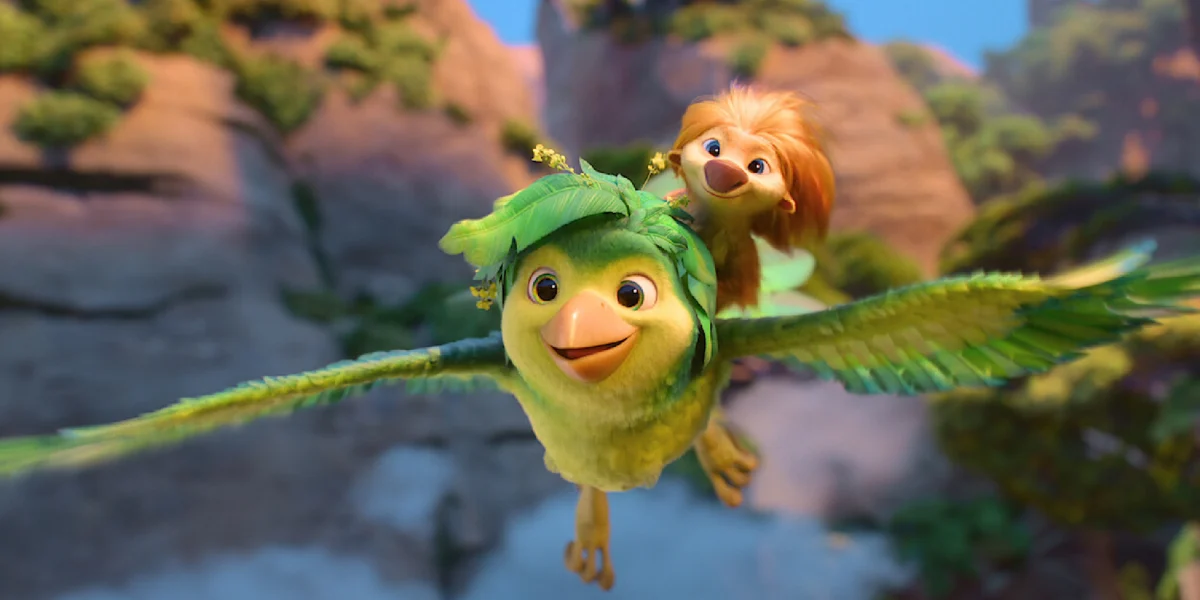
The narrative centers on Ollie, a Pookoo voiced by Michael B. Jordan, whose species is teetering on the brink of crisis due to dwindling food supplies, a predicament exacerbated by the Javan’s raids on their island. Ollie carries a personal burden of responsibility, stemming from a childhood attempt to befriend the birds that inadvertently led to increased conflict. His world is irrevocably altered when, during an encounter with a glowing, mystical fruit, he undergoes a dramatic transformation, becoming a Javan. This physical metamorphosis grants him the unprecedented ability to comprehend and converse with other species, a power that becomes crucial for his survival and for bridging the divide between his people and the Javans.
The Unforeseen Exchange and its Consequences
Ollie’s plight quickly intertwines with that of Ivy, a Javan voiced by Juno Temple, whom he manages to convince to aid him in his quest to reverse the transformation. Their alliance, born out of necessity, becomes the engine of the plot as they embark on a journey across the titular “Valley” in search of the magical flora that initiated Ollie’s change. The narrative takes a further turn when Ivy, through circumstances mirroring Ollie’s, finds herself transformed into a Pookoo. While not a literal body-swap in the traditional sense, the film effectively employs this exchange of physical forms to compel the protagonists to experience life from each other’s perspectives.
This reciprocal experience serves as the primary vehicle for the film’s thematic exploration. By literally walking in each other’s paws (or talons), Ollie and Ivy gain a profound understanding of the other’s struggles, motivations, and societal pressures. The film highlights how the conflict between the Pookoo and Javan was not an inherent animosity but a consequence of miscommunication and competition for scarce resources. The Javan’s raids, while devastating to the Pookoo, are implicitly framed as a desperate measure for survival, a perspective Ollie gains only after experiencing life as a bird. This narrative arc underscores the film’s central message: that cooperation and mutual understanding are essential for the thriving of any community, and that conflict often stems from a failure to empathize.
A Visually Rich World with Familiar Thematic Echoes
The world of “Swapped,” envisioned by director Nathan Greno and brought to life by Skydance Animation, is a testament to imaginative design. The flora and fauna of “The Valley” are rendered with meticulous detail, creating an environment that is both alien and strangely familiar. Greno, whose previous work on “Tangled” showcased a flair for vibrant and detailed animation, imbues “Swapped” with a similar visual richness. The animation team has crafted a world where the natural and animal realms are inextricably intertwined. Creatures are depicted as hybrids, blending familiar animal forms with botanical elements. For instance, deer-like beings appear to be sculpted from birch trees, their antlers resembling branches, while bear-like creatures are imagined as living boulders covered in mossy fur. This unique blend of the organic and the animalistic results in a visually captivating landscape, though the film’s overall animation style leans towards the polished and pleasant rather than the overtly stylized or groundbreaking.
Despite the novel approach to interspecies communication and the visually engaging world-building, the thematic underpinnings of “Swapped” are undeniably conventional. The film grapples with timeless themes of prejudice, empathy, and the power of cooperation – lessons that resonate deeply, particularly in an era marked by societal divisions. The narrative arc, wherein protagonists learn to understand and appreciate those different from themselves, is a well-trodden path in children’s cinema. While the film’s message about the ease with which groups can resort to conflict over collaboration is pertinent and valuable, the storytelling itself rarely deviates from established patterns. The film effectively communicates the importance of bridging divides and understanding differing perspectives, particularly for younger audiences who may be encountering these concepts for the first time.
A Stellar Voice Ensemble and a Memorable Supporting Turn
The ensemble cast of “Swapped” delivers commendable performances, breathing life into the film’s characters. Michael B. Jordan imbues Ollie with a relatable sense of responsibility and initial trepidation, while Juno Temple brings a spirited energy to Ivy. However, it is Tracy Morgan, as the jovial and surprisingly insightful Boogle, a large fish who becomes an unlikely ally to Ivy and Ollie, who arguably steals the show. Morgan’s performance is characterized by an infectious innocence and a disarming sincerity that allows the audience to underestimate Boogle’s wisdom and pivotal role in the protagonists’ journey. His character provides much-needed comedic relief and emotional grounding, serving as a beacon of hope and good humor amidst the unfolding adventure.
The supporting cast, including Cedric the Entertainer, Justina Machado, Ambika Mod, and Lolly Adefope, contribute effectively to the film’s tapestry of characters, each lending their unique vocal talents to the diverse inhabitants of The Valley. Their contributions, while perhaps less prominent than those of the lead actors, help to flesh out the world and its inhabitants, reinforcing the film’s commitment to portraying a varied and interconnected ecosystem.
Analysis of Implications and Broader Context
The narrative of “Swapped,” with its emphasis on overcoming division through understanding, carries significant implications in the current global climate. In an age characterized by increased polarization and often hostile discourse, the film’s core message about the necessity of empathy and cooperation serves as a timely reminder. The Pookoo and Javan’s initial animosity, fueled by a lack of communication, mirrors real-world scenarios where misunderstandings and a failure to bridge cultural or ideological divides lead to conflict. The film suggests that by stepping outside of one’s own perspective and experiencing the world through another’s eyes, individuals can foster greater compassion and a willingness to collaborate for mutual benefit.
The film’s exploration of resource scarcity as a driver of conflict also offers a subtle commentary on environmental and economic challenges. The Pookoo’s dwindling food supply and the Javan’s raids are presented as a zero-sum game, where one species’ gain is another’s loss. However, the underlying implication is that a more sustainable and equitable approach, potentially facilitated by communication and cooperation, could lead to a more prosperous outcome for all. This resonates with ongoing discussions about sustainable resource management and the need for global cooperation in addressing shared environmental concerns.
The Challenge of Originality in a Crowded Genre
While “Swapped” delivers a positive message and boasts impressive animation and voice performances, its primary challenge lies in its narrative predictability. The film’s reliance on well-established body-swap tropes – the protagonists learning empathy, overcoming prejudice, and discovering the value of cooperation – means that the plot’s trajectory is largely foreseeable. In the vast landscape of animated films, particularly those focusing on animal protagonists and their journeys of self-discovery, “Swapped” struggles to carve out a distinct identity. It offers a pleasant and well-intentioned rehash of themes that have been explored in numerous other productions, both animated and live-action.
The film’s visual creativity, while noteworthy, doesn’t quite compensate for the lack of narrative innovation. The unique blend of animal and plant life in the character designs and world-building is a creative highlight, but it doesn’t fundamentally alter the familiar storytelling framework. Consequently, “Swapped” risks being overshadowed by more groundbreaking or stylistically distinctive films within the animated genre. The film’s success will likely hinge on its ability to connect with younger audiences on an emotional level and impart its valuable lessons in an engaging manner, rather than on its ability to surprise or challenge seasoned viewers with narrative novelty.
Conclusion: A Serviceable, Heartfelt, Yet Forgettable Endeavor
In summation, “Swapped” is a perfectly serviceable animated film that offers a heartwarming message and visually appealing presentation, particularly for its target demographic of younger viewers. The film’s strength lies in its innovative approach to interspecies communication and its visually rich world, coupled with strong voice performances. However, despite these merits, it suffers from a pervasive sense of familiarity. The narrative’s adherence to conventional body-swap plotlines and thematic explorations, while valuable in their intent, ultimately contributes to its forgettability. The film’s earnest message about understanding and cooperation is undeniably worthwhile, especially in our increasingly divided world, but it is delivered through a story that has been told countless times before. Without a more daring narrative approach or a more distinctive stylistic flair, “Swapped” remains a pleasant, well-crafted, but ultimately unmemorable addition to the animated film library, a film that, while full of heart, struggles to find the unique spark needed to truly stand out.