


The Liminal Space of the Mediterranean
The Mediterranean route remains the primary maritime corridor for migrants attempting to reach Europe, yet it has become a zone of profound legal and humanitarian ambiguity. As vessels depart from the Libyan coast, they enter a precarious liminal space. While international maritime law mandates the rescue of those in distress at sea, the intersection of European migration policy and North African border control has created a complex, often lethal, dynamic.
The European Union, in its effort to curb irregular migration, has implemented strategies that involve providing financial and logistical support to the Libyan Coast Guard. The intent is to intercept migrant vessels before they reach international waters or Italian search-and-rescue (SAR) zones. This policy creates a state of constant conflict between non-governmental organizations (NGOs) like Doctors Without Borders (MSF)—which operate the vessel Geo Barents—and the Libyan authorities. When interceptions occur, families are frequently torn apart. Men are often separated from their wives and children, with the latter being returned to Libya, where they face documented risks of detention, extortion, and systemic human rights abuses.
Chronology of a Displaced Family
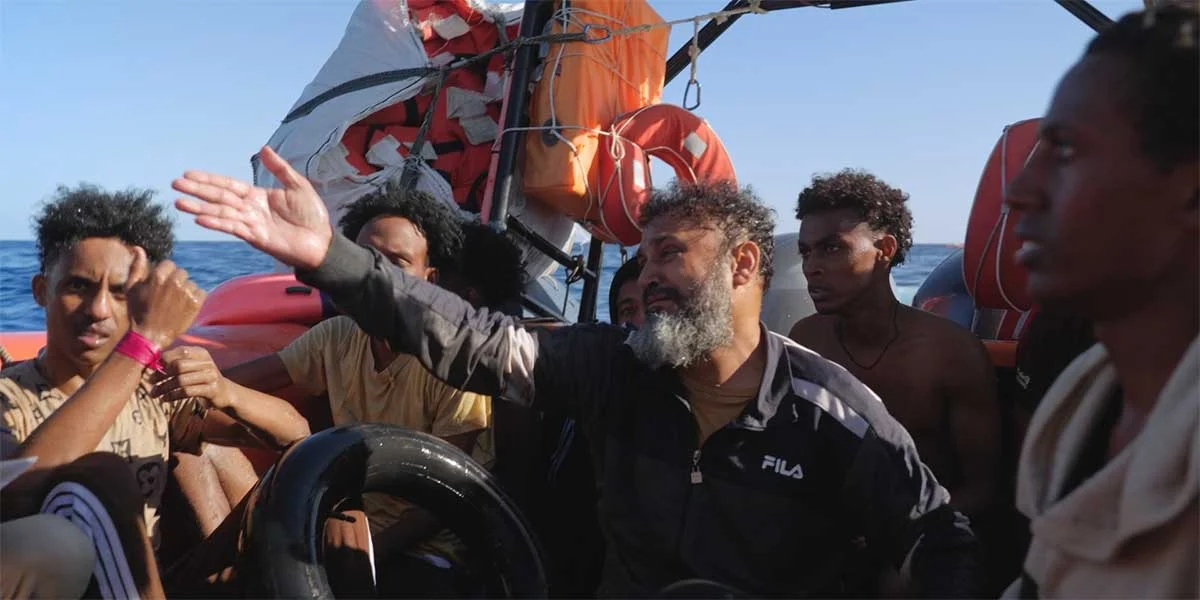
The narrative of Hani and Rawa begins with a perilous crossing that quickly descends into chaos. When their boat is intercepted, the family is forcibly separated. Hani, eventually rescued by the Geo Barents, finds himself in a state of psychological trauma, initially unaware of his family’s fate. His journey from the deck of the rescue ship to the borders of Northern Europe is documented through a combination of professional cinematography and raw, handheld footage.
Hani’s survival strategy involves navigating the bureaucratic maze of European asylum laws. Upon reaching land, he undertakes a clandestine journey, escaping temporary refugee housing to reach Germany, a country he identifies as a viable destination due to its relatively more robust asylum frameworks. During this time, he is forced to shed symbols of his identity, including shaving his beard to avoid profiling.
Meanwhile, Rawa’s experience highlights the darker underside of the "push-back" policy. Her journey is defined by the realities of life in detention centers where women and children are uniquely vulnerable to exploitation. The film captures the ingenuity of their connection, documenting how the couple maintains contact through covert means, such as concealing a mobile phone within the diaper of their child—a testament to the lengths to which displaced individuals must go to maintain a sense of familial cohesion amidst institutional erasure.
Data and Context: The Scale of the Crisis
According to the International Organization for Migration (IOM), the Central Mediterranean remains the deadliest migration route globally. Since 2014, over 28,000 migrants have gone missing or lost their lives while attempting the crossing. The policy of "externalization"—where the EU pays third countries to manage migration—has significantly shifted the nature of these incidents.
In 2023 alone, thousands of individuals were intercepted by the Libyan Coast Guard and returned to detention centers. Human rights observers, including the United Nations High Commissioner for Refugees (UNHCR), have repeatedly raised concerns about the conditions within these facilities. Reports from the UNHCR describe "arbitrary detention, torture, sexual violence, and forced labor" as rampant in these centers. The involvement of EU-funded entities in these interceptions has sparked intense debate regarding the legal and ethical responsibility of European member states for the subsequent treatment of these individuals.
The Ethics of Humanitarian Intervention
A central conflict within the documentary involves the operational challenges faced by NGO crews. The Geo Barents operates under the constant threat of legal sanctions and administrative impoundment. The film highlights the "nauseating compromises" that SAR teams must navigate: should they prioritize a single, immediate rescue that violates protocol and risks the ship’s future operating license, or should they adhere to strict regulations to ensure they can remain in the field for future, potentially larger, operations?
This dilemma reflects the broader tension between humanitarian necessity and political constraint. By documenting the specific instance where the Geo Barents crew defies protocol to save a group of men in distress, the filmmakers illuminate the moral weight of these decisions. For the crews on the ground, the abstract policies drafted in Brussels or Tripoli are secondary to the immediate, visceral reality of lives bobbing in the dark, cold waves of the Mediterranean.
Broader Implications and Institutional Impact
The documentary does not merely record a tragedy; it interrogates the systems that facilitate it. The political impact of migration in Europe has shifted the landscape of governance, with many nations moving toward stricter border controls and populist rhetoric. However, the film argues that these policies often ignore the human reality of those who, having exhausted all other options, view the sea as their only path to safety.
Anthropologist Sine Plambech utilizes her academic background to ensure the narrative avoids the common pitfalls of "poverty porn" or the dehumanization of migrant subjects. Instead, the documentary provides a nuanced look at the agency of the family. By centering on the specific actions of Hani and Rawa, the film challenges the viewer to move beyond the "infinite statistics" and confront the individuals behind the headlines.
Expert Analysis and Future Outlook
The implications of the Libyan-EU cooperation agreement remain a subject of intense academic and legal scrutiny. Legal experts suggest that by effectively outsourcing border control, European nations may be in violation of the principle of non-refoulement—the international law principle that prohibits a country from returning asylum seekers to a country where they would be in danger of persecution or serious harm.
As political movements across Europe continue to debate migration quotas and border security, "Rescue" serves as a critical document of the real-world consequences of these policy debates. It asks the audience to consider not only the legality of migration but the morality of the systems designed to obstruct it.
The film serves as a masterclass in documentary craft, blending intimate, personal stakes with a panoramic view of global politics. By focusing on the resilience of a single family, Plambech and Metz provide a profound, unsettling answer to the question of what happens when individuals are caught between the indifference of borders and the desperation for survival. The story of Rawa, Hani, and Nejma is a reminder that while political policies are written in government offices, their consequences are felt in the deep waters of the Mediterranean, where the cost of a failed system is measured in human lives.
The documentary concludes not with a tidy resolution, but with a series of questions that demand audience introspection. In an era where the movement of people is increasingly viewed through the prism of security and national interest, this work insists on the primacy of the individual experience, challenging viewers to define their own position on the ethics of rescue and the fundamental right to seek safety.